

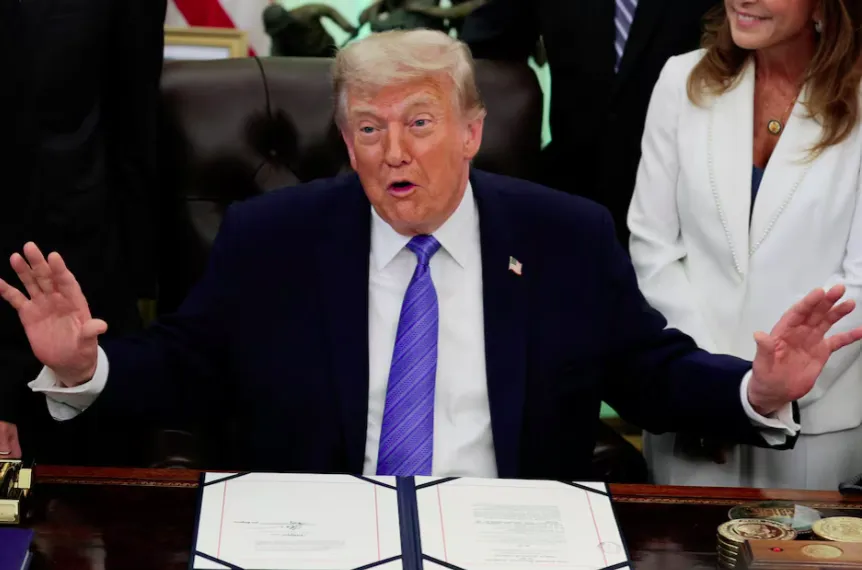



GOVERNOR Ralph DLG Torres on Thursday, in the presence of lawmakers and judicial branch officials, signed into law the fiscal year 2022 budget bill, thus averting a partial government shutdown. FY 2022 starts Friday, Oct. 1.
In signing the bill, the governor also vetoed several line-items.
Last week, both houses of the CNMI Legislature passed a compromise version of the budget measure in the form of House Bill 22-74, House Draft 3, Senate Draft 1, Conference Committee Substitute 1.
The bill is now Public Law 22-8, appropriating $103.3 million in projected local revenue for CNMI government personnel and operations in FY 2022.
In addition to local funding, the CNMI government, in FY 2022, will spend $175 million in American Rescue Plan Act, or ARPA, funds provided by the federal government.
Present for the signing of the bill into law were numerous representatives from all three branches of the CNMI government, including House Speaker Edmund S. Villagomez, Senate President Jude U. Hofschneider, Chief Justice Alexandro C. Castro, Presiding Judge Roberto C. Naraja, Commonwealth Law Revision Commission executive director Hyun Jae Lee, Secretary of Finance David DLG Atalig, Special Assistant for Management and Budget Vicky Villagomez, Tinian Mayor Edwin P. Aldan, Senate Floor Leader Vinnie Sablan, House minority bloc members, as well as Sen. Victor B. Hocog and Rep. Donald M. Manglona who co-chaired the House-Senate conference committee for this budget.
Prior to signing the bill, Governor Torres and Lt. Gov. Palacios met with Attorney General Edward E. Manibusan a few days ago, along with Secretary Atalig and Special Assistant Villagomez.
The governor said his administration fully recognizes the need for transparency and accountability within the government and acknowledges the importance of closely monitoring its fiscal health.
Line-item vetoes
Governor Torres said he voted the bill’s Section 304 regarding overtime payments because it is already a part of CNMI.
“My administration remains cognizant of these governing statutes and regulations. Similarly, the duties and responsibilities placed upon the Office of the Public Auditor and the Office of the Attorney General through this enforcement provision is redundant as these mandates have already been established,” the governor said in his transmission letter to the CNMI Legislature on Thursday.
Section 404, which pertains to budgeting authority, was also vetoed because it ignores the existence of 1 CMC Subsection 7604, which defines the process for changes in revenue estimates, he said.
“This Planning and Budgeting Act dictates this requirement on any changes made to the revenue estimate either in increase or decrease. Because this provision conflicts with Section 702(b) and Section 703(a) as it prohibits the reduction of appropriations to the Judicial and Legislative Branches, I must respectfully line item veto this provision,” the governor said.
Section 501(a) pertaining to reprogramming authority was also vetoed. It would have required the administration to submit written notices of not less than 15 days to the presiding officers of the Legislature prior to exercising any reprogramming authority.
There is already an existing mandate that would require up to 30 days after the end of the quarter, the governor noted.
“The volume of reprogramming processed daily comes from programs outside of the general fund and from members of the Legislature moving funds within its members or committees. This provision would now require me to notify you of your own reprogramming request. Additionally, [this section] constrains reprogramming flexibilities when urgent matters arise. Thus, I must respectfully line item veto this provision,” the governor said.
Section 601 regarding the payment of utilities for the CNMI government was also vetoed, with the governor stating that 1 CMC Subsection 8222 authorizes the governor, lt. governor, and the presiding officers of the legislature to obtain government housing units during their terms in office.
“In lieu of obtaining government housing units and due to the inhabitability of the official residences for the CNMI governor and lt. governor, the Department of Finance, for several years and administrations, has allowed for the utility consumption charges of the sitting governor and lt. governor to be paid by the government during their term in office. No other elected officials’ residences are allowed under [this already established mandate],” said the governor.
Section 603 regarding the exemption of the public auditor’s fee for certain bodies was also vetoed.
The governor said in order for OPA to effectively perform its mandates, it is critical that the OPA fee of 1% from all public corporations and autonomous government agencies remain equitable across-the-board.
Article III, Section 12 of the CNMI Constitution guarantees the public auditor a $500,000 budget.
However, past non-collection of the 1% fee from these government corporations has created funding gaps for OPA, leaving its operations and activities underfunded, the governor said.
Section 604, which would have placed limitations on the governor’s reprogramming authority amid a state emergency, was also vetoed. The governor said this provision would have contradicted his authority as governor to address emergencies when necessary.
“When the Commonwealth is faced with imminent crises or disasters, critical resources for saving lives and protecting property should not be compromised,” he said.
Sections 700(b) and 700(c) pertaining to realigning positions and to the reprogramming authority of all branches, municipalities, departments, agencies, instrumentalities, and offices to which ARPA funds are allocated were also vetoed due to its interference with ARPA fund allocations already in place.
“[This] hinders our ability to stabilize the finances of the government and account for economic disruptions caused by the pandemic,” the governor said.
Section 703(d)(1)(A) pertaining to $39,052 reserved by the secretary of Finance for the double-dipping period liability that may be owed to former Rep. William S. Torres during his tenure in the 12th and 13th Legislature was also vetoed.
Attorney General Manibusan has advised the Department of Finance that the former lawmaker’s claim is without any legal basis especially as it is likely barred by the statute of limitations in 7 CMC Subsection 2505.
Section 704(c) regarding the allocation of $50,000 to the Office of Planning and Development to conduct a feasibility study on the casino gaming industry in the CNMI was also vetoed, with the governor stating that the intent of this provision should instead be placed on the Commonwealth Casino Commission which has the expertise to determine the market potential as well as the legal and regulatory structure of the casino gaming industry.
Section 708(b), which would have allowed for the hiring of 20 temporary employees from a list provided by duly registered political parties, was also vetoed because it is unconstitutional and unenforceable when the process of hiring becomes politically motivated.
“Instead, we must continue to seek qualified non-partisan employees who are willing to fulfill their mandates as set forth by the law,” said the governor.
Section 710(d) was also vetoed because it would have restricted reprogramming for group health insurance which is allocated separately from the respective departments and agencies and is necessary to control expenditures reimbursable to the agency.
Because these reimbursements are processed through reprogramming actions, this provision would have prevented the administration from reimbursing respective agencies if the GHI expenses create a deficit, the governor said.
Sections 710(f)(2) to 701(f)(5) were also vetoed because it would have violated the separation of powers provided in the CNMI constitution by usurping or unduly interfering with the powers and functions of the executive branch by dictating how agencies are to perform their functions, the governor added.
He said Section 702(f) pertaining to the Mental Health Court was vetoed because the court was created as a separate docket within the already existing Superior Court structure.
“Nevertheless, I fully support this program and its objectives and applaud both the legislative and judicial branches for their partnership in prioritizing our community’s mental health needs. Funding for the court will be as provided in Schedule A,” the governor said.
He noted that many issues in this provision have already been addressed in P.L. 21-28, while other issues should be addressed in separate legislation.
“I urge the Legislature to address these issues, particularly those regarding civil service employment matters, in a bill that is not due to sunset on September 30 of next year,” he added.
Section 801(d) regarding the transferr of waived salaries of elected officials to the scholarship trust fund was not vetoed, but the governor noted that it might be problematic as it does not take into consideration the benefit which allows for eligible members to double-dip for 60 days on an annual basis.
The governor said there are currently four members in this classification that qualify for this benefit, and so funds should be reserved for at least 4.5 pay periods prior to transferring funds to the scholarship trust fund.
Section 802(b) pertaining to the Compact Impact Fund was also not vetoed, but the governor commented that it is important for the Legislature to note and anticipate that these funds are adjusted based on any potential changes from data collected every fiscal year.
Section 802(d), which would have granted legislative analysts access to personal taxpayer information through the JD Edward System utilized by the Department of Finance among other things, was also vetoed to protect taxpayer confidentiality.
The system is due to be phased out and replaced by the new Tyler-Munis Financial Management System that will go live effective Friday, October 1.
“My administration supports the Department of Finance’s authorizing of access of the new system to designated users within the legislative branch for all matters pertaining to legislative expenditures,” said the governor.
Section 802(c) pertaining to the Commonwealth Worker, or CW, fund was also vetoed because it does not match with the CNMI Department of Labor expenditure plan submitted to the U.S. DOL and thus is not in compliance with federal requirements.
Section 802(d), which would have mandated that no changes be made to allocations of outside sourced funds in the ARPA spending plan absent legislative consent in the form of a House joint resolution was likewise vetoed.
“I strongly disapprove of this section in its entirety because any additional authorizations or appropriations of ARPA funding is not only unnecessary, but would delay efficient processes already in place,” the governor said, noting that significant changes to the spending plan were made between April and July in order to restore working hours to 80 hours, reinstate furloughed employees, and cancel a reduction-in-force.
The governor added, “While conversation, oversight, and cooperation regarding the adequate expenditure of these resources are welcomed, the fact of the matter remains that the purposes of the available resources have already been identified and are for costs directly related to the Covid-19 public health emergency, off-setting revenue loss, bolstering economic recovery, and providing premium pay for essential workers.”
Additionally, he said, “these funds are already accompanied by rigorous reporting and oversight mechanisms within the federal government and are locally monitored by [OPA]. Thus, these funds are treated as a grant governed by the accountability procedures already in place under CNMI and federal law. The CNMI is adept at the management and fiscal controls of federal funds and has the statutory obligation to ensure the prudent expenditure of these resources.”
He also vetoed $156,550 that would have been allotted to the Micronesian Legal Services Corp.
“While my administration recognizes the [MLS’] efforts to afford much needed legal resources to our CNMI residents, MLS is a non-profit organization and should not be funded through the [FY] 2022 budget appropriation. For this reason, although I must respectfully veto this Schedule A allocation, my administration pledges to support the [MLS] through funding available specifically for nonprofit organizations through ARPA,” the governor said.
He also noted that he fully supports the transfer of the medical referral program to the Commonwealth Healthcare Corp., noting that it is best-equipped to handle all healthcare-related issues in the CNMI.
The administration has prioritized $9 million under the ARPA to provide the hospital with the resources it needs to successfully transition the program back to the corporation.
The FY 2022 budget also provides significant increases in appropriations for the first and second senatorial districts as well as the judicial and legislative branches, due to the significant decreases in executive branch appropriations, primarily for the local Medicaid match and scholarship funding for students enrolled at Northern Marianas College and abroad.
Gratitude
Governor Torres and Lt. Gov. Palcios both thanked the CNMI Legislature for passing the budget bill a week before the end of FY 2021.
“I ask that hopefully next year that you do it a little sooner so that will give us more time to review this along with our AG’s office. But nevertheless, we’re happy that we have a working document,” the governor said.
“During these past two fiscal years, my administration has prioritized, above all, the safety and welfare of our community by addressing the immediate threat of the Covid-19 outbreak. For this reason, Lt. Governor Palacios and I take this opportunity to extend our gratitude to all our first responders, healthcare providers, government employees, and essential workers for their dedication and endurance during these unparalleled times. I also wish to thank all the members of our community for their active participation and patience as we combat this pandemic.”
Lt. Gov. Palacios, for his part, said “fortunately, we didn’t have to work until midnight tonight to get [this budget] done,” he said as he commended the diligence of both houses of the CNMI Legislature.
House Speaker Villagomez thanked the administration for signing the budget bill into law.
“Just know that our intention was to give you at least the 20 days that you have to sign the appropriations bill. That was the goal. I applaud both chairpersons of the [House Committee on Ways and Means and the Senate Committee on Fiscal Affairs]. When we knew that we were going into conference, I was keeping in touch with [Ways and Means Chairman Rep. Manglona]. They [gave] themselves at the most three days to have a product…. Even the community was surprised that they were able to knock it off in just a little over two hours. They were able to iron their differences out. I know that in the end, we can’t make everyone happy, but it’s all about compromise and working together, as shown here with some of your line-item vetoes. It’s fine. Again, it’s all about coming into the middle and coming to the table together, so we look forward to correcting some of those deficiencies as mentioned by the governor,” he told the governor.
Senate President Hofschneider, for his part, also commended the House-Senate conference committee and said, “It’s a monumental conference committee for a budget because last year, I recalled burning the midnight oil… By virtue of us blessing the package that was submitted by the administration essentially solidifies and authenticates the spending plan of ARPA… But it doesn’t stop here. We continue on with other matters.”
He also said that he is especially proud of the judiciary’s efforts to kickstart the mental and behavioral health court system which has been gaining ground nationally, and now in the CNMI.
The administration has allocated $600,000 for this endeavor.
Chief Justice Castro, for his part, expressed his deep appreciation to the administration and the lawmakers for the new budget law.
He noted that the U.S. Congress is still wrestling to pass the federal budget.
“I’m happy and I’m proud of our elected leaders of the Commonwealth… One thing that I’m happy about with my elected leaders here is that we can agree and disagree today, but at the end of the day, we come together and sign this budget so that the government is open and the services provided to our Commonwealth,” he said.
Secretary Atalig said he, too, was very pleased that the budget bill has been signed into law.
“We were able to avert a government shutdown. I think the Legislature and the administration put together a nice bill to operate our government for the next fiscal year. There are some areas that we still need to work with the Legislature in order to finetune some of the things that they wanted to accomplish and some things that the administration wants to accomplish. It will a great working document for us to help both the Legislature as well as the judicial and the administration work on the areas that were line item vetoed.”
He added, “We do want to share that the ARPA portions of the budget are very stringent in terms of the ways we use the money and it’s guided by the U.S. Department of Treasury. We have to follow those guidelines. We’re strictly adhering to that, and so the things that the Legislature wanted to do in terms of ARPA just contradicted the guidelines that we have set forth with the U.S. Treasury. We are still seeking to work with the Legislature to share with us some of their goals that they’d like to see using ARPA funds. We’re still open and we still have an opportunity to work together and help, the bottom line, our community with these funds. I’m just very proud that our leaders were able to come together, put their differences aside, and come up with a working budget to fund our government and to ensure that services to our community is not at all disrupted.”
Governor Torres, in closing, said, “While the pandemic remains our top priority, not only must we continue to strive for long-term financial sustainability for our government, but economic growth for our Commonwealth as a whole. Like with the travel bubble program, my administration is committed to exploring new and innovative ways to diversity our economy, reopen our tourism industry, and provide resources to the private sector and small businesses. I hope to work in partnership with you all to move our islands forward and to best address the needs of all those we serve.”

Leaders from all three branches of the CNMI government gathered in the governor’s conference room Thursday for the signing of the fiscal year 2022 budget into law.
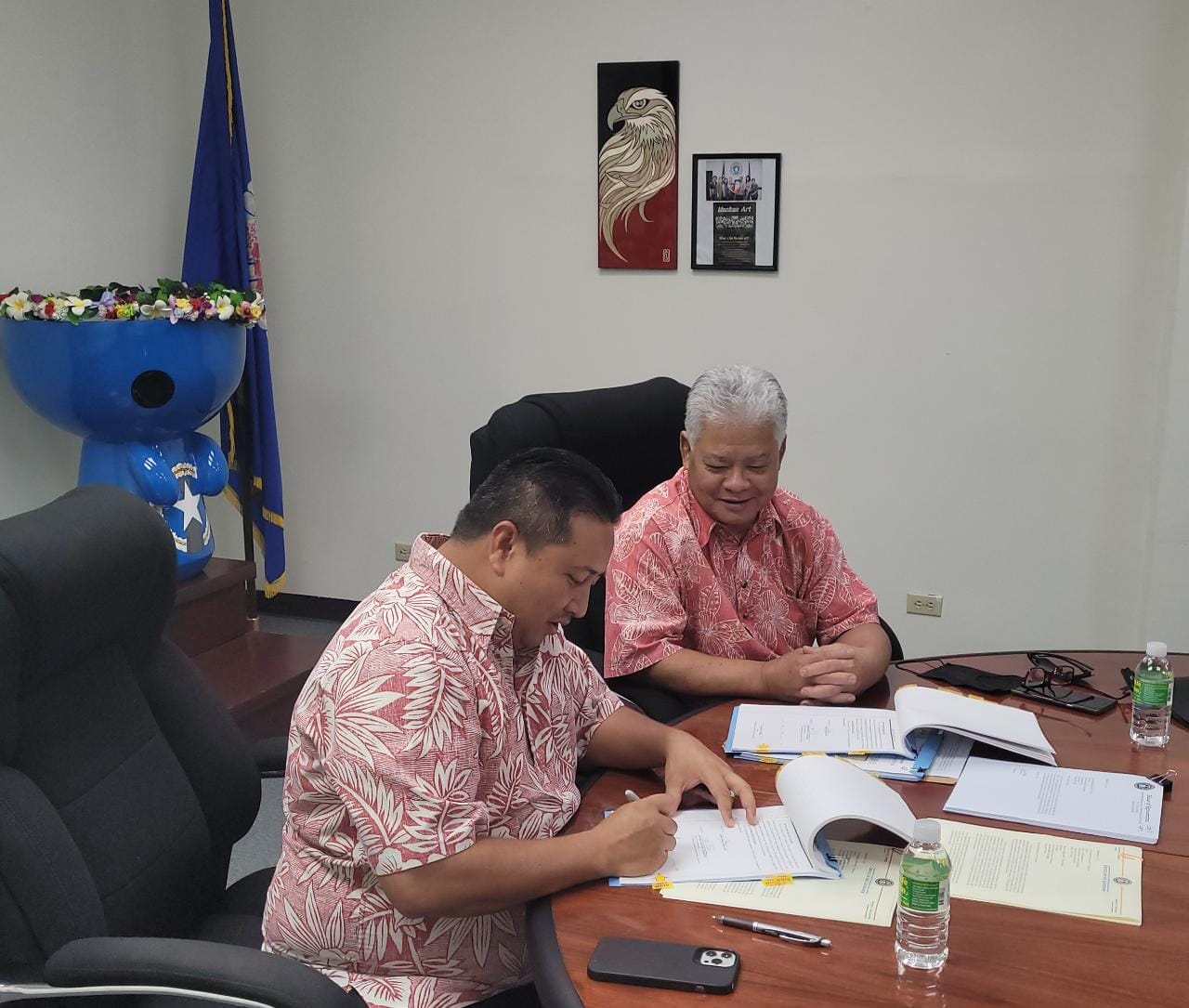
Gov. Ralph DLG Torres, left, signs the fiscal year 2022 budget bill as Lt. Gov. Arnold I. Palacios looks on in the governor’s conference room Thursday on Capital Hill.
