





HAGÅTÑA (The Guam Daily Post) — Years from now, firsthand accounts of the atrocities of World War II will be a thing of the past.
Many of today’s remaining war survivors were still in their formative years when they endured the brutal Japanese occupation and witnessed the liberation of the island 77 years ago.
Survivors who could made their way back to Manenggon for a memorial ceremony on Monday. They placed a wreath in front of the memorial that stands in remembrance of loved ones who suffered and died.
“I can’t forget Manenggon. I cannot do that, not when you lost loved ones,” said survivor Rosita Lizama Taitano Birdwell. “You miss a lot of people. Some people were beheaded. I knew them.”
At the tail end of WWII, as American forces prepared to retake Guam, the CHamoru people were forced into concentration camps. One of those camps was in the southern jungles of Manenggon.
From villages as far as Yigo, people were forced into a long and arduous march to Manenggon, located between Yona and Talofofo.
Birdwell, who was just 6 at the time, recalled the tragedies that befell her family.
“I have a brother that’s buried across the river,” Birdwell said. “He was a baby, a newborn baby. He starved. No medication whatsoever.”
Her father was the only one who was able to view her baby brother after his death.
Birdwell tearfully shared that she had lost her mother shortly before they made the march from Yigo.
“My mother died,” she remembered. “She was in the hospital when she had my baby brother, but then she contracted tuberculosis and was kept there.”
Birdwell never got to say goodbye to her mother.
“My father and his sisters couldn’t get her coffin to the cemetery because the bomb was coming down,” Birdwell said.
Her father had no choice but to leave her mother’s remains in Maite as they continued their march to Manenggon.
“After the war, my father took me over there to find and see where they left my mother, and there was nothing,” she said.
Birdwell doesn’t recall much of her time at the camp, only that her family did their best to survive.
“All I know was there was no real food. My brothers would go out and dig up young papaya trees, the root. You can pickle that, you can boil that,” she said.
“We were lucky because our main group — my father and brothers — found a little cave. So they built out from the cave and we were able to cook, because there were babies also.”
Birdwell remembered the time she thought she had lost her father.
“My father was on the second truck to be traveling up to Mount Santa Rosa,” she said. “A plane was bombing, and they jumped out of the truck. It took my father three days to come back to the camp.”
And when her father made it back to camp, he came with treats.
“He had Hershey bars and candy… He told us that he met the (American) soldiers and that’s a relief for us, so we knew,” Birdwell said. “But I got to tell you — crossing the river, being freed from the camp — I saw all these tall soldiers with guns and I thought, ‘Oh my goodness, they are going to kill us.'”
To her relief and the relief of others, they were Americans there to free them.
After being freed, Birdwell said her family traveled to Maimai before ending up in Agat.
Mixed memories
Julia Villagomez also lived through the war, barely 4 years old at the time. She recalled her encounters with Japanese soldiers.
“I was slapped by the Japanese because we were speaking English,” Villagomez said.
Villagomez was in the concentration camp with her family, including her parents and two siblings. She said her father was often singled out by Japanese soldiers because of his skin color.
“When we were in the concentration camp, my dad was taken every day because he looked (white),” Villagomez said. “I am a Manley.”
But not all her experiences with Japanese soldiers were violent, she said.
“So we have guards in our camp. I remembered a guard — I guess he had children — he made us a doll out of the corn on the cob.”
She and her family were marched from Agana Heights to Manenggon, and although she doesn’t remember much, she recalled some moments from life in the camp.
“I remember playing on the river,” she said. “People washing. And my mom. Then another thing I remember is that when there is a plane flying, no matter what you are cooking you have to put it out,” Villagomez said.
After the camp was liberated, Villagomez said her family was among the last to leave.
“My grandfather was taken as a prisoner of war, and then when the Americans liberated us we were the last ones to leave because my grandmother was dying,” she said.
Now 84, Villagomez said she tries to return to Manenggon every year, to honor those who died.

Guam’s World War II survivors lay a wreath at the Hasso Manenggon Memorial on Monday morning. A sign at the memorial site indicates that more than 20,000 island residents were forced to march to the site and were confined in concentration camps during the war.
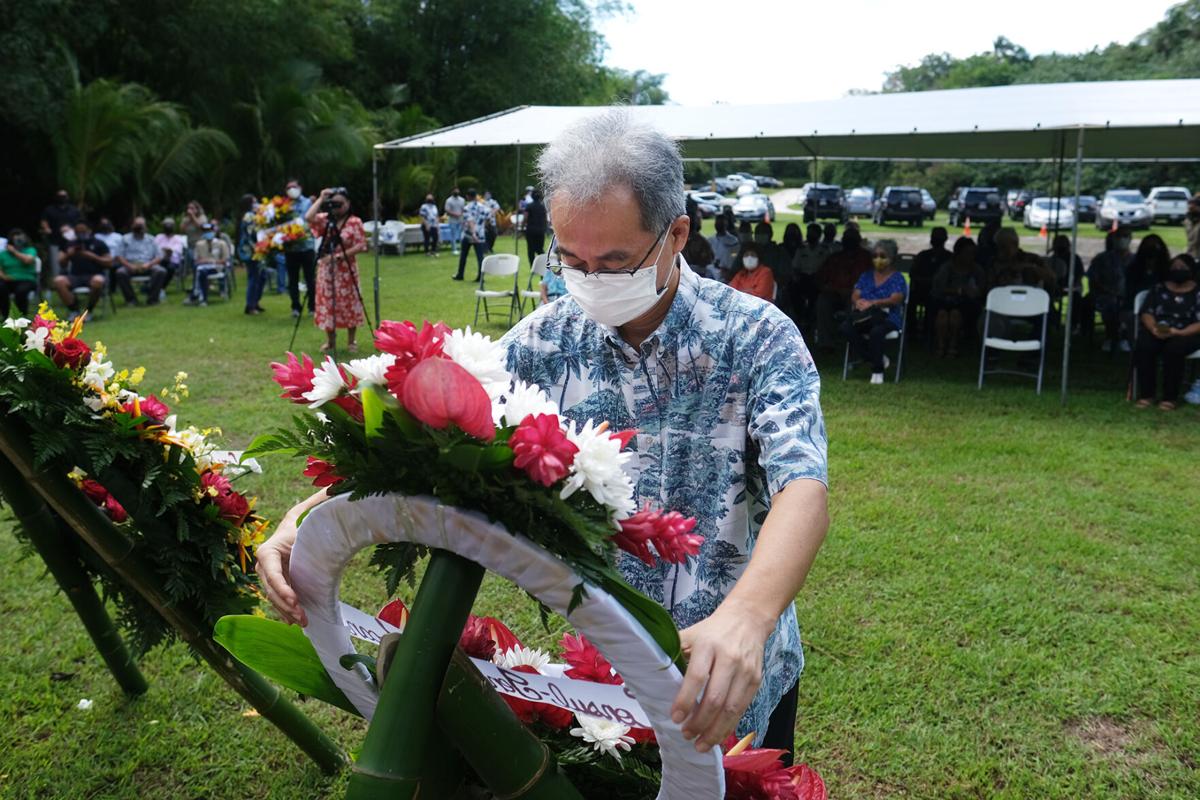
Toshiaki Kobayashi, Japan’s consul-general to Guam, lays a wreath at the Hasso Manenggon Memorial on Monday morning.
