

WITH $175 million in American Rescue Plan Act funds plus the $98.8 million available from local revenue, the CNMI government’s total budget for fiscal year 2022 is $273.8 million.
In FY 2022, the administration’s projected government revenue amounted to $144.8 million only of which $101 million was available for government appropriations, including over $4 million for the Department of Public Lands.
In 2018, before Super Typhoon Yutu devastated Saipan and Tinian, the administration’s FY 2019 budget identified $258 million in projected revenue of which $171.8 million was available for government appropriations, including over $4 million for DPL.
Following Yutu and then the Covid-19 pandemic, the CNMI’s lone industry, tourism, shut down, causing local government revenue to plummet.
Federal Covid-19 relief funds, however, are now providing the Commonwealth with badly needed financial assistance.
In his revised FY 2022 budget submission on Friday, acting Gov. Arnold I. Palacios noted that the net available for government appropriations as proposed by Gov. Ralph DLG Torres in his April 1, 2021 budget submission, which was $98.8 million in local funds, remains unchanged. This amount is derived from a total of $144.8 in estimated gross budgetary resources for the next fiscal year. From this gross revenue, the CNMI government is mandated to set aside $39 million for the Settlement Fund and a total of $6.9 million in payments for bonds floated in 2007.
The revised budget proposal changes the allocations of local funds for the following:
1) The implementation of Executive Order 2021-009, which transferred the quarantine personnel of the Department of Lands and Natural Resources to the Department of Finance-Division of Customs Services.
2) The reallocation of funds for utilities while keeping funding intact for operations and activities with the exception of the judicial and legislative branches.
Also, the suspension of statutory earmarks continues in the revised budget submission.
The suspended earmarks include the tobacco control tax revenue, cigarette tax for solid waste, the customs and immigration quarantine revolving fund, the hotel occupancy tax for the Marianas Visitors Authority, the Office of the Public Auditor fees, the local revenues earmarked for the Public School System technical education program, the revenues earmarked for tax enforcement, the cigarette tax for group health and life insurance, the cigarette tax for cancer fund, the hotel occupancy tax for retirees, the alcohol container tax for retirees, the alcohol container tax for MVA, and the retirees’ share of electronic gaming fee collections.
Travel bubble
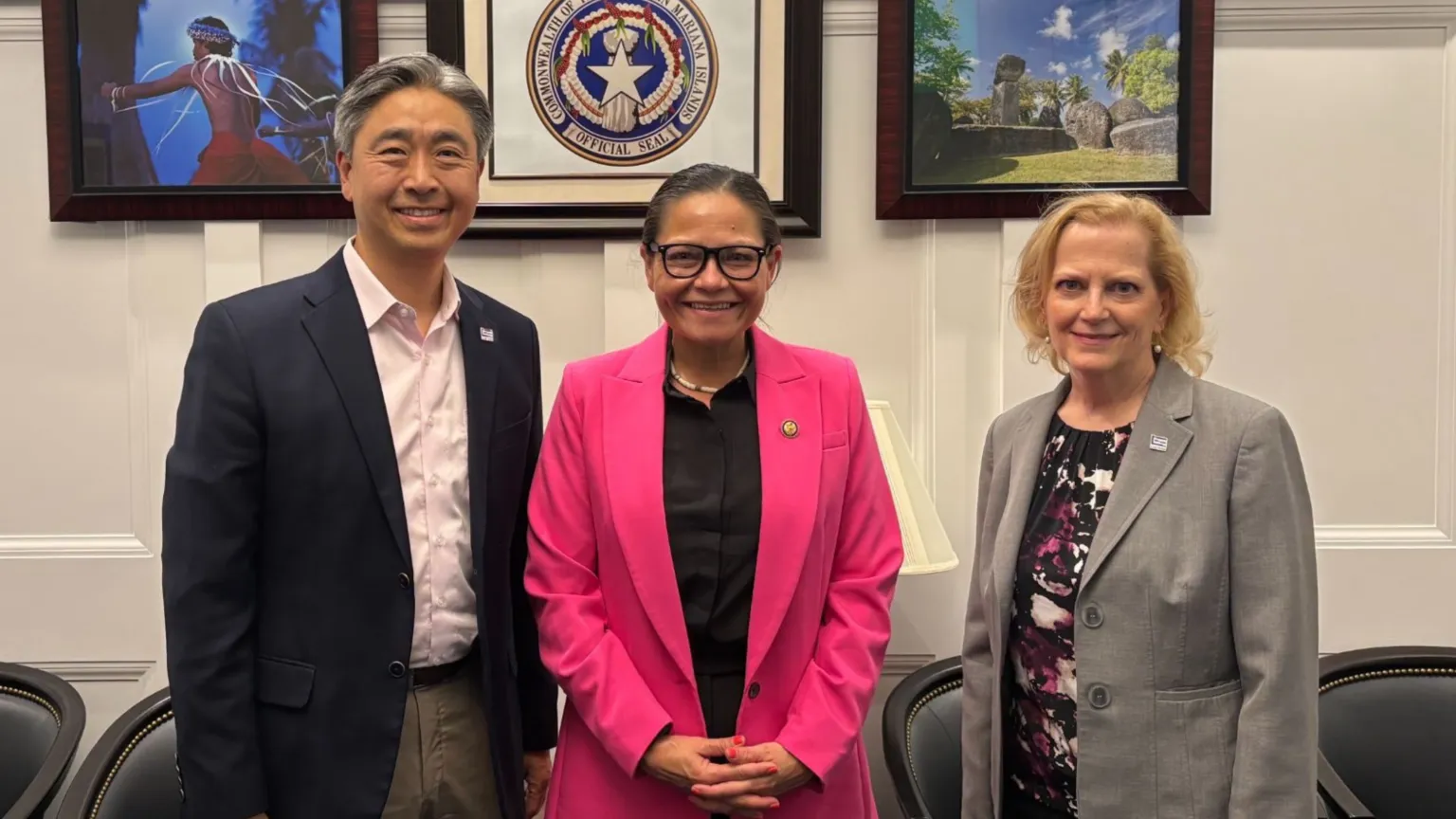
In his transmittal letter, the acting governor told Speaker Edmund S. Villagomez and Senate President Jude U. Hofschneider that the recovery of the local economy depends on the success of “our proposed travel bubble to welcome back visitors to our islands.”
“As we go through the cycle of reopening and adjusting our environment to safely reopen the Commonwealth, our next steps are crucial to our economic recovery,” Palacios added.
Right now, he said, trends in imports, construction, business and consumer spending are the “driving factors” in the CNMI economy that are offsetting the decline of revenues from tourism and casino industries.
Covid-19 response
Palacios said the infusion of federal monies to stimulate the economy in response to the impact of the Covid-19 pandemic has “increased our local consumer spending but drove inflation upwards…throughout the various sectors in consumer discretionary, consumer staples, industries, technology, energy and health.”
He said tracking government spending and watching for a return to normal levels is crucial in determining whether the CNMI remains in crisis or whether its economy is headed to a “slow-steady growth towards recovery.”
“Let us not forget that reopening [our economy] requires our continued commitment to mitigate our public health environment to ensure safety first for our community. The immediate rollout of the vaccine compressed the time to end the threat of Covid-19,” Palacios said, adding that as June 30, 2021, 64% of CNMI community members had been vaccinated.
Thanks to ARPA
Palacios said, “The ARPA funding made available for the provisions of government will aid the Commonwealth in the restoration of hours affected by the fiscal austerity due to loss of government revenue impacted by the public health emergency and Covid-19 including the reinstatement of those employees that were furloughed and the cancelation of the reduction in force including other provisions of the government relative to addressing the impacts of the public health emergency.”
The allocation for government employees’ salaries in the revised submission remains 80% of the local budget.
Of the $175 million in ARPA funds for the CNMI, the legislative branch will get $2.6 million; the judicial branch, $2.1 million; the governor’s office, $809,767; the lt. governor’s office, $568,727; “other offices” in the offices of the governor and lt. governor, $14.7 million; Department of Commerce, $921,080; Department of Community and Cultural Affairs, $2.9 million; Department of Corrections, $3 million, Department of Fire and Emergency Medical Services, $2.3 million; Department of Finance, $10.3 million; Department of Labor, $1.1 million; Department of Lands and Natural Resources, $3.4 million; Department of Public Safety, $2.8 million; and Department of Public Works $1.3 million.
Rota will get $3.8 million in ARPA funds; Tinian, $4.2 million; Saipan, $1.4 million; Northern Islands, $284,602; boards and commissions, $1.3 million; independent programs, $103.7 million; other programs, $10.3 million; and the Department of Public Lands, $450,498.
Palacios noted that the CNMI “is privileged with this substantial allocation to help defray the cost of government services exacerbated by the negative economic impacts of the Covid-19 public health emergency.”
He said the allocations of ARPA funds are provided in the current fiscal year, which is $75 million, and in the next fiscal year, with $175 million.
He said of the $11 million in ARPA funds that the judicial branch stands to receive for the current fiscal year, $10 million will be for the retrofitting of its facility, improvements to broadband connectivity, restoration of work hours and reinstatement of its furloughed employees.
The ARPA funds for the legislative branch increases each of the lawmakers’ operation budget to $65,000 from $60,000; restores the 80 working hours of Legislative Bureau employees, and funds the retrofitting of the legislative building’s facilities.
Palacios said $4 million in ARPA funds is allocated for government employees’ within-grade pay raise; $10.9 million for their health insurance; $20 million for government utility bills and Office of the Public Auditor fee; $39.7 million for Medicaid; $20.2 million for the Medical Referral Program for patients needing urgent health care not available on islands; $10 million for magnetic resonance imaging or MRI and hyperbaric chamber for the Commonwealth Healthcare Corp.; $11.2 million for CHCC hospital operations affected by the Covid-19 pandemic; $11 million for hospital workers needed for the continuity of Covid-19 emergency health operations; and $7.6 million for Northern Marianas College operations related to Covid-19 and the restoration of its employees’ 80-hour work period.