








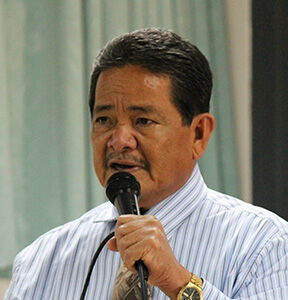
LOCAL banks and other private companies as well as government agencies support the electronic recordation rules that the NMI Supreme Court proposes, according to Chief Justice Alexandro C. Castro.

Alexandro C. Castro
He submitted to the Legislature on April 16, 2021 the proposed CNMI property recording rules pursuant to Public Law 21-39, which Gov. Ralph DLG Torres signed in January.
The law mandates the transition of recordation from manual to electronic and will transfer from the presiding judge to the chief justice the general supervision of the Commonwealth Recorder’s Office.
The measure requires the CNMI judiciary to promulgate rules in establishing the duties and responsibilities of the office tasked to maintain indexes for land transfers, mortgages, leases, judgments, and decrees affecting real property interests, and other indexes as required by court rules, including an index for marriage records.
These indexes “shall include a summary description of the property, names of the parties and other information as required by court rules.”
The chief justice said the judiciary met with officials of title companies, banks and other financial institutions on March 19 to discuss the five-page proposed rules and the transition from paper and electronic recordation.
On April 8, he said, the judiciary invited to another meeting the heads of government agencies that are directly involved with the Recorder’s Office.
Those who attended the separate meetings were representatives from Bank of Saipan, Bank of Guam, City Trust Bank, Bridge Capital, Express Financial, First Hawaiian Bank, Pacific American Title Company, Security Title, the Saipan Chamber of Commerce, the Commonwealth Development Authority, the Northern Marianas Housing Corp., the Department of Public Lands, the Department of Lands and Natural Resources and the Office of Planning and Development.
In his letter to Speaker Edmund Villagomez and Senate President Jude Hofschneider, the chief justice said the private companies, including banks, and governmental agencies support electronic recordation and the proposed rules.
The proposed rules take effect 60 days after submission “unless disapproved by a majority of the members of either house of the Legislature.”
Chief Justice Castro also informed the presiding officers that in the interim, the judiciary has adopted the proposed rules pending the Legislature’s approval.
