



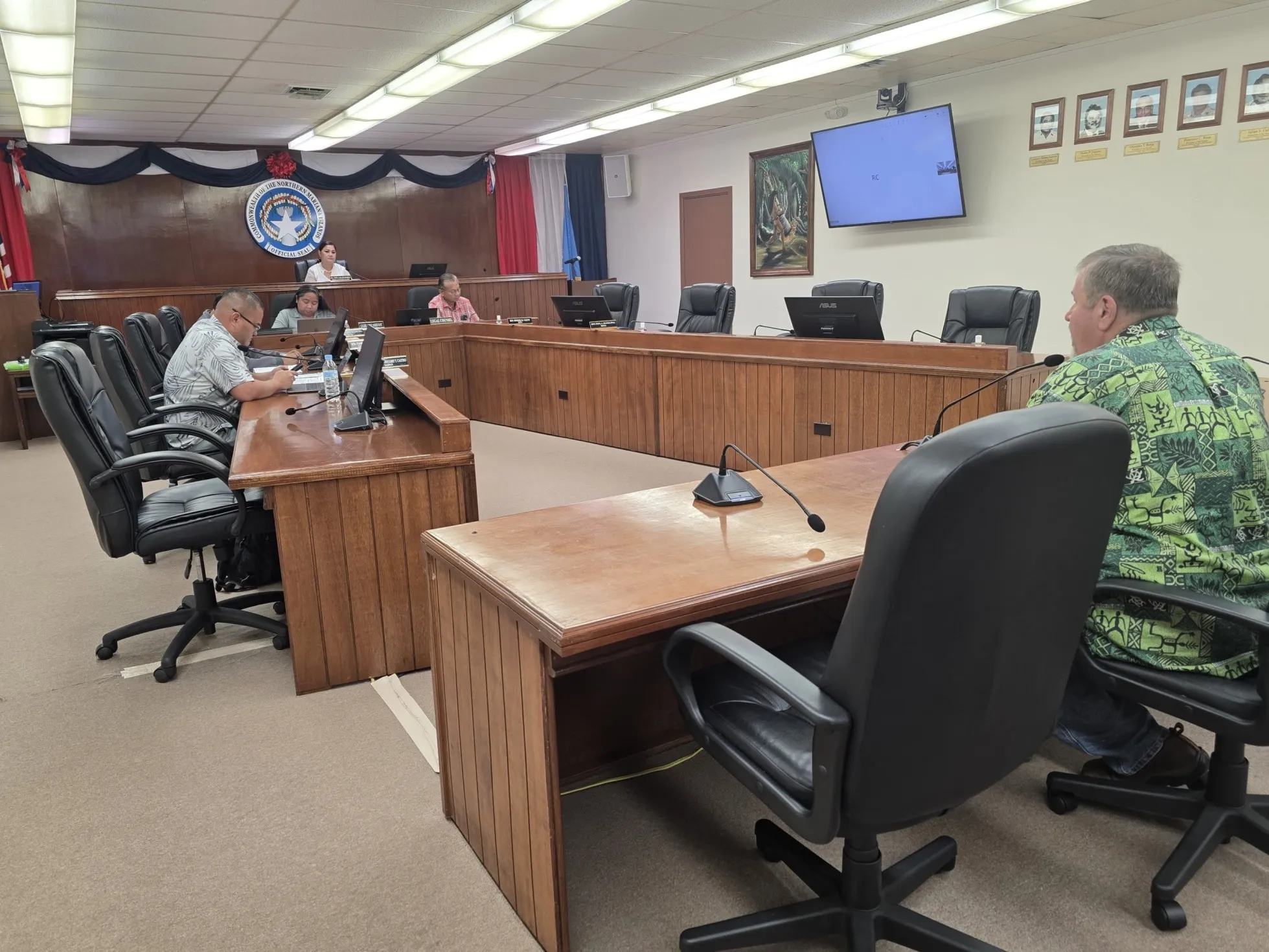


All members of the House, including Speaker Froilan C. Tenorio, were in favor of having an elected AG, but he and House Floor Leader George N. Camacho, Ind.-Saipan, expressed concerns about some of the provisions of H.L.I. 17-2 which was introduced by Rep. Francisco S. Dela Cruz, R-Saipan.
The vote was 17 in favor and only 2 against — Tenorio and Camacho. Rep. Eliceo D. Cabrera, R-Saipan, was absent.
Similar proposals were introduced in previous legislatures, but none were passed.
A legislative initiative, which does not need the governor’s approval, requires the support of at least three-fourths of the members of each house of the Legislature present and voting before it can be put on the ballot. Voters can then decide whether to ratify or reject it.
Tenorio, Covenant-Saipan, asked Vice Speaker Felicidad T. Ogumoro, Covenant-Saipan, to preside over the session so he could participate in the deliberations.
Stating that the office of attorney general should be free from any political influence or interference and should enforce commonwealth law to the fullest extent, H.L.I. 17-2 will amend Article III, Section 11 of the CNMI Constitution, stripping the governor the power to appoint an attorney general.
Dela Cruz wants the attorney general “elected by the people to be the chief legal officer of the CNMI government and be responsible for providing legal advice to public officials, executive departments, public corporations and autonomous agencies representing the commonwealth in all legal matters and prosecuting all violations of commonwealth law.”
The attorney general “shall be at least 35 years old, a resident of the CNMI for at least five years and an active member of the Commonwealth Bar Association for at least five years and have not been suspended from the practice of law in any jurisdiction of the U.S.”
An elected AG will get a $150,000 annual salary and a four-year term of office.
The requirements regarding age, residency and local bar membership were among Tenorio’s concerns.
He urged Dela Cruz to withdraw H.L.I. 17-2 and introduce another version that will require a more “seasoned” AG by raising the age requirement to 50 years old.
The speaker also does not like requiring an AG to be a CNMI resident for five years.
The current CNMI voting requirement of 120 days, he said, should be enough to make an individual eligible to run for AG.
He also asked why a candidate for AG should be a five-year member of the Commonwealth Bar Association.
Dela Cruz noted that the speaker had six months to raise his concerns.
“Why bring them up only now?” he asked.
“This government will begin to have better governance if we have an elected AG,” he said.
According to Dela Cruz, there is at least $7 million that remains uncollected because of the reluctance of the attorney general to go after those who owe the government money.
House Minority Leader Diego T. Benavente, R-Saipan, said 35 is not “too young.”
He also defended the five-year residency requirement saying that an AG should be familiar with CNMI statutes and the commonwealth government.
Rep. Ralph S. Demapan, Covenant-Saipan, said he found it “amazing” that such an important proposal was left sitting in the House Committee on Judiciary and Government Operations for almost two decades since it was first introduced by Rep. Stanley T. Torres, Ind.-Saipan, in the 8th Legislature.
In an interview, Senate President Paul A. Manglona, Ind.-Rota, said he will ask his colleagues to conduct a public hearing on H.L.I. 17-2.
The Senate, he said, wants to make sure that an elected AG will be qualified, competent and “color blind.”
//
