

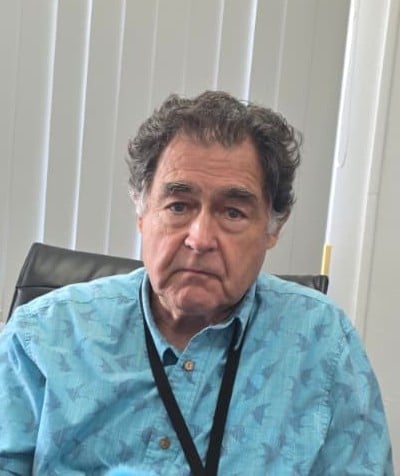


David Gulick, USCIS Honolulu district director, said their office will send teams to the commonwealth once the final regulations for the Commonwealth of the Northern Mariana Islands Transitional Workers Classification, or CW, are approved.
“When the regulations come out, we will be working on things to make sure people get the chance to have it explained to them. It will be like December. We will have teams here to help the community,” he told the Variety in an interview.
The regulations are supposed to be published with finality in the Federal Register this September but the date may be pushed back as the final draft is still a work in progress.
The Consolidated Natural Resources Act of 2008, which contains the statute that federalized the immigration system of the CNMI on Nov. 28, 2009, only recognizes CNMI-issued labor permits until Nov. 27, 2011.
Before that date comes, the estimated over 16,000 documented foreign workers must transfer to federal employment programs, one of which is the transitional workers classification, which is tailored for those who are not eligible to apply for the federal H1 or H2 visas.
Thousands of foreign workers, including those with the tourism industry, will fall under the CW status.
Gulick met with some groups of employers during his recent visit to Saipan.
He said his main message was to ask them for their “patience.”
“I hope employers, in our efforts to grant advance paroles and paroles in place — I hope that they see that we take into account and are doing everything we can to allow them to continue to have the workers they need to continue their business,” he said.
US Labor matter
A number of local employers who petitioned their foreign workers for an H1 visa complained that these had been held because of questions on CNMI wages.
The CNMI’s current hourly minimum wage rate of $4.55 an hour is far below the federal wage rate of $7.25 an hour. Most professionals here are also paid below what their counterparts earn in the states.
Gulick said the disparity between the CNMI and U.S. wages is something that the U.S. Department of Labor should address as the USCIS only deals with immigration matters.
“For an H1, which is for professionals, the wages should be comparable with those offered in the U.S.,” he said.
He said the USCIS generally processes an H1B visa within 120 days and faster if premium payment is made.
If the petition for an H1B is granted, the applicant still has to get the document from his home country unless the U.S. Customs and Border Protection, or CBP, already has a record of that individual.
Gulick said they are working to change this requirement to ensure that work won’t be disrupted in the commonwealth.
“At the moment though, if somebody wants an H1 in the CNMI, they can file the petition but unless the person has been admitted by CBP by some status, like a tourist or something like that, they have to get an H1 visa overseas and come back here. We’re working to change that,” he said.
