



By Walter Ulloa
For Variety
HAGÅTÑA (The Guam Daily Post) — As defense projects spread across Micronesia and Guam’s strategic role quietly evolves, the U.S. military is signaling a commitment to collaboration. A local expert, though, is asking a harder question: collaboration with whom?
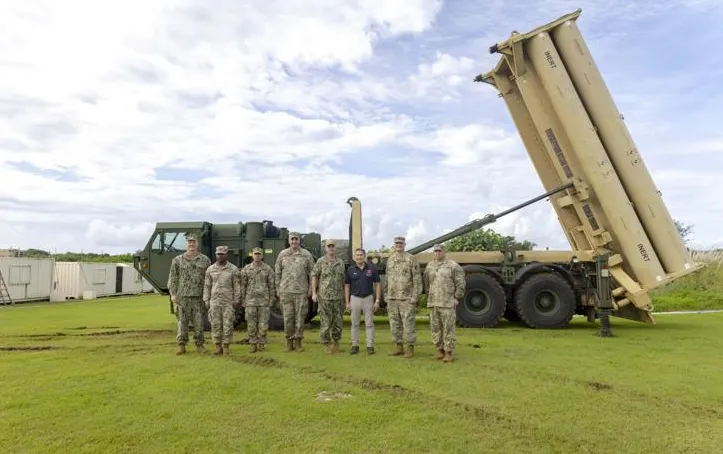
U.S. Navy Rear Adm. Joshua Lasky, commander of Joint Task Force-Micronesia, addressed questions from The Guam Daily Post this past week about the military’s expanding footprint across Guam, the Commonwealth of the Northern Mariana Islands, and the Federated States of Micronesia, including infrastructure projects underway in Yap State.
Lasky called the regional coordination significant, describing how defense work in Yap directly strengthens Guam’s position as a logistics and command hub for the broader Indo-Pacific.
JTF-M works to promote regional stability by coordinating operations across all military domains, Lasky has said, describing the mission as one that covers homeland defense, disaster response, and support to civil authorities through a whole-of-government approach.
“By bringing together diverse perspectives and expertise, these gatherings help build trust, enhance communication, and ensure a unified approach to addressing emerging threats,” Lasky said in a recent joint meeting with the Federated States of Micronesia. “Such cooperation not only bolsters our collective security but also reinforces the commitment of all parties to maintaining peace and stability in an increasingly complex global environment.”
In his responses to the Post on Wednesday, Lasky said, “Defense projects in Yap are a key part of improving U.S. military readiness, forward presence, and power projection in the Indo-Pacific.” He added, “These projects improve the resilience of our partners by providing them with improved resources and infrastructure.”
On cybersecurity and disaster preparedness, Lasky pointed to the Civil-Military Coordination Council as the primary forum where military and local agencies coordinate.
“Humanitarian assistance and disaster relief is a cornerstone of our regional mission, as seen in exercises like Pacific Partnership, the largest annual multinational HADR preparedness mission in the Indo-Pacific,” he said.
And on economic benefits, Lasky said the military actively participates in local industry forums and job fairs to connect residents with federal contracting and employment opportunities.
“Our goal is to ensure that the economic activity generated by the military presence directly supports local families and businesses,” he said.
Robert Underwood, chairman of the Pacific Center for Island Security and a former Guam congressional delegate, welcomed none of what he called the one-sided nature of that relationship.
“The relationship is not an even relationship,” Underwood said. “There is no conversation.”
Underwood, speaking by phone from British Columbia while preparing for upcoming meetings with Washington think tanks, said military leaders may be acting in good faith, but he questioned whether the process itself allows for genuine give-and-take.
“I’m sure he’s adhering to the letter of the law for himself in his actions,” Underwood said of Lasky. “But the relationship is not an even relationship.”
He said the CMCC and programmatic agreements are only as meaningful as the willingness of local leaders to push back, something he has rarely seen happen.
Underwood said activists and community pressure remain the most reliable check on how decisions affecting Guam get made and that elected officials too often follow only when pushed.
“The activists are the conscience of this island,” Underwood said. “They serve as the conscience of the island.”
“I’ve never seen anyone take direct opposition,” he added. “Then you’ll know what the meaning of collaboration is.”
His concern is pointed, in part, because the strategic landscape is shifting faster than local officials can track. A recent Atlantic Council report argued that Marines now slated for Camp Blaz should stay in Okinawa, closer to potential flashpoints like the Taiwan Strait. The Army has also established a rotational presence in the Philippines.
That leaves open the question of what role Guam will ultimately play and who gets to shape the answer.
“The erratic nature of the way the buildup is being conducted really can be laid at the feet of the Trump administration, that seems to be shifting month by month in terms of what is their real objective,” Underwood said.
He pointed to the $6 billion already spent building Camp Blaz and the environmental toll taken on the northern part of the island as evidence that these decisions carry lasting consequences for Guam, whether or not residents have a say.
“How come they spent over $6 billion in it?” Underwood said during an earlier interview with the Post. “And where are we going with that?”
Beyond troops and infrastructure, Underwood raised the possibility of Japanese forces eventually being stationed on Guam — a prospect he described as needing far more public discussion than it has received.
“My gosh, who’s going to have that conversation with the people of Guam?” he said. “Is that just something they work out amongst themselves?”
Still, Underwood stopped short of dismissing the military’s presence or the value of local engagement. He said community activists, elected officials, and the press all play a role in keeping the conversation honest.
“When the people lead, the leaders will follow,” he said, quoting the late activist Ron Rivera.
And with an election cycle approaching, Underwood said candidates for congressional delegate should be expected to answer clearly where they stand on issues tied to the buildup and Guam’s future.
“Our voice on the Armed Services Committee ought to be asking those questions, raising those issues now in a public way,” he said. “Not in a private way, but in a public way, so that it forces some serious conversation.”
Lasky has made clear that the military remains open to input and responsive to local partners. He has repeated this message in his written responses to the Post and at public forums.
“What we really need is a little bit of reflection, feedback (on) where we may be falling short, which gives us the ability to pay attention to the right things and hold ourselves accountable along the way,” Lasky said at a recent stakeholders meeting in Saipan.
The back and forth between military assurances and local skepticism points to a gap that neither press releases nor coordination councils have fully closed. With major strategic decisions continuing to be made in Washington and Tokyo, Guam’s leaders face the continuing challenge of turning consultation into genuine influence.
“Our role is just to accommodate whatever it is that is decided somewhere else,” Underwood said. “And that’s not good.”
