





By Bryan Manabat
[email protected]
Variety News Staff
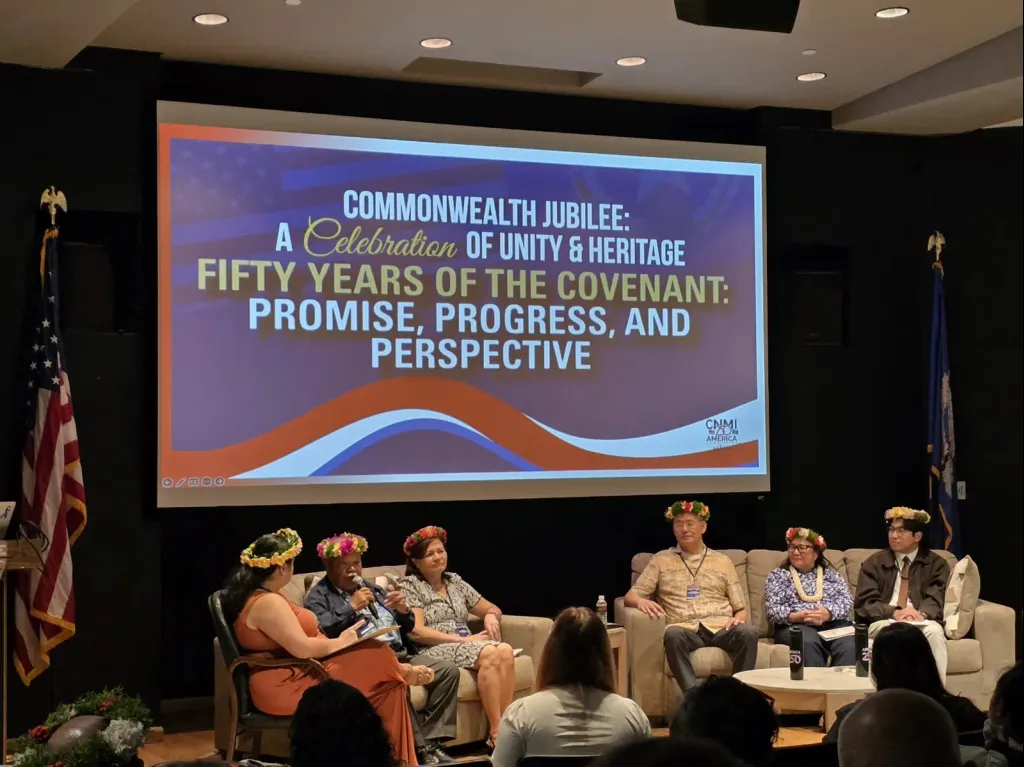
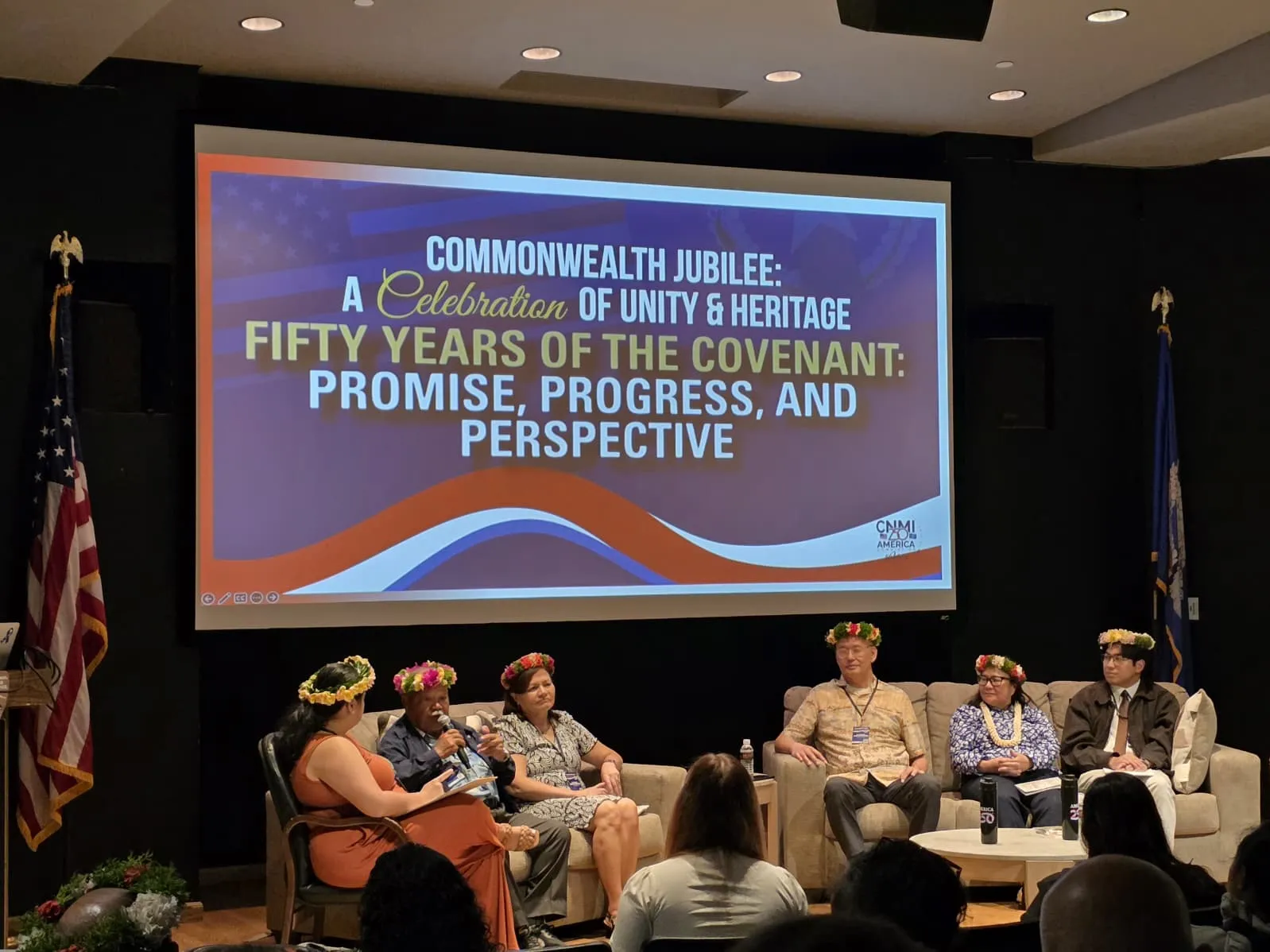
THE 50th anniversary of the Covenant between the Northern Mariana Islands and the United States was marked March 24 with a panel discussion at the American Memorial Park indoor theater, the centerpiece of the third day of the Commonwealth Jubilee.
The three-day celebration, hosted and coordinated by the CNMI America 250 Commission, commemorated the Covenant’s signing and explored the cultural and political identity of the Marianas. The Jubilee was presented in partnership with the Smithsonian Center for Folklife and Cultural Heritage, bringing national cultural expertise into the CNMI’s anniversary commemoration.
Day 1 featured cultural exhibits, traditional demonstrations, and community storytelling honoring the Marianas’ living heritage. Day 2, themed “Embracing American Culture & Heritage,” focused on identity, diaspora, and the evolving cultural landscape of the CNMI. The Covenant forum capped the Jubilee’s final day, bringing together legal and policy leaders to reflect on how the agreement continues to shape life in the Commonwealth.
The Covenant — negotiated over 27 months and approved through a multilayered process involving the CNMI, the Trust Territory of the Pacific Islands, the U.S. Congress, and the United Nations — established the Commonwealth’s political union with the United States. It also granted U.S. citizenship to the indigenous people of the Northern Mariana Islands, forming the foundation of the modern CNMI.
Panelists included former Marianas Political Status Commission member Pedro A. Tenorio; Chief Judge Ramona V. Manglona of the District Court for the NMI; CNMI Supreme Court Justice John A. Manglona; Superior Court Associate Judge Lillian A. Tenorio; and economist Clement C.J. Bermudes, executive director of the Governor’s Council of Economic Advisers.
They examined the Covenant’s provisions on citizenship, mutual consent, land alienation, federal benefits, and political status, as well as the effectiveness of Section 902 consultations and ongoing challenges related to immigration and land ownership.
To close the forum, moderator Gretchen Smith asked each panelist: “What do you find to be the most remarkable aspect of the Covenant and its original design?”
Their responses pointed to a shared theme: the Covenant is not merely a historical artifact, but a living framework that continues to determine rights, protections, and federal relationships.
A hard-fought union
Tenorio said the Covenant’s most remarkable achievement was transforming the CNMI people’s long-held desire for political union with the United States into a binding agreement that preserved key local protections.
He said that by the time negotiations began, “the entire… issue of future political status already [was] written quite firmly in the minds of the majority of the people,” and that his role was to help secure “a very strong affiliation with the United States.”
Fifty years later, Tenorio said, the Covenant’s enduring strength lies in its ability to deliver U.S. citizenship and political union while safeguarding local priorities on land, status, and self-government.
He pointed to land alienation and social protection provisions as particularly significant, noting that Section 805 and Article XII were made subject to mutual consent due to strong public sentiment to preserve land ownership among people of Northern Marianas descent.
He also highlighted the CNMI’s access to Supplemental Security Income as a major achievement at the time.
Still, Tenorio said his “one regret” was that immigration was not permanently placed under mutual consent, underscoring what he views as the importance of negotiated protections.
Citizenship’s lasting impact
Justice John A. Manglona said Article III on citizenship remains the Covenant’s most transformative feature, recalling a time when Northern Marianas residents were treated as foreign nationals.
“Article III on citizenship is important to me. We were foreigners in the eyes of U.S. immigration,” he said, describing the challenges of travel before the Covenant.
For him, the agreement fundamentally changed both legal status and lived experience.
Mutual consent and political identity
Associate Judge Lillian A. Tenorio emphasized the importance of both citizenship and the mutual consent provision under Section 105.
She said the clause reflects a deliberate limit on federal authority, ensuring that certain fundamental provisions cannot be changed without the CNMI government’s agreement.
“We entered into this Covenant as a party separate from the United States,” she said. “We still maintain some of that independence.”
A rare negotiating tool
Bermudes highlighted Article IX, particularly Section 902 consultations, as a unique feature that provides the CNMI with a formal channel for engagement with the U.S. executive branch.
“This is a mechanism enshrined in law that gives us direct access…. You don’t see that anywhere else in the union,” he said.
He described the current round of 902 talks as among the most robust in the CNMI’s history.
Legal relevance today
Chief Judge Ramona V. Manglona pointed to provisions that continue to shape federal court decisions, particularly in Social Security and voting rights cases.
She cited the U.S. Supreme Court’s 2022 decision in United States v. Vaello Madero, noting that the Covenant’s language ensured CNMI residents retained access to Supplemental Security Income.
She also referenced Borja v. Nago, which preserved absentee voting rights for certain residents moving to the CNMI.
A living framework
Across the panel, several themes emerged: citizenship’s lasting impact, the importance of mutual consent, the value of Section 902 consultations, and the continued legal force of the Covenant in federal systems.
Half a century later, panelists agreed, the Covenant remains a powerful political agreement — one that continues to define rights, responsibilities, and opportunities for the people of the Northern Marianas.
Bryan Manabat was a liberal arts student of Northern Marianas College where he also studied criminal justice. He is the recipient of the NMI Humanities Award as an Outstanding Teacher (Non-Classroom) in 2013, and has worked for the CNMI Motheread/Fatheread Literacy Program as lead facilitator.
