




By Walter Ulloa
For Variety
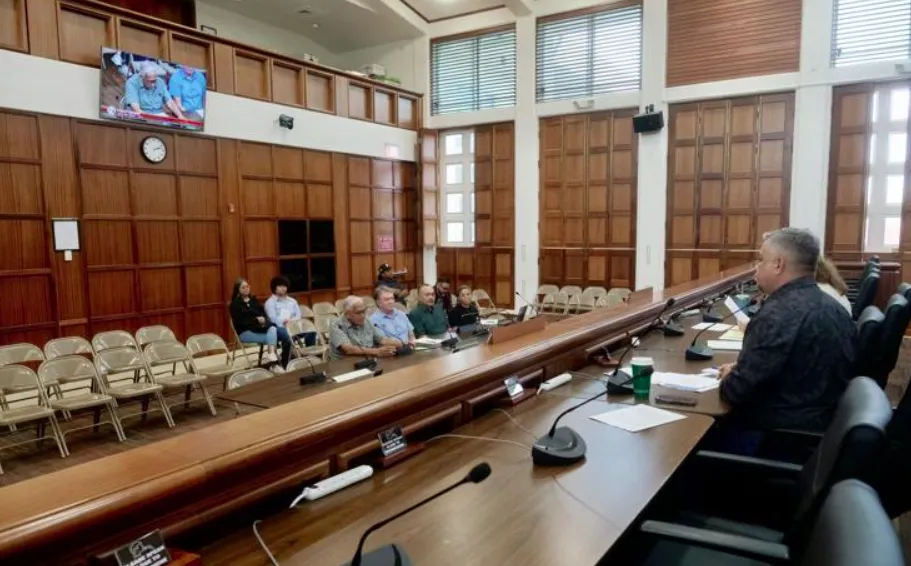
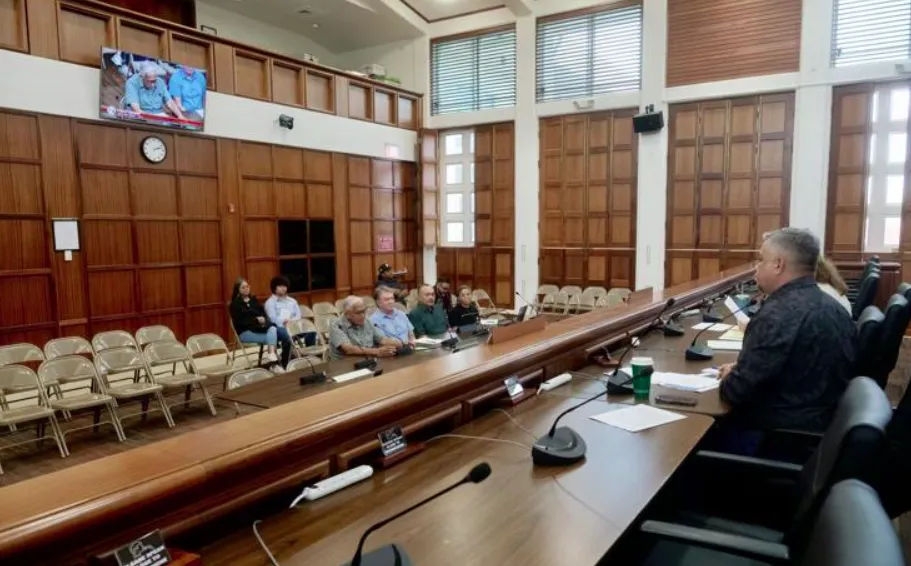
HAGÅTÑA (The Guam Daily Post) — The room at the Guam Congress Building was not full Friday afternoon. Just three senators showed up, a handful of community members took seats in the gallery, and no one from Joint Region Marianas or Joint Task Force-Micronesia came, just as no military officials attended the first briefing in May.
But what the witnesses brought to Sen. Telo Taitague’s reconvened Military Buildup Informational Briefing made the sparse attendance feel beside the point. In two hours of testimony, residents, analysts and preservation advocates laid out a case that Guam is being repositioned as a forward offensive platform in a potential conflict with China, without civilian shelters, without a seat at the table where those decisions are being made, and without so much as an official notification to the people who live here.
Taitague opened by citing a Washington Times report on a $122 billion budget request from Adm. Sam Paparo, commander of U.S. Pacific Command, that allocates $67.4 billion for new missiles, $18 billion to counter Chinese military control systems, $15 billion for a space-based missile warning system and $2.3 billion for drone weapons. Of that total, only $909 million is dedicated to Guam’s defense, as part of a $4.5 billion Pacific Homeland Defense Strategies program.
She also flagged a pending amendment in the fiscal year 2027 National Defense Authorization Act that could require the deployment of microreactors, or small, transportable nuclear units, on Guam by 2030.
“It is very concerning and frustrating that significant developments to the military buildup, which not only impact everyone in this room but everyone on this island, was decided on behind closed doors,” Taitague said. “The people it will impact the most were not consulted, and it is equally frustrating news of these changes came from the media and not from official government channels first.”
Former Delegate Robert Underwood, chair of the Pacific Center for Island Security, or PCIS, told the panel that the central question is not whether to support the military but whether military activities serve the people of Guam.
“The military has an important mission,” he said. “But they are not entitled to uncritical review or support for their activities. The most appropriate question is, is this activity positive or negative for Guam?”
Underwood also encouraged the Legislature to research laws passed in other states that restrict or condition military activities, and said the body has more tools available than it often uses.
Leland Bettis, PCIS director, described a pattern of military priorities shifting without any corresponding commitment to local needs, pointing to the collapse of submarine basing plans at Polaris Point and the uncertain future of Camp Blaz as examples of how quickly the calculus in Washington can change.
“Clearly Guam needs to figure in national strategies,” Bettis said. “We cannot depend on Joint Task Force-Micronesia or U.S. Pacific Command to carry these issues for us. They are too busy, and will soon be even more busy, addressing their growing vulnerabilities in Guam and the region.”
He said the evidence that local coordination has failed is plain enough and that the community needs to carry the load itself.
“If the future of Guam’s families for housing, shelter, education, safe infrastructure and a livable environment are going to be achieved, we are going to have to carry this requirement ourselves,” Bettis said.
Baltazar Aguon, a longtime preservation advocate, condemned the Pentagon’s plans for microreactors and drew a direct line to the Legislature’s recent move to ban deep-sea mining vessels from Guam’s ports under Public Law 38-129.
“We must draw that same line on our soil,” he said. “I urge this body to look at the precedent you set with our ports and apply it to our survival. Don’t negotiate or regulate a nuclear loophole behind closed doors. Put it to the people.”
Aguon called on the committee to place a binding referendum on the November general election ballot asking residents whether they consent to nuclear technology on the island.
“Let the people of Guam decide, once and for all, if we will permit nuclear technology on our sacred island,” he said. “In demanding this vote, we are simply standing up for what any other community who cares for its people and homeland would fight for.”
Monaeka Flores, executive director of Prutehi Guåhan, addressed what she described as the military’s pattern of presenting itself as an environmental steward while expanding activities that harm marine ecosystems. She said the Navy’s use of language such as “stewards of the sea” obscures practices that kill and injure protected species.
Flores also raised the Mariana Islands Testing and Training area and said the comment period for its environmental impact statement continued even as communities across the Marianas were recovering from a recent typhoon.
“It is completely inappropriate, inhumane even, to continue with the comment period during a tragic time,” she said.
She added that three missile defense sites planned for Guam overlie roughly 100 acres of non-federal property and sit atop existing military contamination, including asbestos, lead paint and harmful pesticides that have never been cleaned up. She also called for a full ban on nuclear power generation for military purposes on the island.
“We do not consent,” Flores said. “The people of Guam have never consented, just like we’ve never ceded our sovereignty.”
Sen. Sabina Perez raised concern that Guam is absent from both the National Defense Strategy and the National Economic Strategy and asked Underwood directly how the island gets a seat at the table where those decisions are made. Underwood said the answer starts with Guam raising its most critical concerns at every federal opportunity available.
Sen. Chris Barnett was pointed about where he sees the breakdown occurring. He said the divide between the executive and legislative branches on the buildup has made it easier for military leadership to work around the Legislature entirely.
“Maybe a decade or so ago, we had more alignment with the executive branch and legislative branch and we were all on the same page on where we stood with the military buildup,” Barnett said. “And now we’re victims of divide and conquer.”
When asked how Guam can work better with Congress, Underwood said leaders must “deal from a position of strength rather than a position of weakness.” He urged Guam to actively adopt and push legislative initiatives already in use in other states, saying, “we don’t have to sit back and wait for that.” He added that residents should hold elected officials accountable for their positions.
Underwood said that “even if we were to say, ‘Let’s make a deal,’ there’s no deal. There’s nobody dealing. There’s none of that.” He described the lack of concern for the local population as “most disturbing.”
Taitague closed the hearing with two commitments. She said she will reach out to the Office of the Governor to request that the Legislature be included in the Civilian Military Coordination Council, the body through which the government of Guam, the Department of Defense and federal agencies discuss military activities and make recommendations.
She also announced plans to hold another briefing and invite Congressional Delegate James Moylan to present what he has learned from Congress about the proposed changes to Guam’s buildup, including the offensive missile deployment and the potential arrival of microreactors.
Written testimony may be submitted to [email protected] or mailed to Taitague’s office at Suite 407, DNA Building, 238 Archbishop Flores St., Hagåtña.
“The defense of this island and the United States as a whole is necessary,” she said, “but it should not come at the expense of our people.”
