





By Bryan Manabat
[email protected]
Variety News Staff
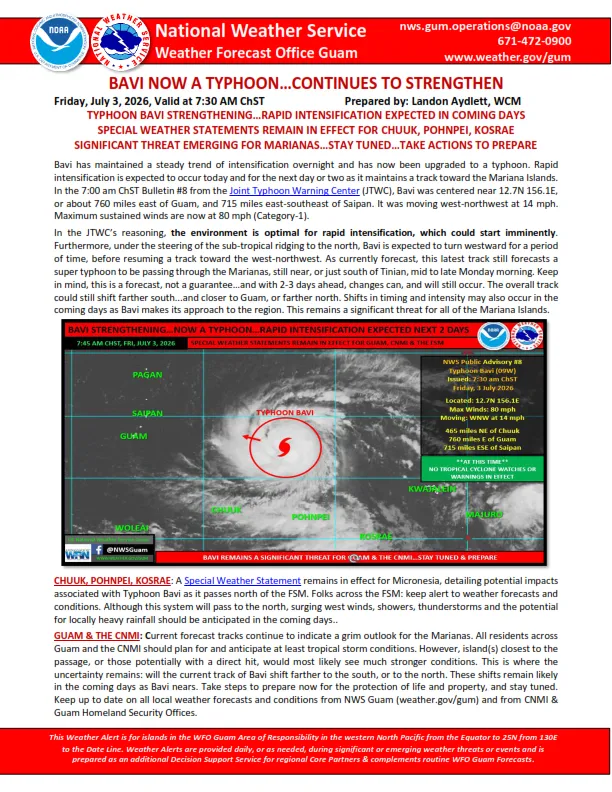
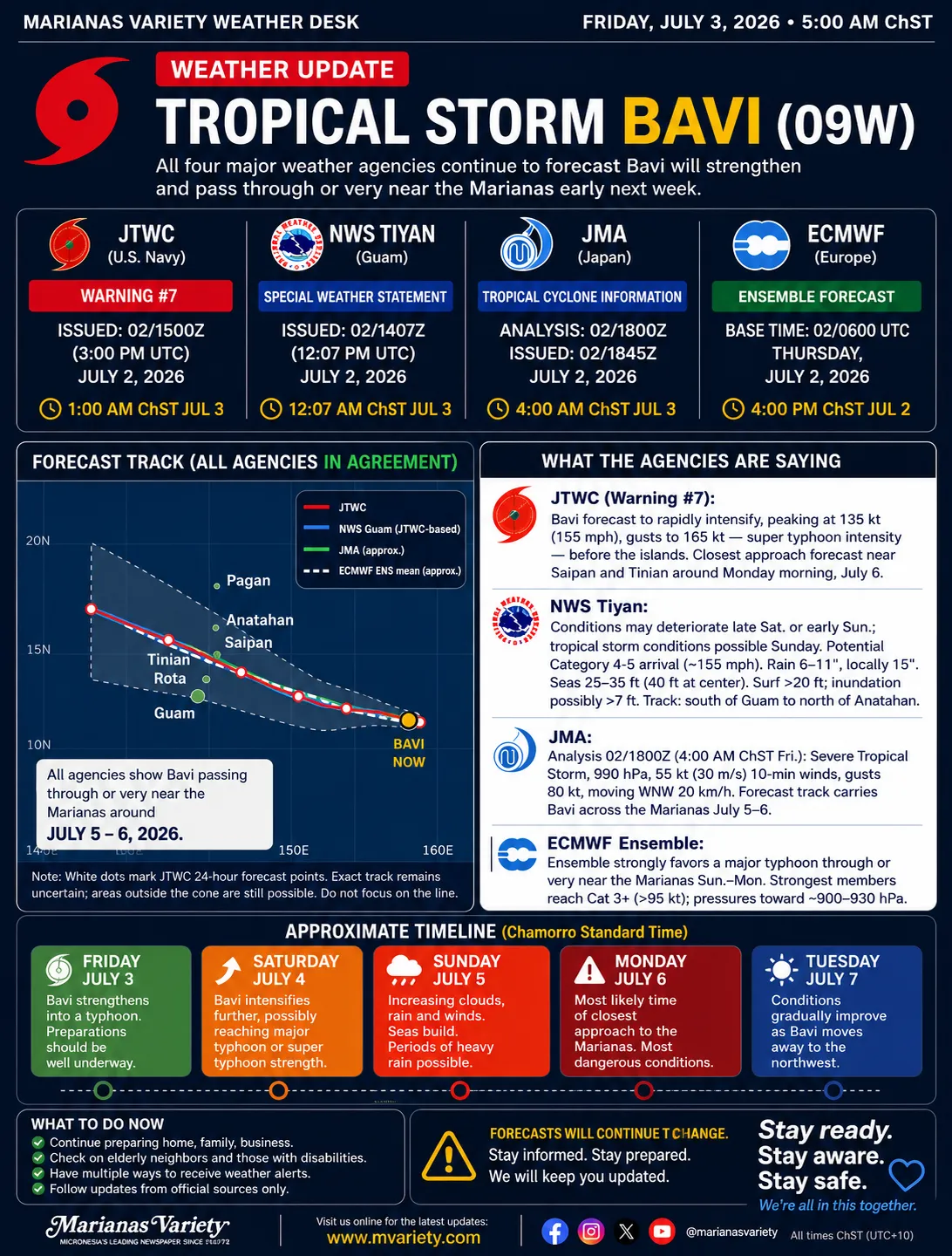
THE Commonwealth Utilities Corporation is racing to secure critical infrastructure, protect newly arrived equipment, and advance Typhoon Sinlaku recovery efforts before Typhoon Bavi reaches the Northern Mariana Islands, a system forecasters now expect to intensify into a super typhoon by late Sunday or early Monday.
“We’re going to continue restoration efforts tomorrow, then shortly thereafter begin our pre-storm preparations,” CUC Executive Director Kevin Watson said during a Thursday afternoon briefing at CUC headquarters. “The storm is now predicted to make landfall Sunday evening, Sunday night or early Monday morning.”
Racing the clock on Sinlaku recovery
CUC reported Wednesday that 71% of Saipan and 73% of Tinian had been re-energized, but Watson acknowledged that Bavi’s arrival will slow the remaining recovery work.
“It definitely is going to delay it because we can’t continue restoration during the typhoon,” he said. “But we will not hesitate — as soon as it’s safe and the all-clear is given, we’ll be out clearing debris and continuing our restoration efforts.”
Guam Power Authority crews that assisted with Sinlaku recovery completed their assignment Thursday and are scheduled to return to Guam on Friday to prepare their own island for the approaching storm. CUC is preparing to request additional GPA assistance should Bavi significantly impact Saipan.
Securing transformers, materials and line crews
CUC received a shipment of new transformers this week, helping address a critical shortage following Sinlaku, and immediately began moving them into warehouses for protection.
“We’re going to move all of our new transformers we just got yesterday inside the warehouse, protecting them from being damaged by the storm,” Watson said.
He said CUC still does not have enough transformers to replace every unit damaged during Sinlaku. Additional shipments are expected weekly from suppliers in South Korea and the U.S. mainland, as well as through FEMA.
“We have got most of our material ordered,” Watson said. “This upcoming storm could increase the amount that we need, so we’ll have to wait and see how much additional damage the new typhoon brings.”
Line crews currently assisting on Tinian will return to Rota to prepare their homes before the storm. Their post-storm deployment will depend on damage assessments across the islands.
“It’s a moving situation and evolving,” Watson said. “Hopefully the typhoon will miss us.”
Power plant vulnerabilities remain
Watson said only temporary repairs have been completed at Saipan’s power plant since Sinlaku, and those measures are unlikely to withstand a super typhoon.
“I wish I could say yes,” he said when asked whether the plant is more storm-resistant. “We’ve only done temporary repairs to reduce and minimize the rainwater coming in, and they will not hold up to a super typhoon. Those temporary repairs will more than likely blow away.”
CUC staff met Thursday morning to discuss additional storm preparations, including reinforcing vulnerable areas within the power plant.
Concrete poles replacing aging infrastructure
CUC continues receiving shipments of concrete utility poles, with more than 600 needed to replace aging wooden poles across Saipan. Manufacturing delays, however, continue because of labor shortages at the supplier.
“They’ve proven themselves in the past,” Watson said of the concrete poles. “But again, I think the wooden poles will probably experience more failures. Some poles that survived the last storm may not survive this time.”
He added that only a few concrete poles failed during Sinlaku, most of them after being struck by debris.
Water system preparations and vulnerabilities
CUC Utility Coordinator Joel Hoepner said the water division’s greatest vulnerability remains the power lines supplying electricity to the well fields.
“If we don’t have wells, we don’t have water,” Hoepner said. “Even though our generators were functioning, we could not get our wells powered up.”
CUC plans to close all reservoirs before the government issues a shelter-in-place order, giving residents and the hospital time to fill their water tanks. Wells will continue operating, even if some storage tanks overflow during the storm.
“We want to make sure that everyone has water for their health and well-being,” Watson said.
Hoepner said CUC may temporarily shut off water service in the Dan Dan tank service area to accelerate filling of the new one-million-gallon concrete storage tank, which the utility hopes to bring online immediately after the storm.
“We’re scrambling to get that done,” he said. “We might have to increase the fill rate. We’re planning on doing that at night.”
Advice to residents: Store water now
Watson urged residents to prepare for the possibility that household water tanks may not survive the storm.
“There’s no guarantee that your individual water tanks are going to survive,” he said. “I’m purchasing several 5-gallon buckets and a large trash can so you can at least have enough water to flush your toilet and bathe.”
Recalling the aftermath of Sinlaku, Watson said he had to carry buckets of water up five flights of stairs.
“I don’t want to do that again,” he said.
Shelters, water stations and portable toilets
CUC is preparing to reopen water stations and deploy portable toilets at the same locations used after Sinlaku. The stations will operate from 7 a.m. to 11 p.m. to help ensure residents have access to water.
“We are already preparing the portable toilets and the shelters and everything pre-storm, ready to mobilize,” Watson said.
Hoping for a faster-moving storm
Watson said Bavi’s forward speed could significantly influence the amount of damage it causes.
“Hopefully, if it does hit us head on, it’s moving at a rate of 12 mph,” he said. “Our last one was moving at 4 or 5 mph, and it just stayed here for two or three days. We don’t want that to happen.”
Bryan Manabat was a liberal arts student of Northern Marianas College where he also studied criminal justice. He is the recipient of the NMI Humanities Award as an Outstanding Teacher (Non-Classroom) in 2013, and has worked for the CNMI Motheread/Fatheread Literacy Program as lead facilitator.
