

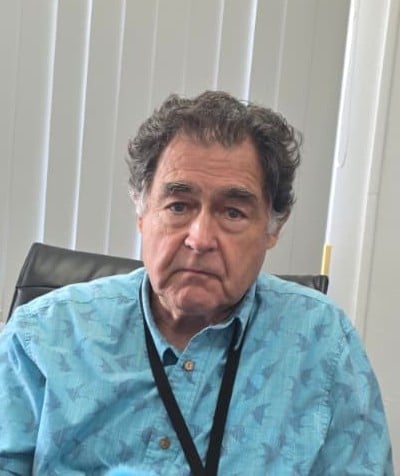


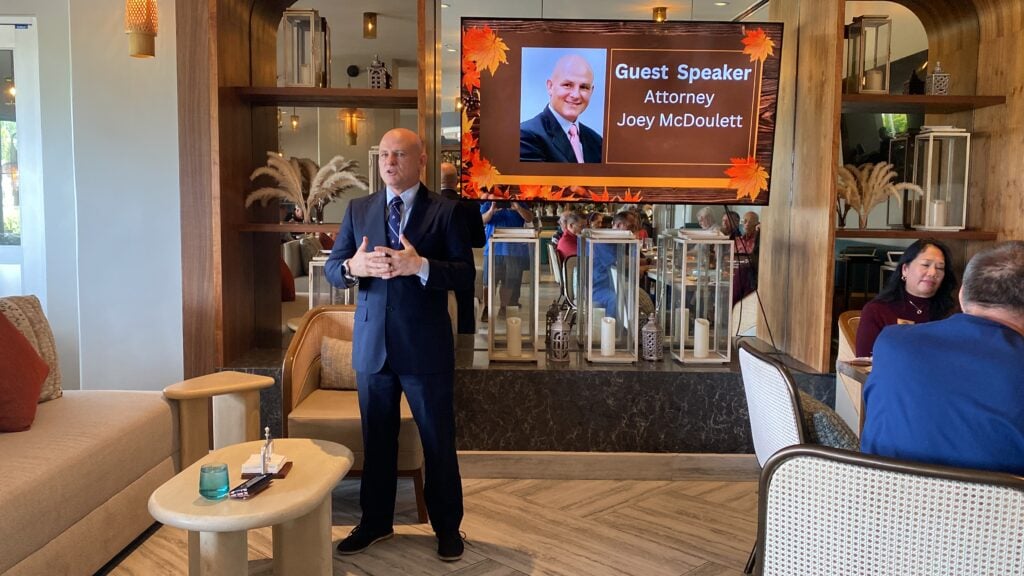
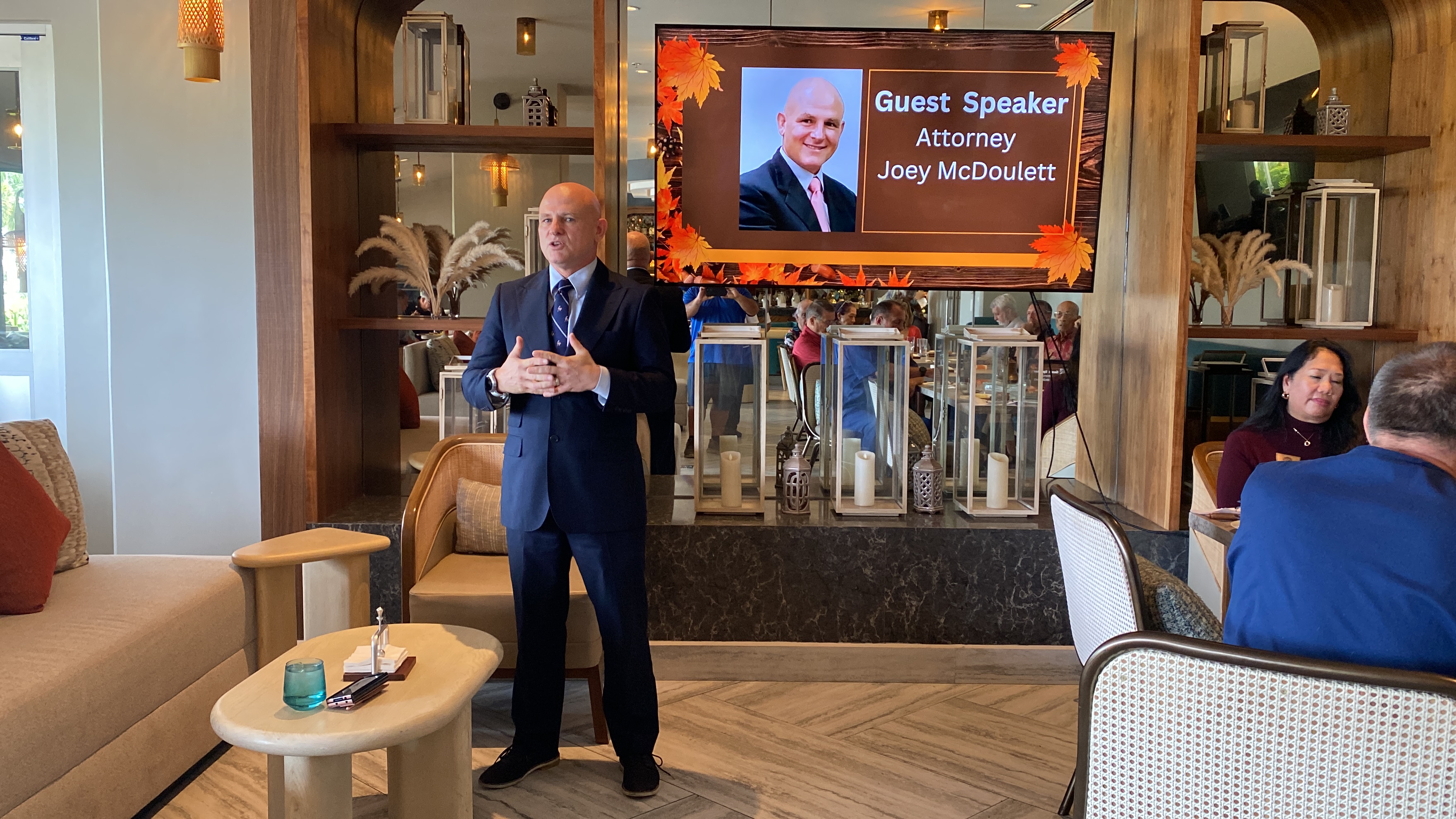
Attorney Joe McDoulett speaks to Rotarians on Tuesday, Nov. 12, 2024.
ATTORNEY Joe McDoulett shared some of his perspectives on U.S. immigration law as guest speaker of the Rotary Club of Saipan at the Crowne Plaza Resort on Tuesday.
He told Rotarians that U.S. immigration law is “complicated,” and individuals and employers should heed the advice of immigration attorneys when they encounter issues pertaining to family or employment immigration.
“People do not believe or understand how complicated [U.S. immigration law] is. It is second only to the tax code in how long it is, how many regulations and statutes it covers,” he said.
He said individuals who oversimplify immigration regulations can fall victim to scams, believing they are eligible for immigration statuses to which they are not actually entitled.
During his presentation, he made a reference to a letter he sent to Variety regarding individuals who were taking the legal advice of “unqualified document handlers and accountants” regarding a “C16 visa,” which does not actually exist.
McDoulett said some level of separation should exist between an employer and an immigration beneficiary in order to prevent misinformation from spreading.
“If your employee comes to you and says, ‘Hey boss I got this problem, what should I do?’ … You must maintain your separation from the employee’s interests, otherwise you’ll just get caught up in giving bad legal advice,” he said.
In such cases, McDoulett said, an attorney is the best person to seek out.
“You can suggest to [the employees that] they can get better advice from somebody that can give it, as opposed to you giving it,” he said.
McDoulett also discussed the CW-1 visa, which grants a nonimmigrant status to its beneficiaries.
He said the CW-1 visa was created in recognition of the fact that the CNMI has a “desperate need for labor” with a local population that is “not sufficient enough to support the labor needs that it has.”
He noted, however, that the U.S. Congress has “always had this very conservative view of immigration.”
“They want to control [immigration],” he said. “They don’t want immigration benefits to be issued to people outside of permanent residents and U.S. citizens.”
He said the U.S. Congress made the CW-1 visa “hard for employers to follow, hard to use to get employees in place” so that employers would instead hire U.S. citizens or permanent residents.
Although options like the H-2B visa exists, they are “expensive.”
“I don’t know if Congress is going to listen [to the CNMI’s labor needs]. I don’t know if in the next four years our ability to expand CW or push it past December of 2029 is going to be available to us,” he said.
McDoulett highlighted how crucial it is to be entirely truthful in immigration paperwork.
He said false information presented to U.S. Citizenship and Immigration Services might make someone eligible for deportation.
McDoulett mentioned a person who was born in Greece, had a birth certificate, and later moved to the Philippines and acquired a different birth certificate. Both certificates contained different dates of birth. He said it would be important to share that sort of information with an attorney.
“The … most important thing for anybody to do is always to be completely truthful,” he said. “There are usually ways to get past some of the things they would automatically flag you for inadmissibility. There are waivers, but you can’t get those waivers unless you tell the truth.”
McDoulett said the incoming Trump administration is “not a fan of immigration in general.”
However, although President-elect Donald Trump has vowed to deport millions of undocumented immigrants, McDoulett is not sure how feasible that would be in the CNMI.
He said a “conservative estimate” of undocumented immigrants in the CNMI might be around 10,000.
“This idea that we could round up everybody that’s undocumented and deport them is unrealistic for a couple of reasons, mostly because of money,” he said.
He said the CNMI Department of Corrections will not able to handle that many detainees and the CNMI government itself does not have enough staff.
Moreover, he said, the U.S. and China do not have a diplomatic agreement in place “that permits the United States to put people in custody on planes to be deported to China.”
The result will be undocumented detainees in political limbo, he said.
“Until that’s sorted out, if the idea is that we will detain until deportation, then those people will be stuck in jail for essentially however long it takes,” he added.
