



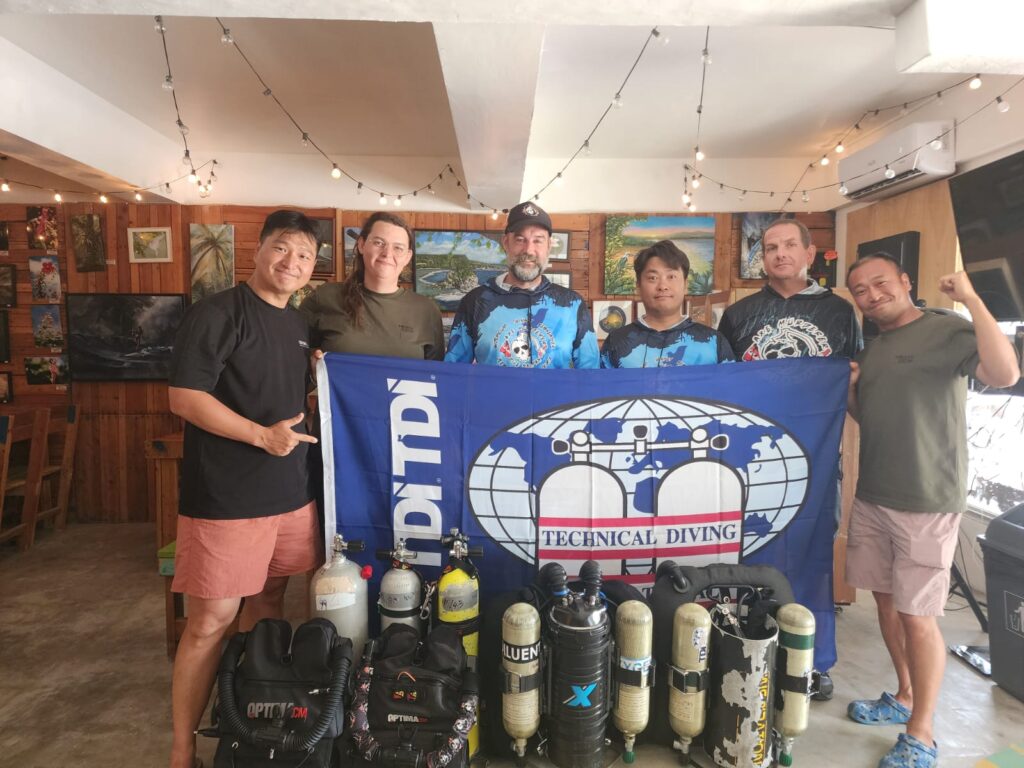
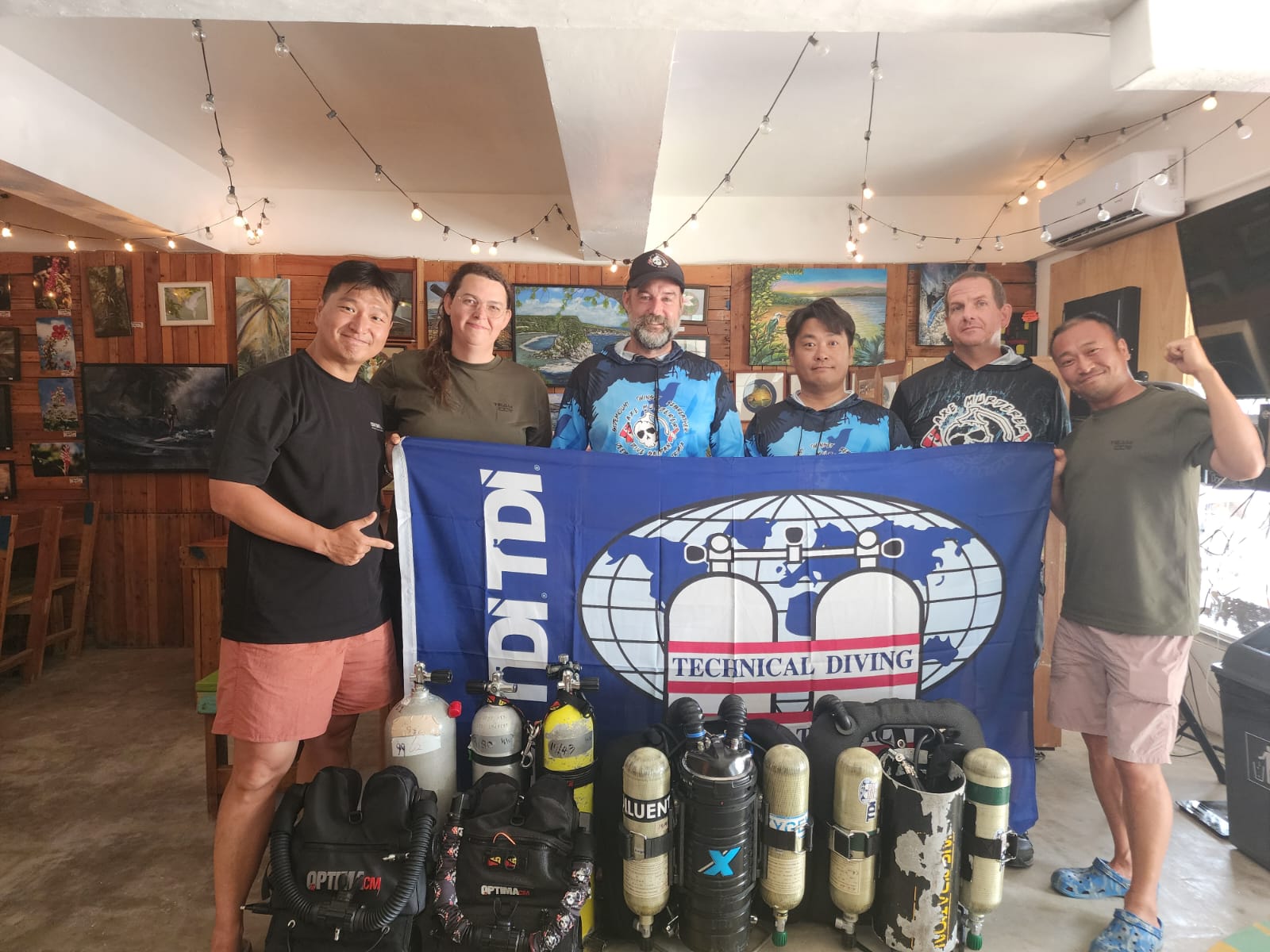
Divers Jay Wolfe, Jessykah Bird, Harry Wilcox, Jung Hoon Park, “BK” Seung Kyoon Baek and “Steve” Seung Hun Cho pose for Variety.
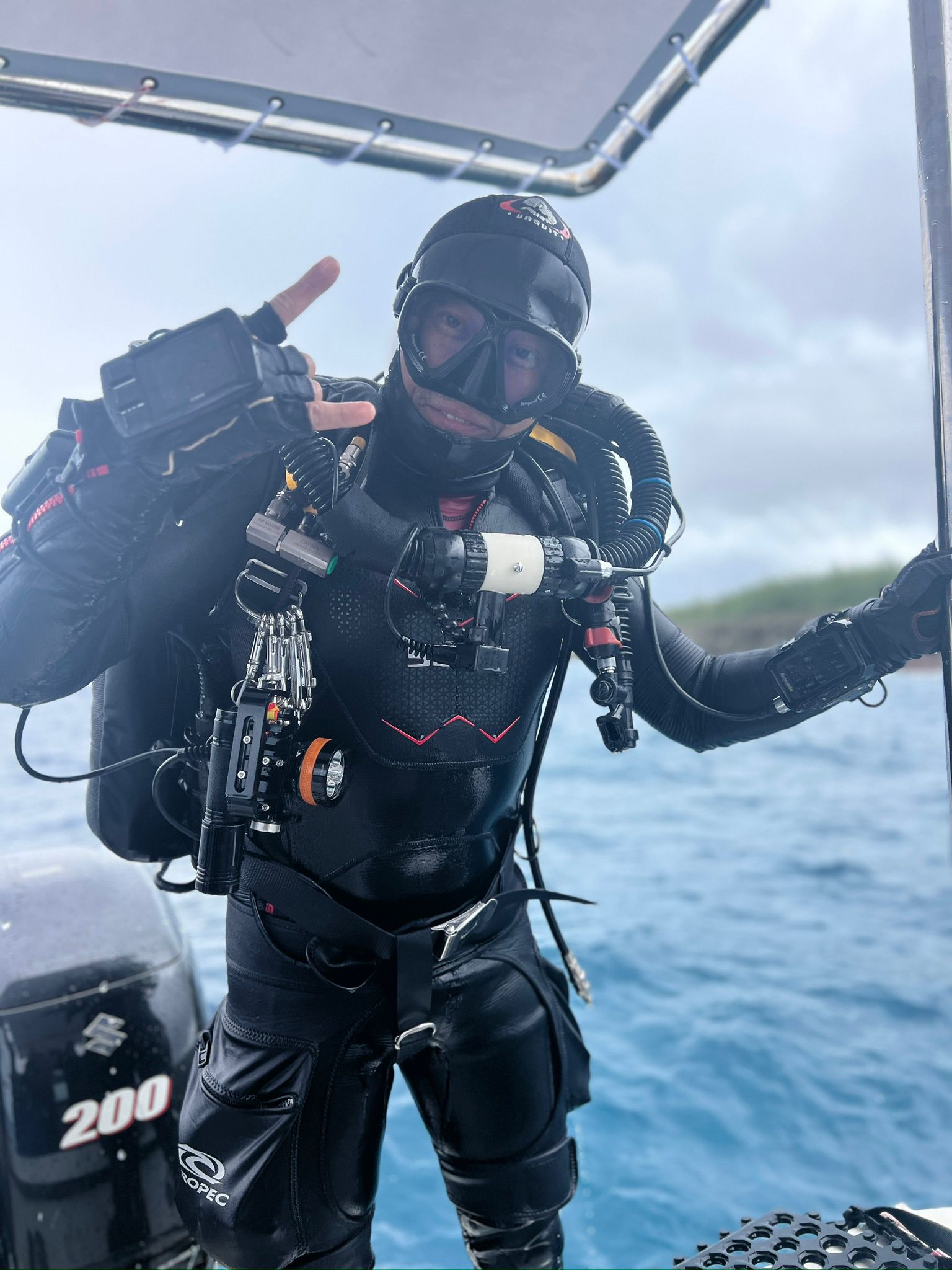
“BK” Seung Kyoon Baek surfaces after his record-setting dive to 114 meters.
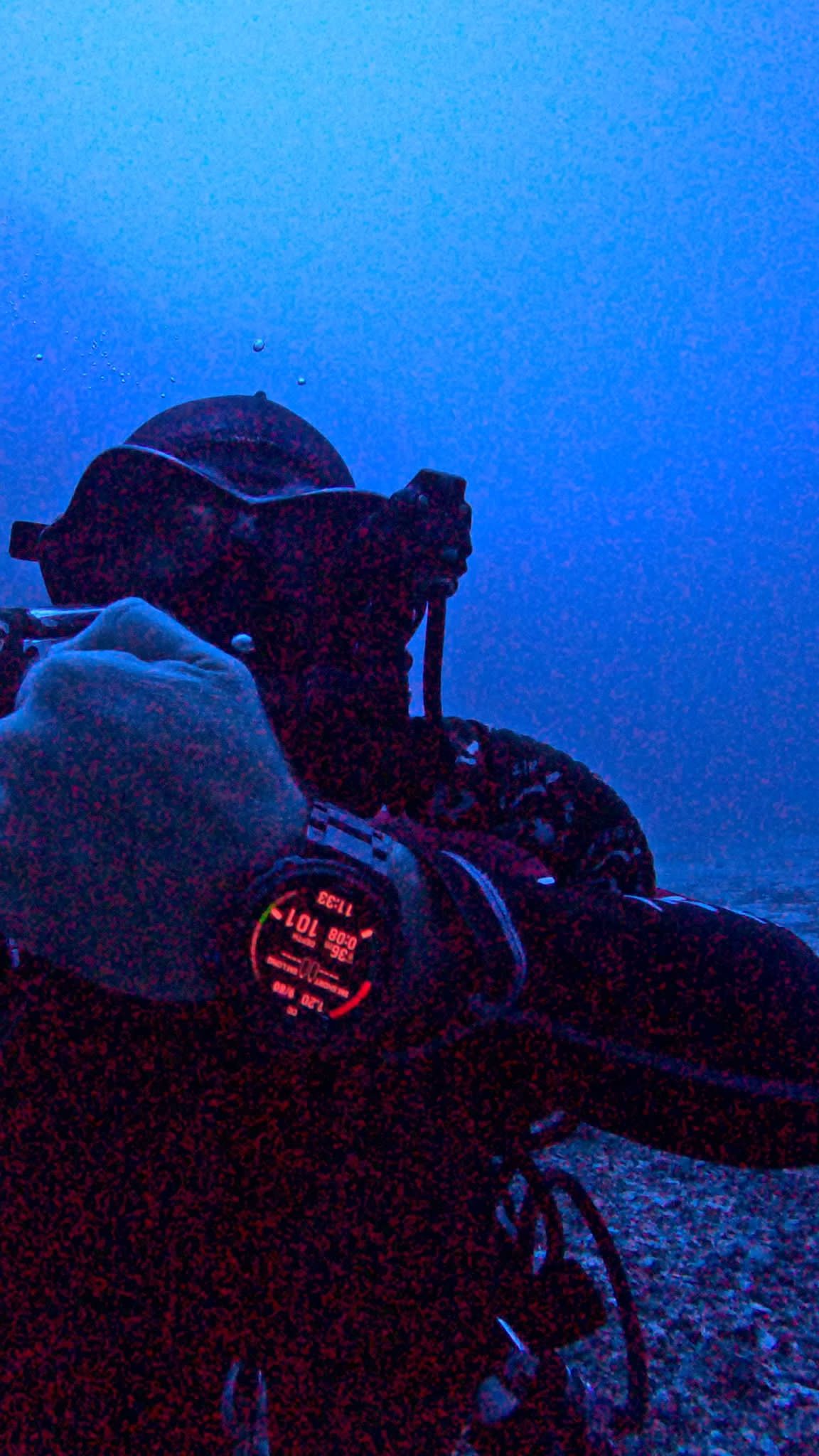
Axe Murderer owner Jay Wolfe takes a selfie at 101 meters.
SIX divers set a CNMI record by reaching a depth of more than 100 meters (328 feet).
“It’s the first CNMI deep dive record as far as we know,” Axe Murderer Tours owner and operator Jay Wolfe said in an interview.
Besides Wolfe, the other divers who reached the 100-meter depth were Jessykah Bird, Harry Wilcox, Jung Hoon Park, “BK” Seung Kyoon Baek and “Steve” Seung Hun Cho.
According to Wolfe, for recreational dives, “99% of the dives that are done in the world are about 20 meters.”
“The recreational depth limit is 40 meters for recreational dives, and the reason for that is for safety … but with the appropriate training, divers can go deeper. And that’s something we’re offering here. But to reach 100 meters, which is the highest level of certification, you must work slowly, and it’s learning about using the right gases and how to manage any problems that might come up,” he said.
Wolfe said all of them reached the 100-meter depth, but BK reached an actual depth of 114 meters on Aug. 21, and Steve was the first of the six divers to reach the 100-meter depth on Aug. 20.
Wolfe also acknowledged their boat captain, Yoshinari Izuka, and two other support divers, Logan Anderson and Hyen Jae Jo.
“Our boat captain Yoshinari Izuka, Saipan’s dive encyclopedia, gave us a lot of ideas about different sites that he had visited, and some efforts by Japanese technical divers reaching deeper depths in the Marianas, but as far as we know, no one has reached 100 meters using a Closed-Circuit Rebreather or CCR system and using the right gases,” Wolfe said.
“Yoshinari gave us some ideas he thought would be good areas for attempting new depth records in the CNMI, and then I talked to Jung Hoong Park from team CCR Korea whom I’ve known for a while and we came up with the idea to get together. A group of divers who wanted to try to reach 100 meters.”
Wolfe said the CNMI “is known for its Marianas Trench — everyone should assume there’s deep diving available here. It’s easy to reach deep depths here, and there are many sites that are good places for that kind of diving. It took a lot of planning to acquire the right gases and to find the right time that would be good for the right water conditions and to bring together our whole group, which is a group from Korea and from the United States to do this. Because it takes not only the people doing the diving but also a lot of support from the boat and the other divers to do this type of diving safely,” Wolfe added.
He said their group initially conducted check dives, and dove slowly with the goal of reaching a depth of 100 meters.
“It’s a long process, slowly working your way down,” Wolfe said.
Specialized equipment
Wolfe said for the dive they used a Closed Circuit Rebreather system: Dive Rite O2ptima CM, AP Diving Inspiration Evo, and IQSub XCCR.
“It’s a diving system that cleans your air and gives you a better gas mix, depending on the depth, so it has much more variation. It allows us to go deeper more safely,” he said.
As for the dive itself, they chose a Tinian site.
“We did several dives, exploring deeper and checking out all our equipment, you know, same procedure as regular diving, where I check for leaks and make sure that the arrows for the equipment [are] working well before we start to go deeper,” Wolfe said. “We dove … in the Saipan western dive sites, the western lagoon, and also in the northern sites. Then we focused on the Tinian dive sites. Because Yoshi told us there was the possibility of reaching deep depths in the area, what we did was we started exploring each day just a little bit deeper and checking out the dive side, making sure it’s appropriate for our record-setting dive,” Wolfe said.
He said their group saw World War II wrecks and deep caves.
As they went deeper, Wolfe said they realized that “no one has [probably] been there [and] it’s special just by going to some place that maybe no one has ever seen. We were visited by a lot of different fish species while we were down there, and they’ve never seen a person either. We haven’t seen them; they haven’t seen us. So they are coming up and saying hello, so we took some pictures and video and just seeing the coral down there that’s still very healthy, and there’s a lot of it. The CNMI’s really a nice place to do this type of diving because the surface water temperature is very high and even at the deepest part, it’s still comfortable.”
One of the divers, Jessykah Bird, said she learned diving in Korea.
“That’s how I met team CCR Korea,” she said. “And I worked with them a bit as I do cave exploration, too. That’s been more of my focus. However, anytime you go somewhere new that no one’s ever been, there’s a planning component to it because you don’t know what to expect — if the ground’s going to keep going, and you don’t know if suddenly there’s an undercurrent. So there’s always a bit of apprehension but also a little bit of excitement to discover something new, something unique or something that can become useful, either to the scientific community in the area or even just tourism, in general.”
“The feeling in that depth is totally the same as in shallow water,” Jung Hoon Park said. “We made many dive practices, slowly increasing the depths, so that everybody can feel comfortable. It was not scary or surprising, just that we enjoyed it. We reached it, this is great, and safe, we were happy.”
Park added, “There’s a lot of recreational diving on Saipan but less technical diving. Hopefully this deep dive that we have done can encourage more technical diving here.”
BK, through a translator said, “We did a lot of practice and finally we did it!”
Steve, speaking through a translator, said: “It’s my first time in Saipan, and my first time diving that deep in the CNMI. It’s a group effort, I’m happy.”
