




HAGÅTÑA (The Guam Daily Post) — The U.S. Environmental Protection Agency has announced the completion of the nation’s first enforceable standards for per- and polyfluoroalkyl substances, known as PFAS, in drinking water. The U.S. EPA first announced proposed maximum contaminant standards for six types of PFAS about a year ago. Before these new regulations, the federal agency had been publishing unenforceable health advisories for certain types of PFAS.
Also known as “forever” chemicals because their components break down very slowly over a long period of time, PFAS substances can be found in various products as well as in food and the environment, including in drinking water, according to the U.S. EPA. Exposure to certain levels of PFAS may lead to various adverse health impacts, including increased risk of certain cancers.
The substances first made headlines on Guam several years ago, when local media reported that certain water wells yielded concentrations of perfluorooctanesulfonic acid, or PFOS, a type of PFAS, that exceeded a lifetime health advisory set at the time by the U.S. EPA.
“This final rule represents the most significant step to protect public health under EPA’s PFAS Strategic Roadmap. The final rule will reduce PFAS exposure for approximately 100 million people, prevent thousands of deaths, and reduce tens of thousands of serious illnesses,” a press release from the U.S. EPA stated.
Sen. Sabina Perez, head of the legislative committee on environment, said the new regulations represent a significant step forward “in the fight for a safer, healthier future” and congratulated President Joe Biden’s administration for strengthening regulatory protections.
But she added that it was only the first step to addressing PFAS entirely. The next would be to ensure that Guam “expeditiously” meets and maintains the new standards and is equipped to achieve and maintain compliance.
“(Guam Waterworks Authority and Guam Environmental Protection Agency) will need our support in the upcoming years to accomplish this and to protect our community from the overwhelming harm of PFAS contamination,” Perez said.
Under the new regulations, the U.S. EPA is setting individual enforceable maximum contaminant levels at 4 parts per trillion for PFOS and perfluorooctanoic acid, or PFOA. The agency is also setting maximum contaminant level goals, a nonenforceable health-based goal, at zero for PFOS and PFOA.
For some other types of PFAS – PFNA, PFHxS, and “GenX Chemicals” – U.S. EPA is setting maximum contaminant level goals and maximum contaminant levels at 10 parts per trillion.
“Because PFAS can often be found together in mixtures, and research shows these mixtures may have combined health impacts, (U.S.) EPA is also setting a limit for any mixture of two or more of the following PFAS: PFNA, PFHxS, PFBS, and ‘GenX Chemicals,’” the U.S. EPA release stated.
Implementation period
All public water systems will have three years to complete initial monitoring for the newly regulated chemicals. They are required to inform the public of the PFAS level measured in the drinking water. When PFAS is found at levels exceeding standards, water systems must implement solutions to reduce PFAS in the drinking water within five years.
Guam EPA will be responsible for ensuring that Guam’s public water systems comply with the new rule, according to Public Information Officer Nic Rupley.
Perez said it was important to note that the new regulations address six PFAS chemicals out of a family of thousands, for which toxicology studies would still need to be conducted before they too are regulated.
“For the greater protection of our people and island, it is important that we transition towards the precautionary principle in which chemicals are tested to ensure its safety before publicly used, to identify and mitigate sources of PFAS in the environment and working towards eliminating it from firefighting foam and consumer goods altogether,” Perez added.
Treatment
GWA has installed PFAS treatment systems at a few locations on the island but had been anticipating more mitigation needs in light of these new federal standards. Post files state that GWA identified 34 water wells that may need treatment to comply with new PFAS regulations.
GWA has drafted a five-year plan, for fiscal years 2025 through 2029, part of which considers capital improvement projects for regulatory changes addressing emerging contaminants, including PFAS. This plan proposes various rate increases over the five-year period to help fund CIPs.
Public input on the PFAS regulations did include concerns over challenges that rural water systems could face in implementing treatment technologies or covering analytical costs.
Specifically, the Silent Spring Institute, a nonprofit research organization, noted that water systems on Saipan and Guam faced challenges with treating and monitoring for PFAS partly due to the rural and isolated nature of those systems. This emphasized the need for the U.S. EPA to ensure equitable implementation and to plan support for communities that “bear the brunt of PFAS contamination, cleanup and remediation,” according to the organization.
Grants allotted to Guam
In addition to announcing the new PFAS regulations, the U.S. EPA announced nearly $1 billion in newly available funding through the Infrastructure Investment and Jobs Act, also known as the Bipartisan Infrastructure Law, to help states and territories implement PFAS treatment and testing.
The Emerging Contaminants in Small or Disadvantaged Communities grant program, as the name implies, is meant to support public water systems in small or disadvantaged communities to address emerging contaminants, including PFAS.
“EPA is announcing an additional nearly $1 billion in funding through President Biden’s Investing in America agenda to help 56 states and territories which can be used for initial PFAS testing and treatment at both public water systems and for homes served by privately owned wells,” the U.S. EPA website on the grant program stated.
“EPA awards funding to states based on an allocation formula that includes factors such as population, number of water systems, and data related to emerging contaminants,” the website added.
The grant program’s annual appropriation is $1 billion for each fiscal year from fiscal 2022 through fiscal 2026. The Feb. 13, 2023, allotment memo shows that nearly $19 million was allotted to Guam for fiscal years 2022 and 2023 combined.
The fiscal 2024 allotment memo, dated April 10, shows $9.4 million allotted to Guam for the fiscal year.

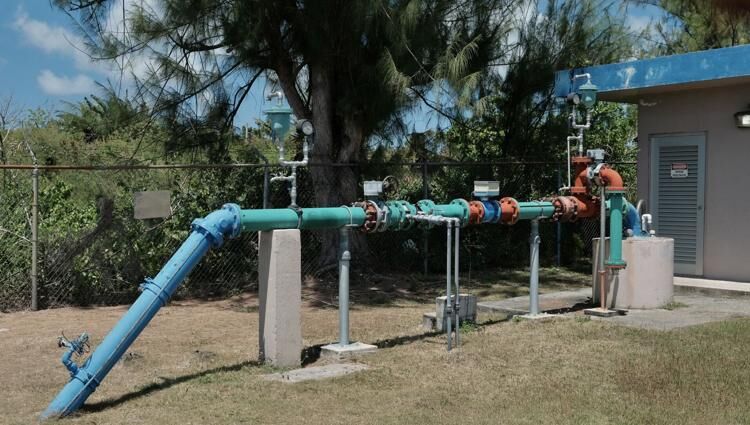
The Guam Waterworks Authority M-18 water well in Harmon on Tuesday, March 19, 2024.
