




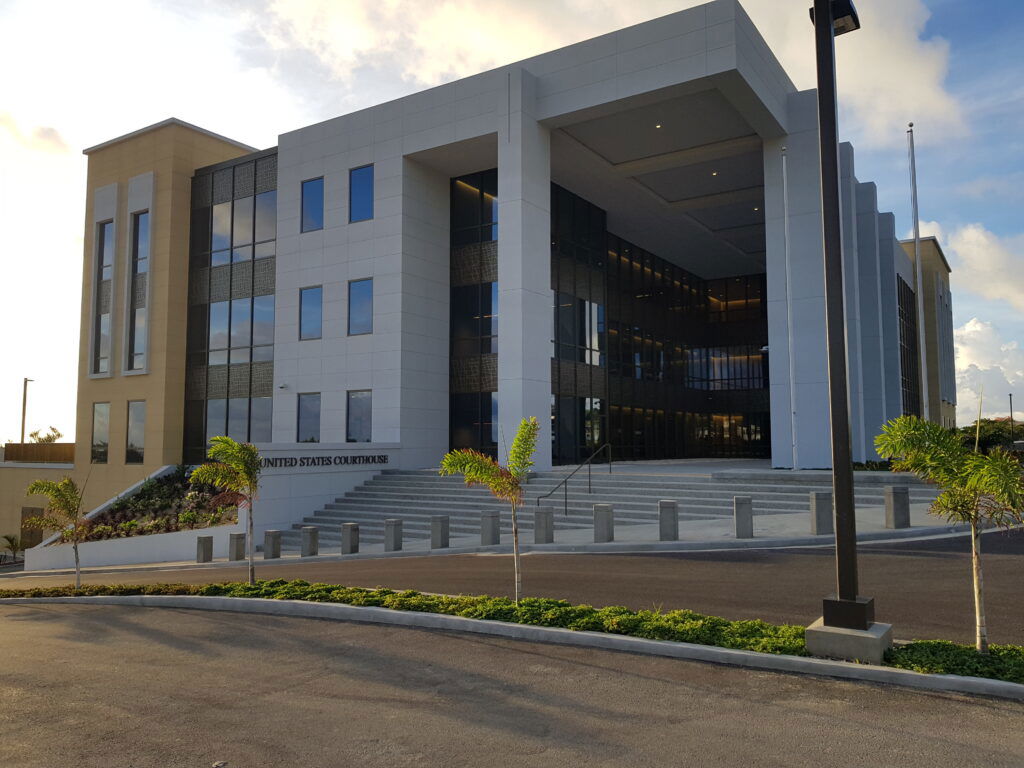
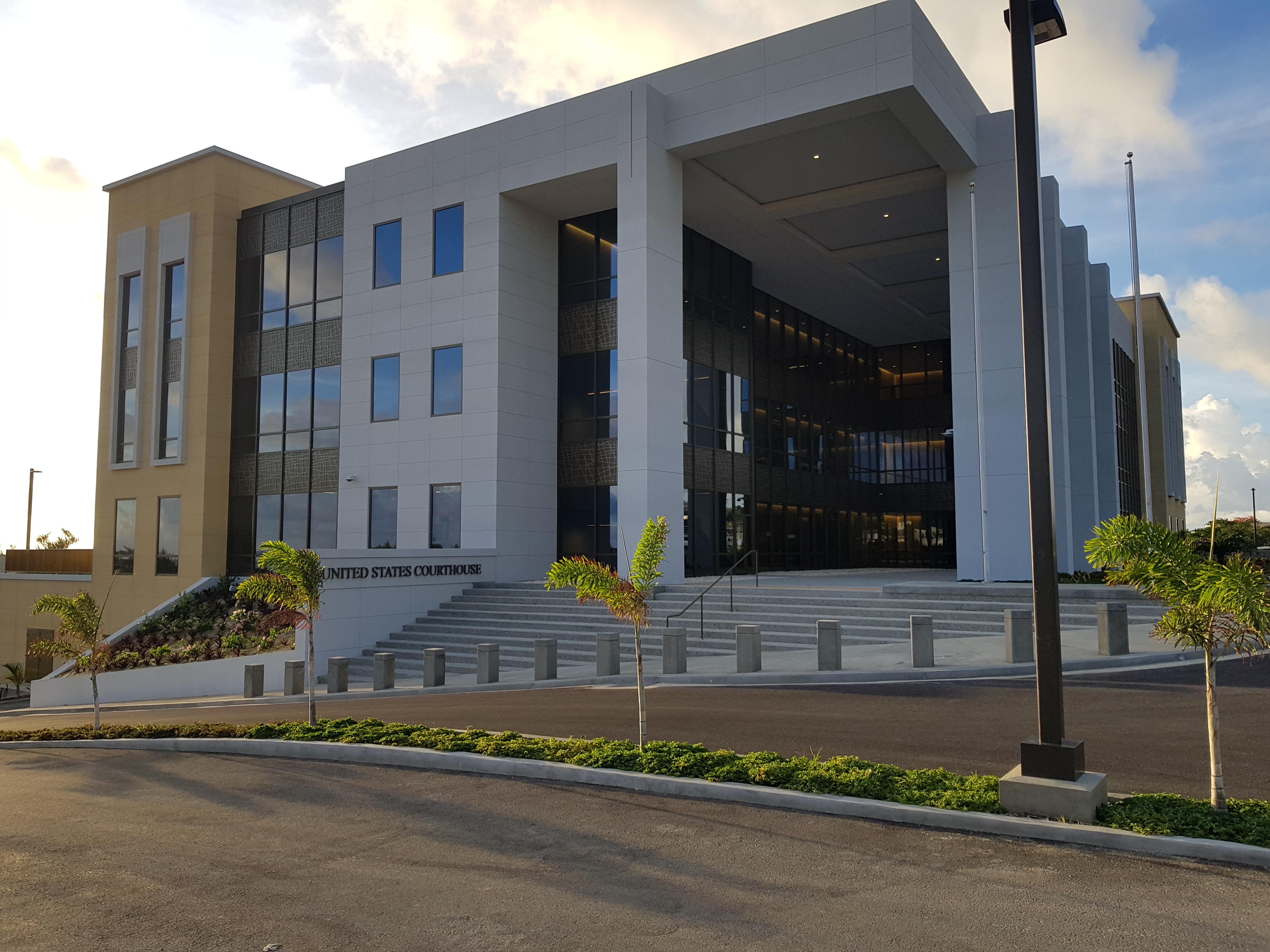
The United States Courthouse in Gualo Rai, Saipan.
IMPERIAL Pacific International has filed a second emergency temporary restraining order in federal court to stop the Commonwealth Casino Commission’s revocation hearing set for April 2.
IPI also asked the court to set an early hearing on whether the TRO should be converted into a preliminary injunction.
IPI, through attorney Michael Chen, requested the District Court for the NMI to issue an order restraining CCC from deliberating and voting on the charges filed by its executive director to revoke IPI’s casino license.
The emergency TRO named Gov. Arnold I. Palacios, CCC Chair Edward C. Deleon Guerrero, Commissioner Rafael S. Demapan, Commissioner Ramon M. Dela Cruz, Commissioner Mariano Taitano, Commissioner Martin T. Mendiola and Executive Director Andrew Yeom as defendants in their personal and official capacities.
“This relief is necessary to preserve the status quo pending adjudication of IPI’s important claims (presently pending in this court),” Chen said.
He added, “The revocation hearing conducted by CCC between February 28, 2024 and March 1, 2024, after the federal court denied the emergency motion for a TRO filed by IPI on February 27, 2024, violated the due process rights of IPI guaranteed by the U.S. Constitution and the Constitution of CNMI because four of five commissioners, with the exception of Chairman Guerrero, acted as the hearing officers in quasi-judicial capacities, and they have a material, direct, personal and pecuniary interest in the outcome of the proceedings.”
Functioning in quasi-judicial capacities, the four hearing commissioners had prior knowledge of and involvement with the underlying claims, therefore it would render the revocation hearing as a “mistrial,” Chen said.
“CCC, as currently constituted by the five commissioners, lacks the institutional capacity and resources to adjudicate the defenses raised by IPI where the constitutionality of CNMI statutes is at issue,” he added.
“All five commissioners cannot function as impartial decisionmakers when deciding on the constitutionality of the underlying regulatory fee statute and regulations because their personal, professional and political interests are at stake,” he said.
Moreover, CCC, acting through the five commissioners, does not have jurisdiction to adjudicate the defenses raised by IPI where the interpretation of the casino license agreement is at issue, the lawyer said.
According to Chen, “Under 4 CMC § 2314 (h), suspension and revocation of casino license, unanimous vote of all commissioners is required.”
He said if the five commissioners proceed with the deliberation and decision currently scheduled for April 2, 2024, the revocation of IPI’s license would be a virtual certainty because it would be “professional suicide” for the five commissioners to decide otherwise, Chen said.
“Plaintiff’s fundamental rights guaranteed by the Constitution will suffer irreversible harm,” he added.
“Given the imminence of the deliberation and decision to be conducted by the five commissioners of CCC on April 2, 2024, Plaintiff is unlikely to receive a hearing by this court on these questions until long after its license is revoked, its billion-dollar investment is shuttered, and its own solvency put at grave risk. The anticipated $300 million investment aimed at revitalizing the gaming industry in CNMI will be jeopardized, and the economy of CNMI will suffer harm,” Chen said.
Prior to the shutdown of its business due to Covid-19, IPI had 1,093 employees and had an annual payroll of over $54 million, Chen said.
“Based upon the projection of the HR director of IPI, Mr. Howyo Chi, as of March 1, 2024, IPI had 14 active employees, with 345 employees currently on furlough,” Chen said.
“It is estimated that at least one third of the furloughed staff remain on the island and are prepared to return to work. Additionally, numerous inactive former employees of IPI have personally expressed interest in returning to work,” he added.
Based on its “Casino Re-Opening Labor Headcount Forecast,” IPI will have a total headcount of 481 within one year after reopening, based on a conservative estimate of operation success, Chen said.
“There is no question that an injunction to prevent the five CCC commissioners from deliberating and voting on the revocation hearing does not mean IPI will be able to reopen its business without a lift of the suspension currently in place. However, it would level the field and allow IPI and CCC to resume the settlement discussion for lifting the suspension, where the gap was very narrow prior to the revocation hearing,” Chen added.
He said issuing a TRO strongly furthers the public interest in preserving the CNMI economy.
“The anticipated financing by Kyosei Bank Corp. will allow IPI to satisfy its creditors, resume operations, and restart construction. A TRO barring the deliberation and voting of the revocation hearing would allow IPI and the Executive Director of CCC to continue their settlement discussions and provide a levelled playground, which would allow the infusion of capital to resume IPI’s business operation and restart the construction. The resumption of its business operations will create jobs for the local economy, increase CNMI’s tax revenues as well as enable IPI to pay fees due to CNMI going forward while the Parties litigate whether the annual regulatory fee is constitutional and the outer boundary of CCC’s regulatory powers,” Chen added.
He said the public interest favors enjoining the commissioners to deliberate and vote on the revocation hearing to preserve the status quo.
IPI’s previous TRO motion to stop the Feb. 28 revocation hearing was denied by designated Judge David O. Carter.
On April 2, 2024, CCC will deliberate and decide whether or not to revoke IPl’s exclusive casino license.
During the revocation hearing earlier this month, IPI submitted a settlement agreement under which it would pay $31 million for its arrears and $16 million for the lifting of the license suspension. IPI said it would also give up the exclusivity of its gaming license.
Gov. Arnold I. Palacios has said that he rejected IPI’s settlement proposal because the casino investor wanted to pay only $15 million of the more than $60 million it owes the Commonwealth in arrears.
According to CCC, IPI owes the CNMI government over $62 million in annual exclusive casino license fees and over $17.62 million in regulatory fees plus fines and penalties, for a total of $79.63 million. IPI was unable to meet its obligations to the CNMI government after its casino ceased operations due to the onset of the Covid-19 pandemic in March 2020.
