







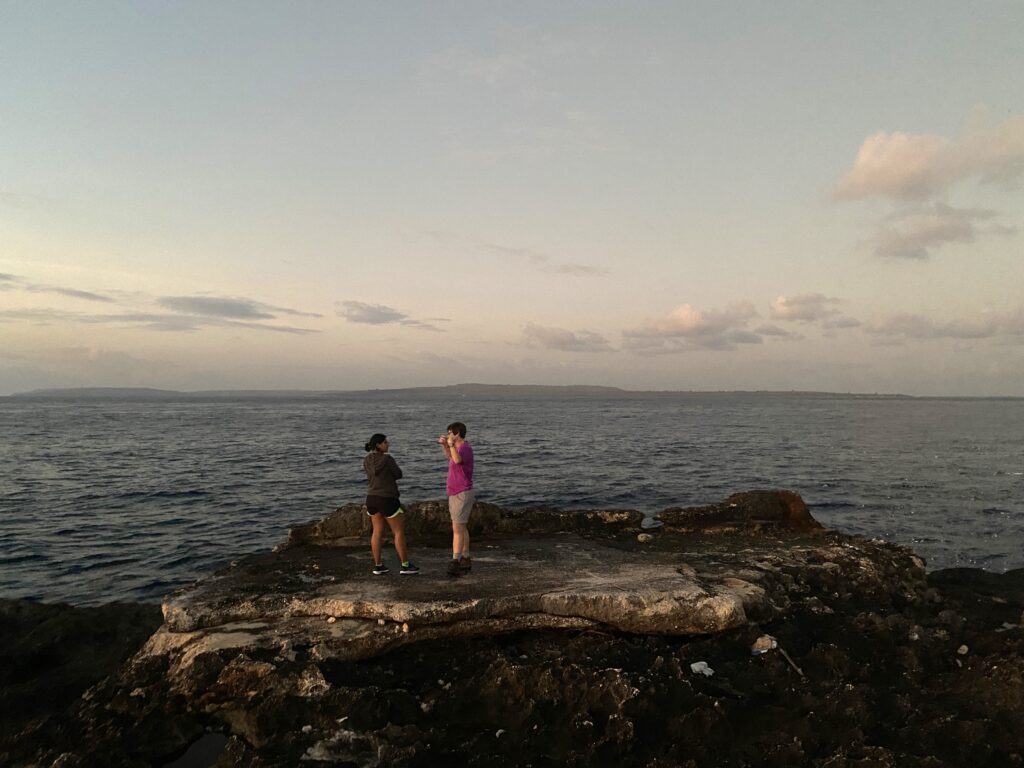
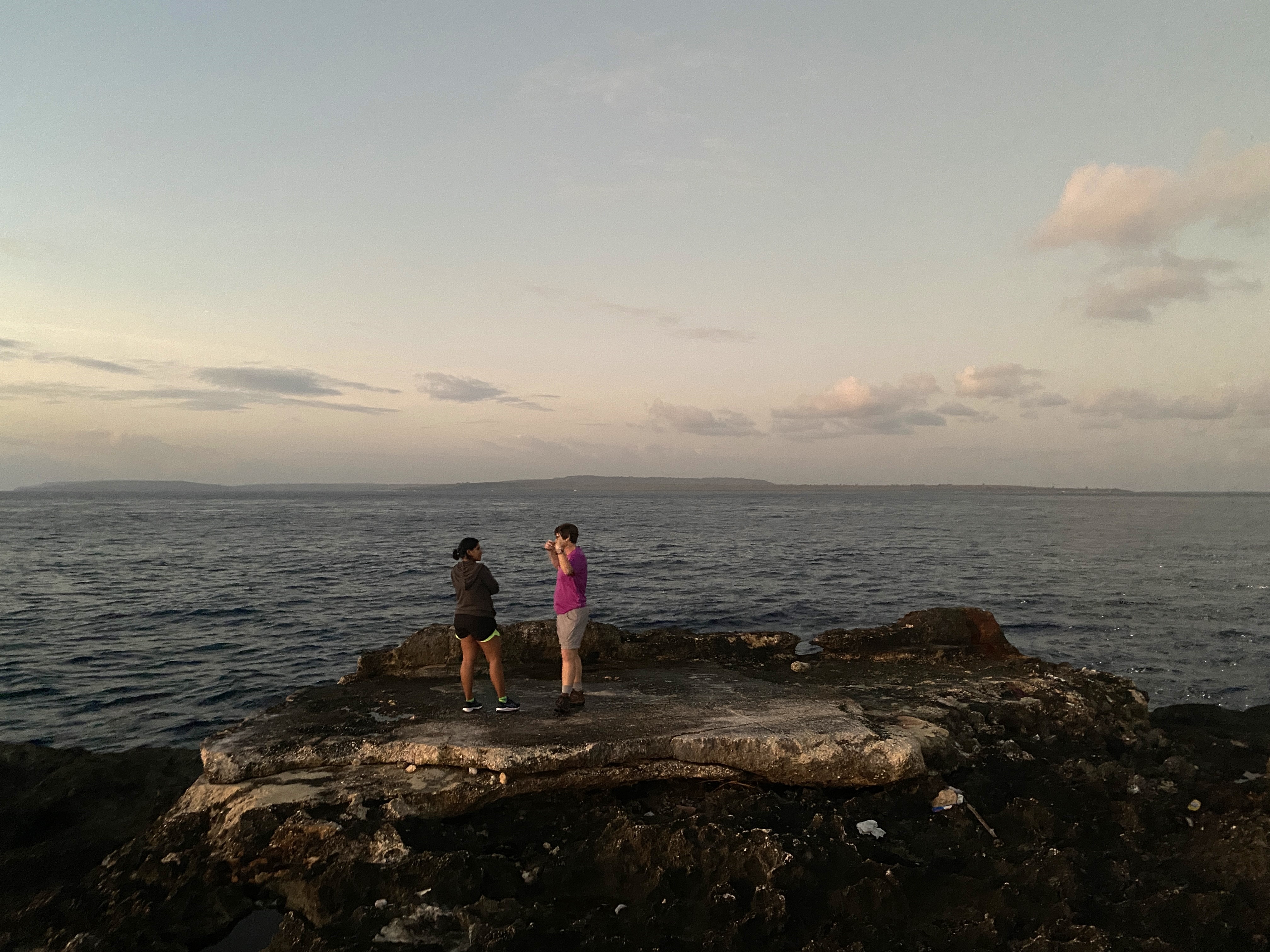
With Tinian as a backdrop, volunteer Mahi Puri talks with natural resources specialist Jill Liske-Clark at Agingan Point during the Third Annual Saipan Fanihi Count on Wednesday morning.
THE Third Annual Saipan Fanihi Count started during the predawn hours of Wednesday, Feb. 28.
The event coincided as a field trip for the participants of the Mariana Islands Conservation Conference, and its goal was to conduct an assessment of the fruit bat or fanihi population on Saipan.
Volunteers were asked to record the number of bats seen by time and the general direction the bats were flying in.
There were 19 survey sites spread out across the island, including those in Marpi, Kagman, Capital Hill, Mount Tapochao and Naftan.
Variety was with Jill Liske-Clark, a natural resources specialist, at Agingan Point.
The surveys ran from 4:30 a.m. to 6:30 a.m.
At Agingan, Liske-Clark said the “best guess” is that there are “50 to perhaps 100” fanihi on Saipan.
On Tinian, where a fanihi count will take place on Feb. 29, the current estimates place the number of fruit bats at around 55.
Liske-Clarke said Aguiguan has around 50 fanihi that form a colony.
At Agingan, Liske-Clarke and volunteer Mahi Puri wanted to see if fruit bats could be spotted flying between Saipan and Tinian. (Variety did not witness any fanihi flying between Tinian and Saipan.)
“We know they go between islands,” Liske-Clarke said. “That’s how they spread all the way from Guam to Asuncion.”
The annual counts on Saipan and Tinian have helped identify fruit bat colonies on both islands. For Liske-Clarke, the counts are good news.
“It’s really exciting for me. I’ve been in the Marianas 10 years now…. [Fruit bats] showed up on Guam at Andersen Air Force Base maybe seven or eight years ago, and they showed up on Saipan three or four years ago, and on Tinian a couple of years ago. It could be longer, that’s just when they were first detected, but conservation is what I do and I genuinely feel like we are at the beginning of fanihi recovery.”
She added, however that the species has not yet reached sustainable population numbers, but the “trajectory is positive.”
She said there are “gaps” in the scientific knowledge regarding the interisland travel of fruit bats. Additionally, studies are being conducted to analyze where fruit bats collect most of their calories or what types of food are “healthiest” for them.
Liske-Clarke said fruit bats are important dispersers of seeds.
“There are certain trees…, certain native species [and] the seed is really too big for any bird to spread [it]. We kind of know that it has to be the fainihi that’s moving it around,” she said.
A connection can also be made between seed dispersers like the fanihi and healthy reefs, she added.
“It’s kind of a circle of life,” she said. “[Fruit bats] eat the fruits and seeds of these native trees, but then they can fly long distances and basically plant that seed somewhere else and keep our native forests going. The forests are obviously critical for biodiversity, but they’re also critical in protecting our ecosystem. They hold the soil in place so we have less sediment run off into the lagoon. Healthy forests mean healthy coral reefs — it all goes together.”
Data from the fanihi count was still being compiled as of press time Wednesday evening.
