






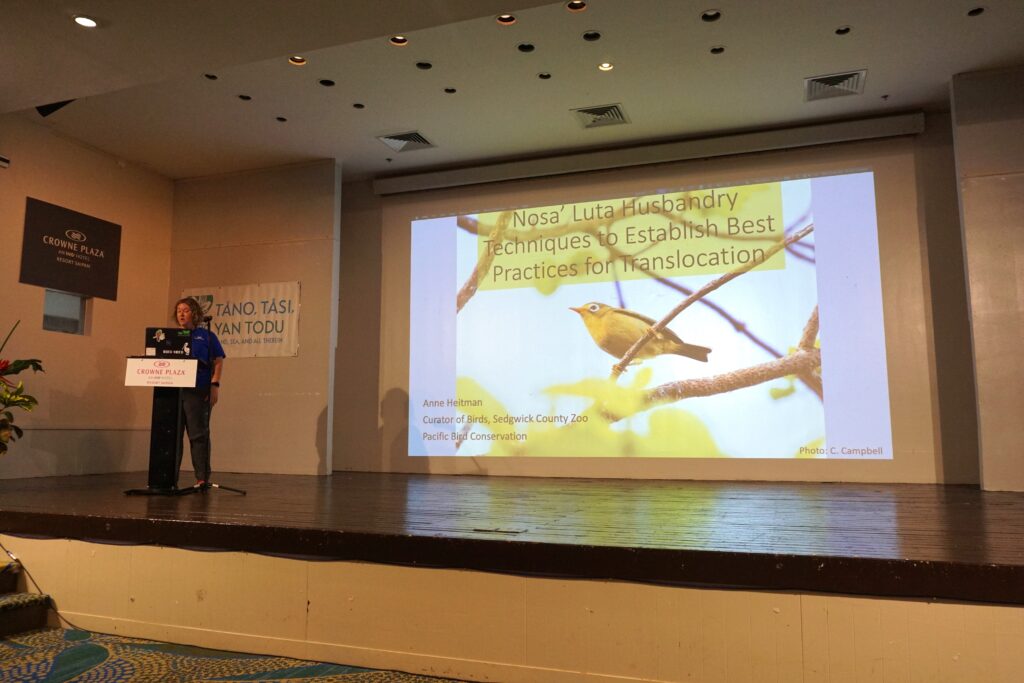
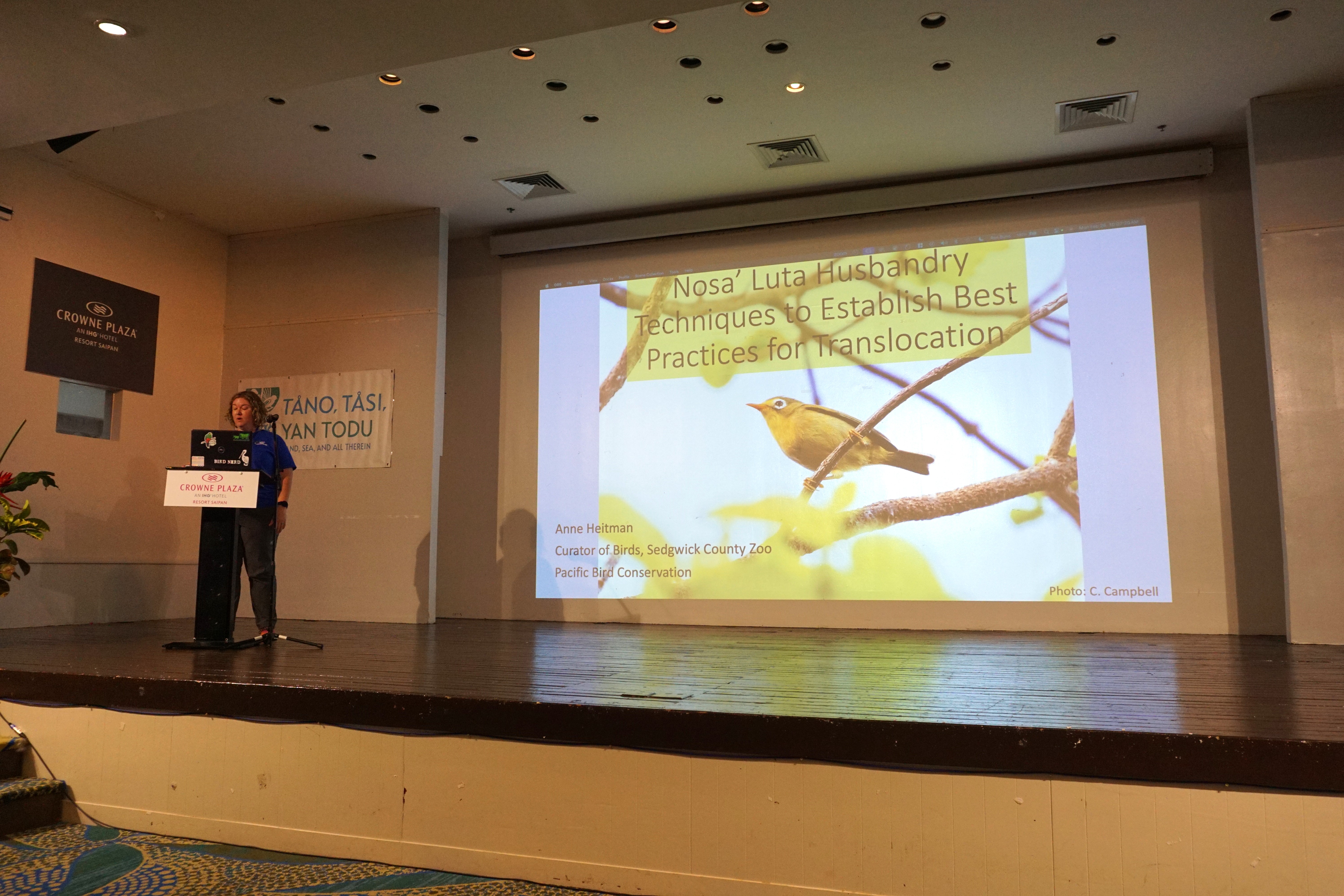
Researcher Anne Heitman speaks about the Pacific Bird Conservation’s efforts to develop captivity and husbandry protocols for the Nosa’ Luta or Rota White-eye (Zosterops rotensis).
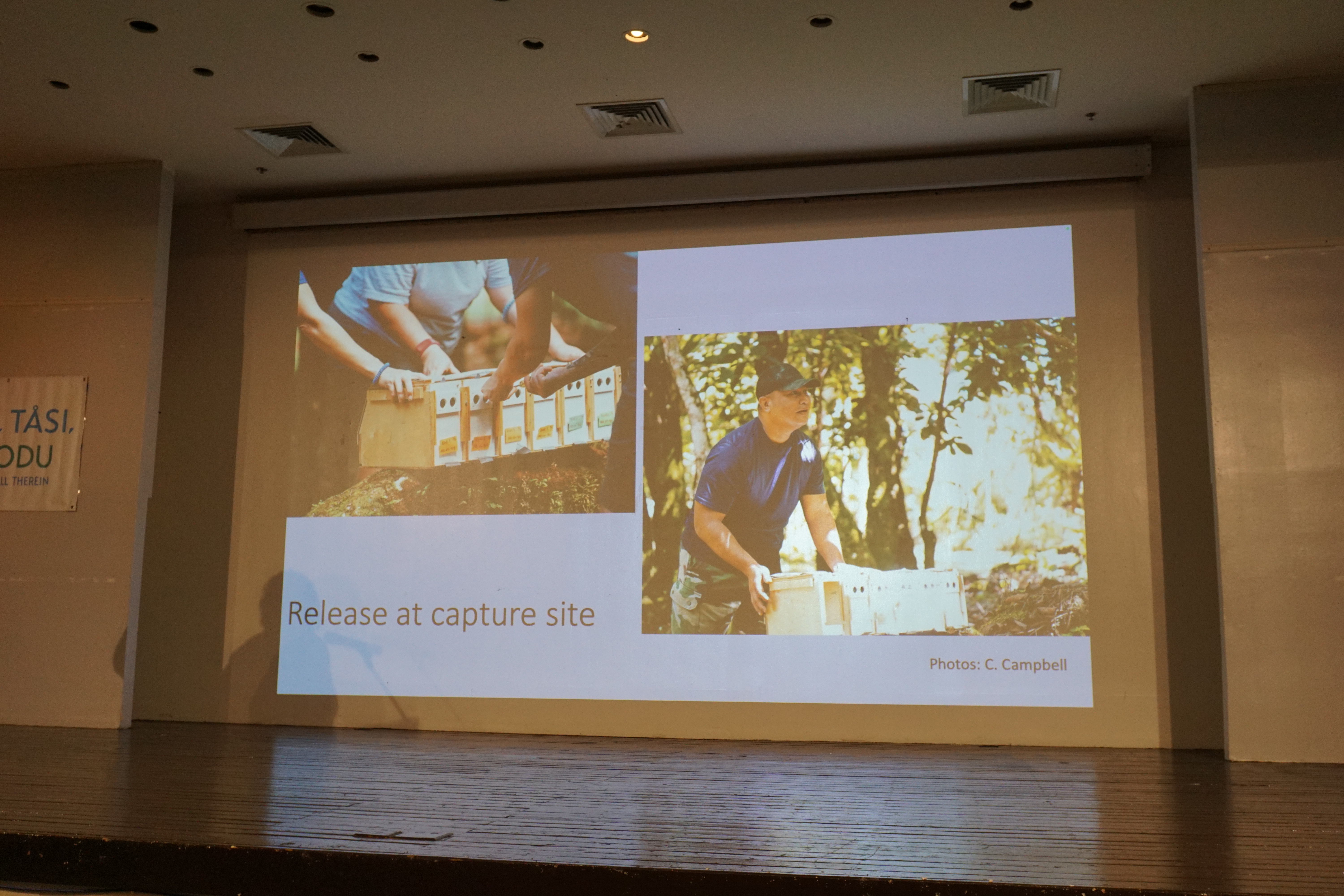
This slide demonstrated the moment just before captured Nosa’ Luta were returned to their habitat, at an undisclosed location on Rota in 2023.
ON the first day of the Mariana Islands Conservation Conference at the Crowne Plaza Resort Saipan on Monday, Feb. 26, researcher Anne Heitman of the Pacific Bird Conservation shared the work she and others conducted on Rota in 2023 to understand how the Nosa’ Luta or Rota bridled white eye (Zosterops rotensis) fared under captivity.
The research also focused on preparing animal husbandry protocols in the event the CNMI Division of Fish and Wildlife decides to relocate the species to other islands in the Marianas.
Heitman said the Nosa’ Luta is endemic to Rota, meaning it is found only on the southernmost island of the CNMI. If it dies out, there will be no Nosa’ Luta anywhere in the world.
According to Common Flora and Fauna of the Mariana Islands, the bird is around 10 cm from bill to tail, “with a body not much bigger than a golf ball.”
It is similar to the common Nosa’ species found elsewhere, except the Nosa’ Luta has a “brighter, sharper, yellow body color.”
Heitman said the Pacific Bird Conservation wanted to create protocols for Nosa’ Luta in temporary captivity in case the Division of Fish and Wildlife aimed to create “insurance populations” on islands other than Rota.
“Last year, 2023, was our fist year practicing our methodology with one of the listed species, which was the Nosa’ Luta,” she said. “We’re just practicing at this point. There are no future plans yet. We’re working on recovery, so this is all just practicing methods, trying out our techniques, using our former protocols to establish new protocols to see if we can narrow any of the knowledge gaps in how we would work with these species to move them to other locations.”
Heitman said an effort to establish a captive population of Nosa’ Luta was attempted in the 1990s, but the “success rate…was pretty low, overall.”
She said based on data from the past project, “chick mortality was high” and analysis also showed “metabolic bone disease” among the chicks. Heitman said this indicated that the nutrition of the birds was “inappropriate.”
The 2023 project undertaken by the Pacific Bird Conservation aimed to establish husbandry and capture protocols so that Nosa’ Luta specimens could safely be relocated off island.
Heitman said the project involved capturing the birds using mist nets set up at private property.
The project’s first obstacle involved finding the birds, she added.
“The species quickly showed us that they are truly canopy dwellers and very rarely came down to our nets that were at the lower levels,” Heitman said. “We were also dealing with a lot of wind and rain.”
She said they captured their first three birds on day three of the project. They later switched to canopy netting and “had a lot more success after that,” Heitman said. In total, they captured 12 birds.
“We feel like we learned a lot but we still have a lot to learn in that we were only able to collect 12 birds and our target was 20, but we are going to be continuing to work on that,” she said.
Heitman said they next had to study the kind of food they could feed the Nosa’ Luta. She said prior translocation protocols for the Canario (golden white eye or Cleptornis marchei) and the common Nosa’ informed Pacific Bird Conservation’s creation of protocols for the Nosa’ Luta. The intent was to identify the food that they would not reject while in captivity, she added.
Heitman said the team collected fruits from the trap site that included bananas and cucumber tree fruit.
“The banana was really hit or miss,” she said. “Some…really liked the banana and others…were not interested in it at all.”
Cucumber tree fruit was not popular among any of the birds, she said. Likewise, the Nosa’ Luta did not enjoy commercially available pellets or dried meal worms, Heitman added.
But the birds were partial to papaya, a commercial nectar that “replicates flower nectar,” and fresh meal worms, she said.
The Pacific Bird Conservation also measured the stress levels of Nosa’ Luta in captivity through the secretion of stress hormones in their droppings.
Heitman said the stress response of the Nosa’ Luta was typical of stress patterns in other species.
“We usually see a spike on day one, day zero being the day that they’re brought into the room,” she said. “About half of these birds had a day one spike and those were spikes above day zero, and then also above baseline values.”
She said birds held longer in captivity demonstrated a “secondary” stress hormone spike in the last few days before release.
Heitman said the maximum time a bird was kept in captivity was eight days, with an average of three days in captivity for most birds.
She said in comparison to a study done on the Canario in 2018 and 2019, the Nosa’ Luta had similar baseline stress hormone values,” but “lower variability and lower spikes in their day one values.”
After the project concluded, the birds were released at the same spot they were captured, Heitman added.
In an interview, she reiterated that there are no current plans to relocate the Nosa’ Luta. She added that the study helps the Pacific Bird Conservation and DFW to be ready to move them, should the day arrive.
“Because these are endangered species we will make sure that we have all of our methodology really locked down and we’re very confident with our protocols before we do any translocation,” she said.
