



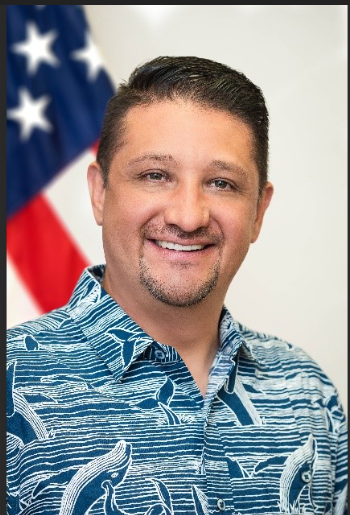

John F. Tobon
MANY human and sex trafficking crimes are not reported to the authorities, Honolulu Homeland Security Investigations special agent in charge John F. Tobon said.
“Unfortunately, individuals being exploited and victimized as part of these schemes often are unable to report or do not have the ability to report it, so the number of cases and instances are really hard to pinpoint because it is one of the most under reported crimes that we have,” Tobon added.
As part of the National Human Trafficking Awareness Day, and #WearBlueDay, which is observed on Jan. 11, Tobon and HSI public affairs officer Denise Hauser spoke to reporters on Friday via videoconference.
According to Tobon, “The color blue has been chosen as the color to support anti-human trafficking effort and to support victims of human trafficking. Once a year, this is something that we promote, not just in the U.S., but really around the world.”
Tobon said the blue campaign was created to, among other things, “make people aware of the different types of activities where people as part of their day to day lives could encounter a victim of human trafficking.”
He added, “Human trafficking in the U.S. primarily takes two forms: it’s either sex trafficking or labor trafficking.”
Both are “problematic” throughout the U.S. and its territories, Tobon said.
“Our goal is to make people more sensitive, more aware of those types of conditions … so we can then also count on the general public to help us identify those individuals that may need help and assistance,” he added.
He said human trafficking takes many forms.
“For instance, when we are talking about labor trafficking … individuals are not getting paid or they are paid below minimum wage or they are paid under the table or people work and their pay is withheld — that is usually one of the signs of labor trafficking,” Tobon said.
“Another sign is when you have individuals that are working but their travel documents are held by the person that they are working for — that is also a sign of labor trafficking,” he added.
“When it comes to sex trafficking, the most obvious ones, in many of our communities, are going to be illicit massage businesses. All these businesses, where a massage is advertised but there is actual sex work going on — those are the signs of both labor and sex trafficking,” he said.
Tobon said, “A lot of exploitation in sex trafficking happens with people that are no strangers to the victims. So they are friends or relatives who, in many instances, are actually the ones coordinating [the victims’] exploitation.”
Much information about abuse doesn’t reach HSI, he said.
“In many instances it does not get to us because people are not aware that these things are something that should be reported [or] they do not know who to report to,” he added.
Tobon said through the #WearBlueDay campaign and working with community groups HSI can raise awareness.
By working with many community groups and non-governmental organizations, “we collaborate to both share information and bring services to victims that are identified as part of those efforts,” Tobon said.
He noted that there are certain immigration benefits for victims of human and sex trafficking.
“We want to make sure that those that are victimized today understand that there are benefits that we can offer them as victims of human trafficking…. If they find themselves in these types of situations, they should not be afraid of reaching out to the authorities or reaching out to HSI in order to report their victimization. That will allow us to offer certain immigration benefits for those individuals that are here … undocumented. Regardless of your immigration status … there are victim services available to you, and we want to make sure that we get to you and offer those services,” Tobon said.
To report suspected human trafficking to federal law enforcement, call 1-866-347-2423.
To get help from the National Human Trafficking Hotline, call 1-888-373-7888 or text HELP or INFO to BeFree (233733).
