







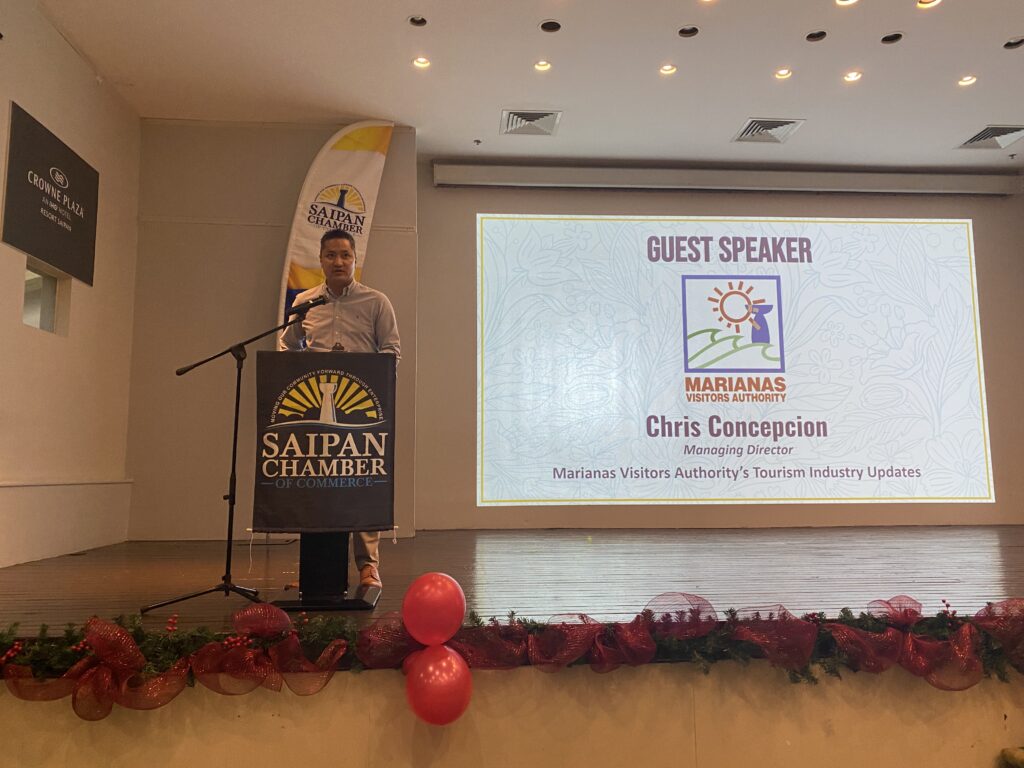
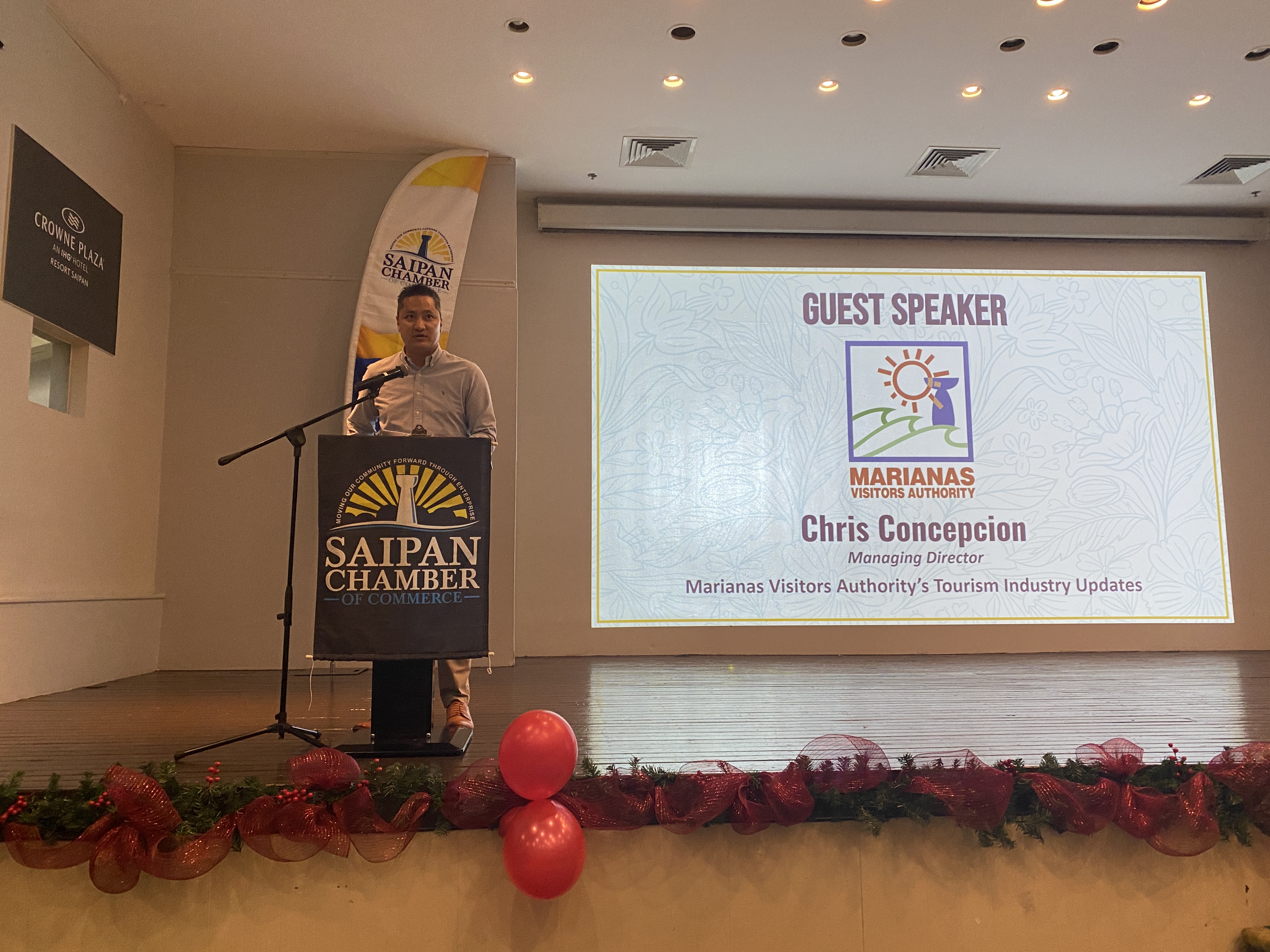
Marianas Visitors Authority Managing Director Chris Concepcion talks about the China tourism market during the Saipan Chamber of Commerce meeting on Wednesday at the Hibiscus Hall of Crowne Plaza Resort Saipan.
THE proposal by some U.S. lawmakers to end the discretionary parole program for Chinese tourists who want to visit the CNMI will “essentially kill” the islands’ second largest tourism market, Marianas Visitors Authority Managing Director Chris Concepcion said on Wednesday.
In his remarks during the Saipan Chamber of Commerce meeting at the Hibiscus Hall of Crowne Plaza Resort Saipan, Concepcion noted that China once comprised 44% of the islands’ market, but in the last year, they comprised only 2% of arrivals.
But despite an absence of direct flights from China to the CNMI, Concepcion said Chinese visitor numbers “are outpacing arrivals from Japan as of four months ago” because those Chinese visitors are taking connecting flights via Seoul, South Korea, the CNMI’s primary market.
Concepcion also shared that Hong Kong Airlines has announced that it will resume its direct flights to Saipan in 2024.
He said in order for CNMI tourism to fully stabilize, the industry needs at least three markets of travelers.
Chamber board member Alex Sablan, for his part, briefed members regarding the status of the CNMI Economic Vitality Security Travel Authorization Program or EVS-TAP. The program, which remains pending, will allow prescreened nationals of the People’s Republic of China to travel without a visa only to the CNMI under specified conditions.
Sablan said EVS-TAP is a “legitimate, vetted visa for the CNMI to allow [Chinese] nationals into the CNMI for tourism.”
He believes that the current discretionary parole program is the “wrong visa to be utilizing for tourism.”
EVS-TAP, he added, was created during the Trump administration and had to go through the federal review and comment process.
Sablan said around $4 million is needed to begin the implementation of EVS-TAP.
He said the chamber leadership is in discussion with U.S. Congressmen Gregorio Kilili Camacho Sablan about the funding issue.
