




HAGÅTÑA (The Guam Daily Post) — Genetic analysis of two ancient human skeletons recovered from Ritidian Point suggests that early settlers of Guam and the rest of the Mariana Islands archipelago may have originated from the Philippines with Taiwanese ancestry, according to a new study by a group of international anthropologists.
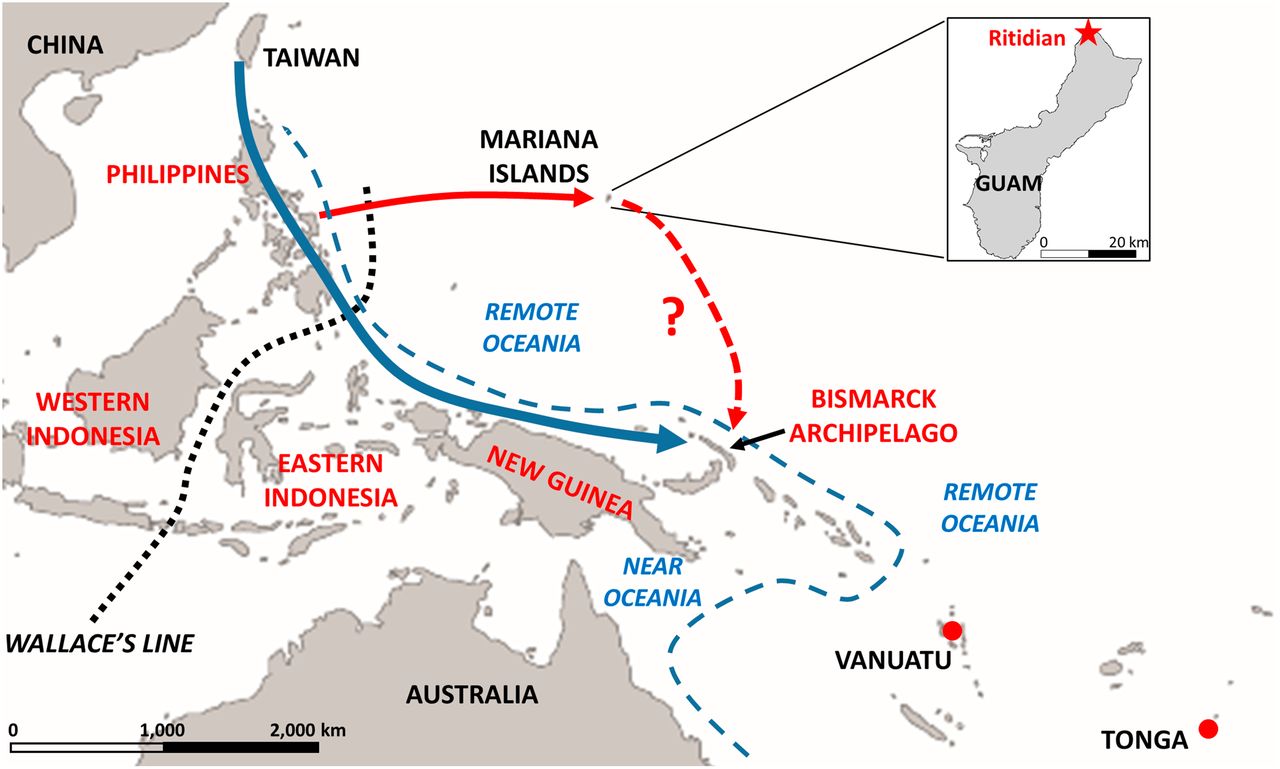
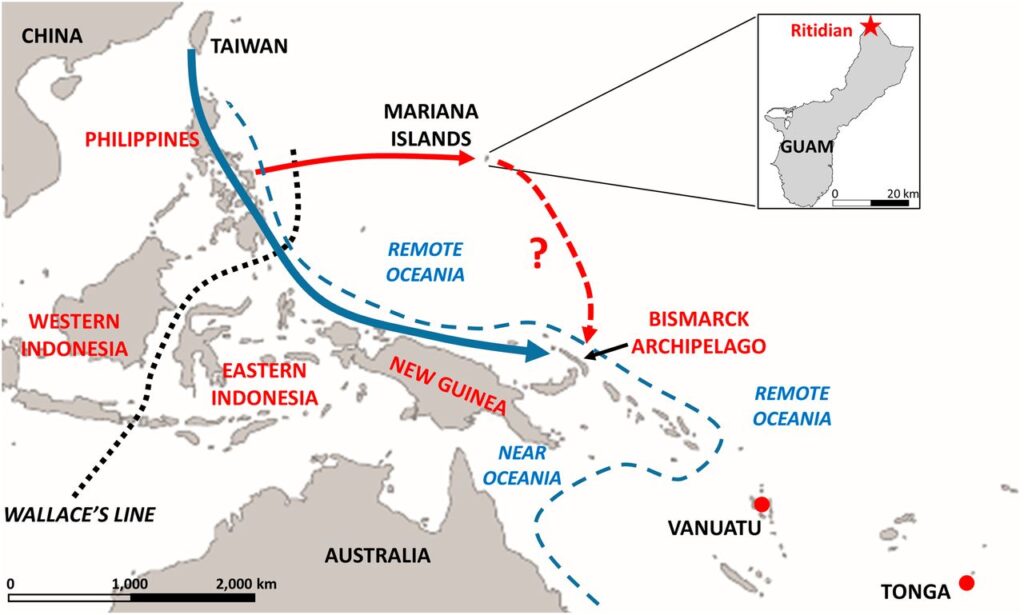
Inset shows the location of the Ritidian site on Guam. Location names in red have been suggested as potential sources for the settlement of the Mariana Islands. Wallace’s Line divides biogeographic regions and lies at the boundary of the prehistoric continental landmasses of Sunda and Sahul. The dashed blue line indicates the boundary between Near and Remote Oceania. Red dots indicate the locations of the early Lapita samples from Vanuatu and Tonga; the blue arrow indicates the conventional route for the Austronesian expansion to the Bismarck Archipelago, which was then the source of initial voyages to Remote Oceania; the solid red arrow indicates the route for the settlement of the Marianas; and the dashed red arrow indicates the potential contribution of Mariana Islanders to further settlement of the Pacific.
bioRxiv image/The Guam Daily Post
Direct radiocarbon dating of a bone from one of the human skeletons showed that the ancestor was on Guam some 2,180 years ago — plus or minus 30 years, according to the study.
The two ancient Guam human remains show some genetic overlap of samples from people with ancestry in Taiwan and the Philippines, according to the study.
The skeletons were in a ritual cave buried side by side in extended positions, with heads and torsos removed, according to the study.
“We analyzed ancient DNA from Guam from two skeletons dating to 2,200 years ago and found that their ancestry is linked to the Philippines,” according to the study. “Moreover, they are closely related to early Lapita skeletons from Vanuatu and Tonga, suggesting that the early Mariana Islanders may have been involved in the colonization of Polynesia.”
Some 4,000 years ago, Austronesian-speaking people from Taiwan island-hopped through the Philippines and southeastward through Indonesia, reaching the Bismarck Archipelago around 3,500 years ago, and from there they spread into western Polynesia, the new study states, citing prior studies on the early migrations into Polynesia from Taiwan.
The new study suggests that the voyagers from Taiwan, via stops in the Philippines, may have had the seafaring capability to brave the seas in proas, or canoes, to reach Guam directly from islands in the Philippines.
The report, titled “Ancient DNA from Guam and the peopling of the Pacific,” is co-authored by Irina Pugach, Alexander Hübner, Matthias Meyer and Mark Stoneking of the Max Planck Institute for Evolutionary Anthropology in Germany; Hsiao-chun Hung from the Department of Archaeology and Natural History, Australian National University; and Mike T. Carson of the Micronesian Area Research Center, University of Guam. The study was published in the U.S.-based Proceedings of the National Academy of Sciences.
“Here we report the analysis of ancient DNA retrieved from these remains; our results contribute to the debate over the starting point for the first voyages that led to human settlement of the Marianas, and we provide additional insights into the role of the Marianas in the larger view of the peopling of the Pacific,” according to the study.
“We also find a close link between the ancient Guam skeletons and early Lapita individuals from Vanuatu and Tonga, suggesting that the Marianas and Polynesia were colonized from the same source population, and raising the possibility that the Marianas played a role in the eventual settlement of Polynesia,” according to the study.
Research at the Ritidian site in Guam was performed in cooperation with the Guam National Wildlife Refuge and the U.S. Fish and Wildlife Service. The study received funding support from the Chiang Ching-kuo Foundation for International Scholarly Exchange in Taiwan, the Australian Research Council and the Max Planck Society in Germany.
“There is debate over where people came from to get to the Marianas, with various lines of evidence pointing to the Philippines, Indonesia, New Guinea, or the Bismarck Archipelago, and over how the ancestors of the present Mariana Islanders, the Chamorro, might be related to Polynesians,” the study states.
