





HAGÅTÑA (The Guam Daily Post) — Typhoon Mawar’s devastation of the island is expected to significantly stall the full recovery of tourism back to pre-pandemic levels, based on adjusted projections from the Guam Visitors Bureau.
COVID-19 and international travel restrictions drove the tourism industry into the floor back in 2020. Prior to Mawar, visitor arrivals were projected to hit 670,000 this fiscal year, or about 41% of the over 1.6 million arrivals seen in fiscal 2019, a banner year for the industry.
“Subject to a deeper dive in market conditions,” states a tourism impact report prepared by Gerry Perez, GVB acting president, fiscal 2023 will see just 400,000 visitors.
Post-Mawar estimates for fiscal 2024 are likewise grim, according to GVB. Rather than recovering by 70% and breaking the 1 million visitor threshold for the first time since 2019, arrival numbers are expected to be between 550,000 and 600,000 in fiscal 2024. That’s less than the 41% recovery anticipated pre-Mawar for the current fiscal year, and “all conditioned on local recovery progress that is eclipsing the adverse impact from COVID-19,” the report states.
Recovery from the typhoon is “likely to take 24 to 30 months based on historical recoveries of private facilities, public infrastructure, operational restoration of the island’s destination value chain, and consumer confidence in our source markets.”
A full two years is about how long it took the tourism market to recover from typhoons in the past, according to the report. In the aftermath of 2002’s Supertyphoon Pongsona, arrivals were back up to pre-typhoon numbers of over 950,000 in about that time frame, the report states. Pongsona did about $730 million worth of damage to the island.
It points to the almost 20-year tourism recovery after Supertyphoon Paka in 1997 as an anomaly. Guam did not get back to the 1.2 million arrivals pre-Paka until 2016. Recovery was prolonged “by a series of events that include: the 1997 Asian economic crisis, KAL crash, Gulf War, 8.1 magnitude earthquake, two super typhoons in 2002 (Chataan and Pongsona), SARS, and Sept. 11, 2001.”
Though a damage assessment post-Mawar is pending, mayors have estimated that hundreds, if not thousands, of people were left homeless by the latest storm to strike Guam.
Stranded visitors
In the meantime, GVB is taking steps to make the almost 5,000 visitors who were stranded after Mawar more comfortable, a news release from the agency states.
The agency has reached out to tour agents, local bus companies, hotels and industry partners to transport visitors and “provide a sense of security” by covering a portion of the cost of their lodging and meals as they await a flight out of Guam.
“Ensuring the safety and well-being of our visitors remains a priority as our island deals with post-storm recovery efforts,” Perez said. “In keeping with our island’s håfa adai spirit, the hardworking staff at GVB are working alongside our tourism partners to extend our hospitality to our stranded visitors.”
The Guam Hotel and Restaurant Association is helping coordinate response efforts, the release states. Likewise, the Consulate of the Republic of Korea is helping with transportation, immediate medical services and water for departing visitors.

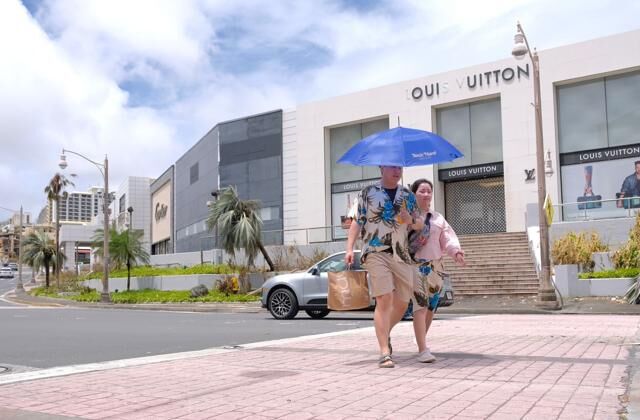
Tourists cross a street in Tumon on Wednesday, May 31, 2023, a week after Typhoon Marwar.
