






HAGÅTÑA (The Guam Daily Post) — Private schools, including religious institutions, will soon be able to apply to become government-subsidized charter schools, with lawmakers voting Monday to override the governor’s veto of a measure that would open up the charter school petition process.
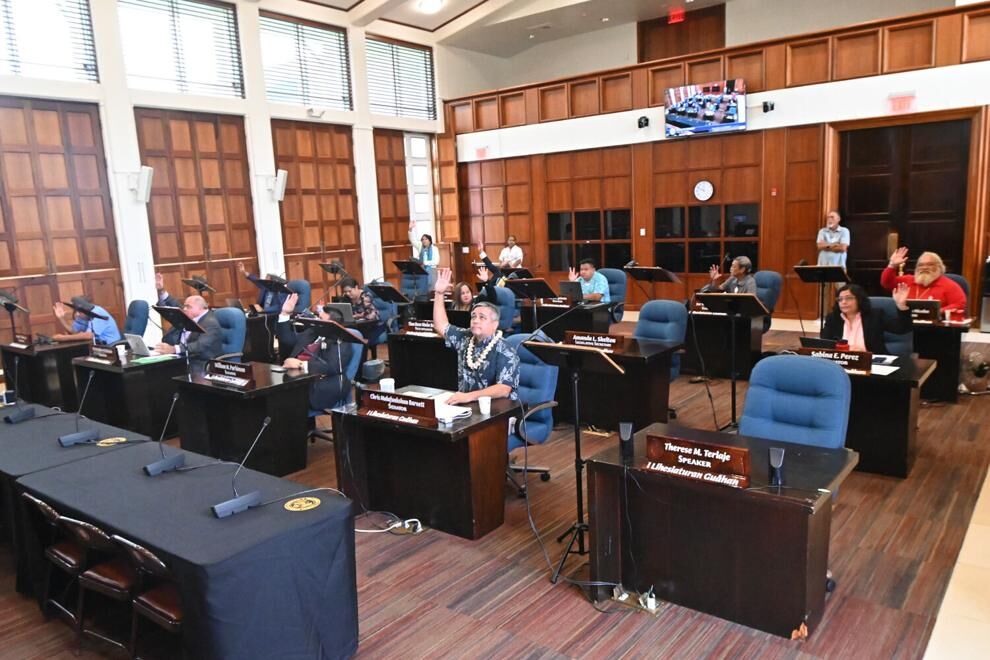
Lawmakers voted without opposition to override the veto of Bill 62-37. It received 13 votes in support, with Sen. Amanda Shelton absent and excused, and Sen. Joanne Brown recusing herself from the vote. Brown said she had a child attending a private school that may pursue charter school status.
Private schools can still petition the Guam Academy Charter Schools Council to convert into a charter school for the 2023-2024 school year. The deadline is Sept. 1. Council members will have to host a public hearing within 30 days of the petition being submitted, and then either approve or deny the application within another 30 days.
Any applying school has to provide at least kindergarten-3 through eighth grade education; have a project-based curriculum; and show it uses a critical thinking method of learning to teach “the CHamoru language and history, music, physical fitness, and the performing arts.”
Subsidies for charter schools are based on enrollment, and the charter school council is seeking $7,500 per student in the upcoming school year, The Guam Daily Post reported last week.
Based on discussions between lawmakers Monday, at least one religious school, Our Lady of Mount Carmel Catholic School, is preparing to apply. It’s unclear whether the institution intends to petition to convert for the upcoming school year.
Gov. Lou Leon Guerrero in a veto message this month said that Bill 62 violated the First Amendment and the doctrine of separation of church and state, as well as the Organic Act of Guam. She stated she couldn’t authorize the spending of taxpayer money on a religious school, which would then be regulated by the government.
But Attorney General Doug Moylan differed in a legal opinion issued to lawmakers. Several faith-based organizations receive money from the government of Guam already, he noted.
Education committee chair Sen. Chris Barnett, the main sponsor of Bill 62, said Monday that the governor’s veto was “flawed.” He said that the U.S. Supreme Court was clear “that if we’re going to obligate public funds to private schools for charters or school vouchers or school choice, then we must also do the same for private religious schools.”
Any school that was allowed to sign a charter would have to report to the charter school council, and must be accredited, Barnett noted.
“So while they’re teaching – if they’re teaching the hymns that nåna taught us – they also have to teach calculus and English and all those important things that really lead to the complete education of our child,” he said.
Appropriations chair Sen. Joe San Agustin said the Organic Act explicitly forbade the use of public money for the support “of any sect, church, denomination, sectarian institution … or for the … support of any priests, preacher, or minister.”
However, he said he spoke to officials working on a charter school petition for Mount Carmel that “there will be no religion.”
“I’m in full support of the override – provided we have a separation of government and religion – regardless of what the attorney general says. I have to stick with what I just read out from the Organic Act,” San Agustin said.
Vice Speaker Tina Muña Barnes, who helped pass legislation that authorized charter schools on Guam about a decade ago, said the initiative had already proved successful at providing kids educational alternatives. She supported Bill 62.
“I did look at the concerns that were brought to our attention. But we’ve already come over that,” she said. “We understand what needs to be done, and why take it away from our students?”
Pandemic powers
Lawmakers also began discussion Monday on a potential veto override for Bill 7-37, aimed at providing a check on the governor’s powers to continually extend a state of public health emergency.
Sen. Chris Duenas, a critic of the administration’s handling of the COVID-19 pandemic, introduced the measure back in the 36th Guam Legislature when it was similarly vetoed. Duenas on Monday said his office was getting repeated complaints during the nearly three-year-long public health state of emergency, which was extended by the governor on a month-to-month basis.
Among the biggest concerns from citizens were the prohibitions on religious gatherings; the shutdown of businesses like restaurants and bars; the “useless” position of the Guam Army National Guard on roadways early in the pandemic; and workplace discrimination against “dirty, unvaccinated people.”
Bill 7 would require the Legislature to approve the extension of a public health emergency every 30 days, though Barnett successfully amended the timeline to every 60 days. It would also bump down the penalty for violation of a quarantine or isolation order from a misdemeanor to a civil penalty punishable by a $25 fine.
Speaker Therese Terlaje said she couldn’t support the measure if it made the penalty for quarantine violations so low.
Senators were still debating the measure when they went into recess at noon Monday.

Senators vote to move Bill 62-37, vetoed by Gov. Lou Leon Guerrero, to the voting file during session Monday, July 24, 2023.
