






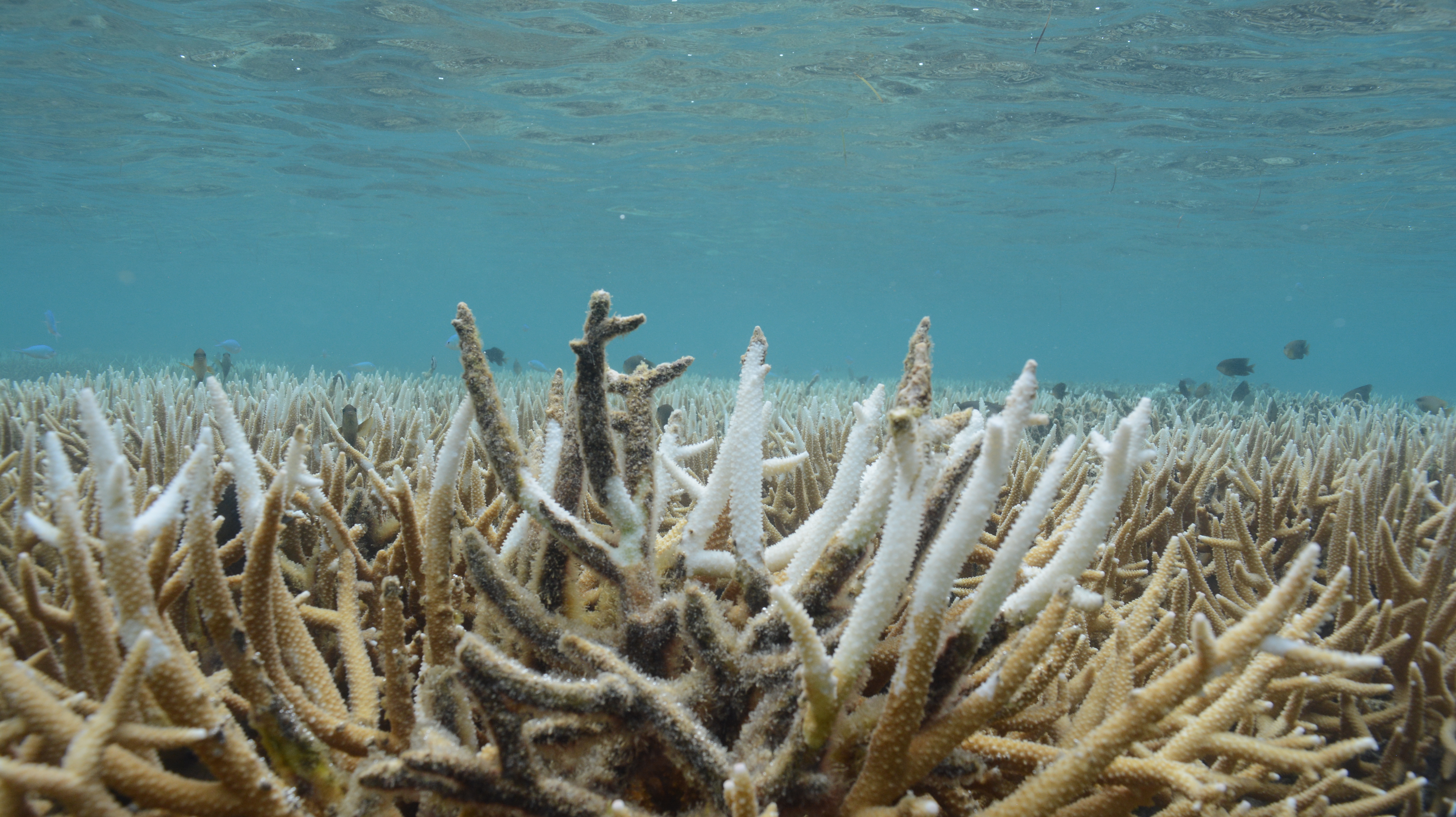
These corals in San Antonio show bleaching at the tips, which most likely indicate they were damaged by low tides, according to Elly Perez, a scientist at DCRM.
THE author of the Division of Coastal Resources Management Current Coral Reef Conditions Report warns that a coming strong El Niño season brings with it a moderate risk for coral bleaching in the waters of the Marianas.
Elly Perez spoke with Variety on Thursday, June 15. Perez is a scientist with DCRM’s Marine Monitoring Team. In May of this year, she authored the Current Coral Reef Conditions Report, where she shared a forecast of how increased surface temperatures in the Southern Pacific are going to impact the Marianas.
In the report, Perez writes, “High agreement among forecast models and a robust pool of warm water below the surface are among the reasons forecasters think there is a 62% chance that El Niño…is on its way, if not by summer, then by fall (greater than 80% chance).”
In the Marianas, El Niño has historically been associated with extreme low tides and an increased probability of tropical cyclones, Perez writes. The low tides can expose coral heads to direct sunlight and “have the potential to cause widespread damage,” according to the report.
Aside from damaging property and causing debris to fly into the lagoon, storms have many other impacts on the health of the reef, Perez said. Damaging waves can break the physical structure of the reef and heavy rainfall can cause flooding, reducing salinity and increasing nutrient and sediment runoff.
In a June 8 press release available on their website, the National Oceanic and Atmospheric Administration announced El Niño’s arrival, defining it as “a natural climate phenomenon marked by warmer-than-average sea surface temperatures in the central and eastern Pacific Ocean near the equator, which occurs on average every 2-7 years.”
El Niño has an “opposite counterpart” called La Niña, according to the National Weather Service’s website. “La Niña refers to persistent colder-than-normal (0.5°C or greater) sea surface temperature anomalies across the central and eastern equatorial Pacific (170°W to 120°W longitude and 5°N to 5°S latitude),” according to one article.
In regard to the timeframe for the weather patterns’ frequency, Perez says that climate change makes it a challenge to brace for the effects caused by El Niño and La Niña.
“As climate change progresses, we don’t really have a complete understanding of how El Niño and La Niña are going to be affected,” Perez said. “The biggest problem is we don’t know. We know that it will change, because climate change changes everything. So, it will affect El Niño and La Niña but we’re not positive how.”
“[El Niño and La Niña] may increase in frequency and intensity. Amplified [El Niño and La Niña] impacts, such as extensive coral bleaching events, are already being felt around the world,” Perez said.
She said the forthcoming CNMI’s Eyes of the Reef Program is an effort to produce data about coral reef bleaching and other coral reef disturbances in the CNMI. Divers and swimmers in the program submit reports documenting bleaching and disease after every dive on the reef, to include reports where neither disease nor bleaching is present.
“I think we’re going to learn a lot this summer,” Perez said, adding that this season’s El Niño is most likely going to be “strong.”
“We have the potential to learn a lot about specifically how these El Niño events might affect us moving forward.”
Perez said it’s unlikely bleaching in the CNMI caused from El Niño or La Niña can be stopped. However, she added that residents can aid in recovery by refraining from stepping on corals, leaving stressed corals alone, and temporarily refraining from killing herbivorous fish, which eat algae that grow on stressed corals.
“If there is a bleaching event, we will all need to come together and take care of our reef,” she said.
