





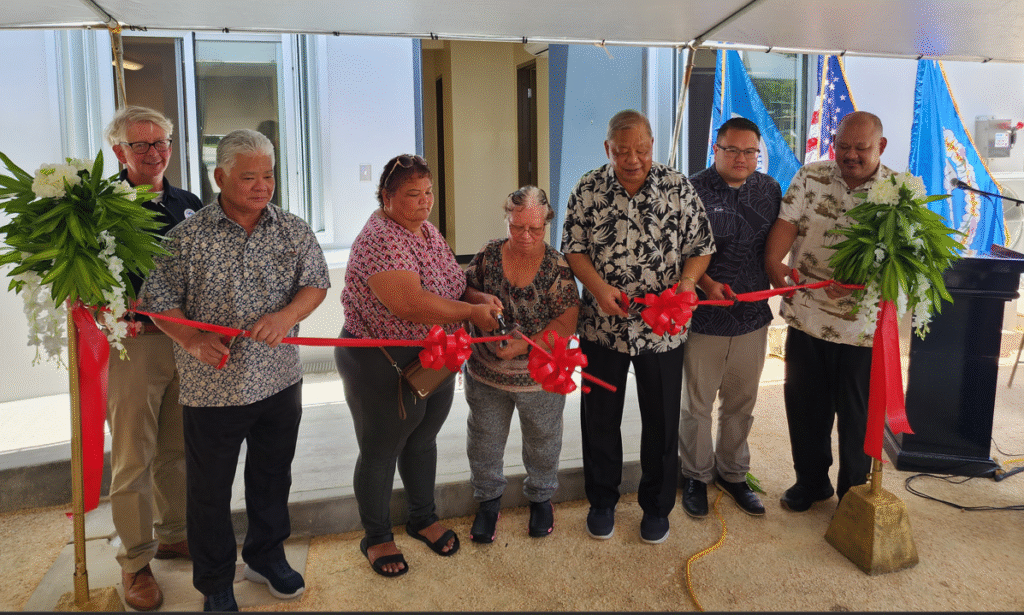
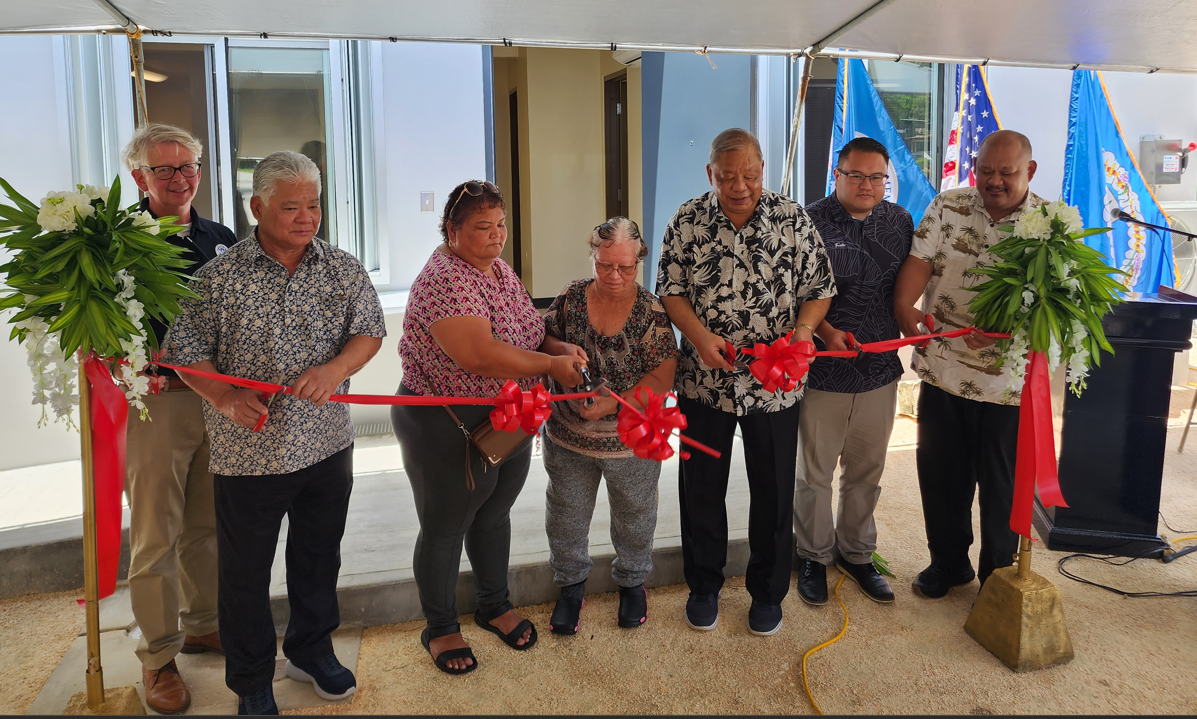
From left, FEMA Long-Term Recovery Office Director Wayne “Randy” Clayton, Gov. Arnold I. Palacios, Ana Agulto Lizama, Joaquina Agulto, Lt. Gov. David M. Apatang, Reps. Manny Castro and Rep. John Paul Sablan cut the ceremonial ribbon for last home built under FEMA’s permanent housing construction program.
THE last home to be constructed under the Federal Emergency Management Agency’s permanent housing construction program is owned by Joaquina Agulto and is located in Chalan Kanoa.
Agulto, through her eldest daughter Ana A. Lizama, expressed her appreciation to all the agencies and organizations involved in the construction of her home.
Lizama said she grew up in her mom’s old home which was destroyed by Super Typhoon Yutu in October 2018.
“I thank God for allowing the construction of this new home,” she said. “It was a long journey, long waiting. Patience is really a virtue. My mom waited and she really wanted to give her deepest appreciation to every person that has built her new home. She had been dreaming about it almost every night.”
She said her mother’s family members “were constantly called to answer a lot of questions and provide information they needed to have this home built for my mom.”
She said construction started in February 2023 and the contractor was RNV Construction.
Lizama said they applied for FEMA’s permanent housing construction program or PHC after Yutu devastated southern Saipan and Tinian.
Lizama said her mother’s new house has two bedrooms, one bathroom, a small kitchen and a living room.
“We built this house which is more resilient and with hard structural integrity,” said FEMA Long Term Recovery Office Director Wayne “Randy” Clayton during the ribbon-cutting ceremony on Thursday morning for Agulto’s new house, which also marked the end of the PHC program.
He said like any other home built under PHC, the house meets the 2018 International Building Code, standards for wind resistance — up to 195 miles per hour — and complies with all applicable federal, state, and local building codes.
According to FEMA, there were several delays in obtaining permits for the construction of the new house because it is located on a wetland deemed biologically and archaeologically sensitive.
Moreover, FEMA said, the property was built with a unique septic system that contained a ponding basin. Live plants are required for the three-part septic system — vegetated submerged bed — to function properly, FEMA added.
In his remarks, Gov. Arnold I. Palacios said he and Lt. Gov. David Apatang grew up in Chalan Kanoa.
“We know this house, we know who it belongs to, and it’s really nice to come back to the neighborhood,” Palacios said.
“As we celebrate this essential milestone in our journey of recovery from Super Typhoon Yutu,” Palacios noted the presence of FEMA officials which, he added, “underlies the shared commitment of both the Commonwealth and the federal governments to disaster recovery — a commitment that although was challenging has proven fruitful, enabling the completion of the final home under PHC. This is testament to our collective resilience and resolve to get things done.”
On behalf of the CNMI, he extended his gratitude to Clayton as well as to FEMA Region 9 officials Robert Fenton and Robert Pesapane.
Palacios said he looked forward to their continued support for public assistance and hazard mitigation programs in the CNMI.
“Nearly 1 billion dollars have been allocated for our recovery,” the governor noted.
Also present at the ribbon cutting ceremony were Precinct 1 Reps. John Paul Sablan and Manny Castro. FEMA External Affairs Officer Veronica Verde was the emcee.
The PHC program provided two forms of assistance: direct repairs to disaster-damaged homes, and new home construction.
“Direct repairs helped restore residences to a habitable condition by fixing things like foundations, frames, roofs, windows and essential personal property (e.g., refrigerators, stoves, hot water heaters). New construction was authorized when an applicant’s pre-disaster residence was determined to be destroyed or beyond the scope of repair assistance,” FEMA said.
In total, 101 households (93 on Saipan and eight on Tinian) received direct repairs, and 179 (165 on Saipan, 14 on Tinian) received new homes, FEMA added.
