






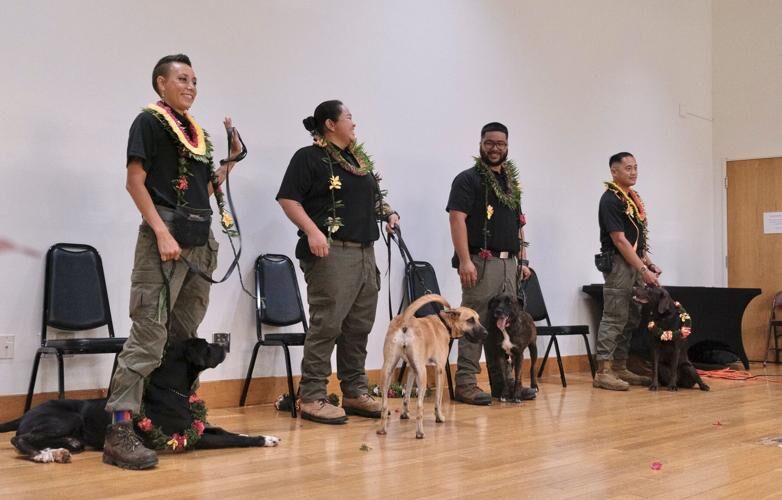

A graduation ceremony was held for the Guam Invasive Species Detector Dog Team at the University of Guam in Mangilao on Friday, April 28, 2023. From left, Mary “Ally” Worcester with detector dog Elvis; Louise Marie Baza with detector dog Na’i; Tristen Lizama with detector dog Maui; and Garrett Certeza, with detector dog Penny.
HAGÅTÑA (The Guam Daily Post) — Four rescue dogs from Guam and Hawaii are now ready to come to the aid of the island by sniffing out invasive species that threaten the environment and prevent pests from making their way to other places in the Pacific.
A graduation ceremony at the University of Guam signaled the completion of a nine-week invasive species detector dog training course conducted by the U.S. Department of Agriculture Wildlife Services.
“We have four dogs total. Na’i is our only dog from Guam. She was acquired at (Guam Animals in Need), the animal shelter. Because of the short amount of time we had to get the dogs, we had to look at other places. So we contracted Conservation Dogs of Hawaii to look for dogs, in Oahu specifically. They found us Maui, Elvis and Penny,” said Garrett Certeza, project leader for the Guam Invasive Species Detector Dog Team.
The Guam Invasive Species Detector Dog Team is a pilot project funded by the U.S. Department of Interior’s Office of Insular Affairs. The goal is to prevent the movement of invasive species such as the coconut rhinoceros beetle, which was what the canine officers were trained to sniff out in this specific course.
Before the handlers and the dogs could start training, the dogs had to become accustomed to their future handlers.
“I, kind of, initially began pairing the dogs based on the traits I knew about the handlers. Ultimately, what ended up happening is we had the dogs go to each handler in the way that the dogs responded to them,” Certeza said.
The process amounted to the dog being able to choose its handler.
“Na’i really, really worked well with … Louise Baza. She really had the patience that the dog needed to take the dog from the shelter to become confident and a working dog. And we had Maui, who is very energetic and needs a lot of energy, very strong. I, kind of, naturally paired her with handler Tristan Lizama. With Elvis, Elvis was the largest dog and kind of funny. He ended (up) going with our smallest handler which is Ally (Worcester). She came in a little bit later, she came into our team in January. She really wanted Elvis,” said Certeza, who is paired with Penny.
‘A strong relationship’
Worcester said that Elvis was quite a handful – at first.
“Elvis is probably the biggest goofball of a dog. I actually prefer female dogs and I have my whole life. They’re easier to train, smarter – no offense to the men out there. But I zeroed in on him because he’s just this big ol’ goofy dog and I’m like, ‘You’re going to be my boy whether or not you like it.’ And it turns out him and I have such a strong relationship,” Worcester said.
To get Elvis to the point where he followed her lead, Worcester learned techniques to control him and the value of “extra” patience.
“I have trained a lot of dogs in my life, but Elvis has been a very challenging dog, very stressed coming from a rescue point and not knowing his background. I didn’t quite know what obstacles I was going to go have to go through. But turns out, beating his kennel stress, and stress on a leash is one of the hardest things I’ve had to do when training a dog, so definitely extra patience,” she said.
Worcester and Elvis, along with Certeza and Penny, Lizama and Maui, Baza and Na’i graduated Friday, a moment the handlers were proud of.
Now that they’ve graduated, Worcester is eager to get to work with her partner.
“I think training dogs and working alongside them has been very fulfilling but (I’m) really looking forward to actually starting our operations and getting to do our inspections from a day-to-day basis and getting to watch my dog work it out. And, hopefully, I hope, we find the first beetle,” she told The Guam Daily Post.
With these four detector dogs and their partners on the front lines, Certeza said it’s an opportunity to tackle invasive species in a cost-effective manner.
“I think it means a whole lot of opportunity. As many of you know, dogs are used for a variety of problems and to attack different problems. They’re really cost-effective, … in term of invasive species management in a sense that you can theoretically train any dog to look for any insect, any type of invasive species. There are, of course, some that would be more difficult than others, like just a single adult beetle that can fly. That, of course, is different from looking for drugs, people’s hands touch it and it gets packed in large quantities,” Certeza said.
‘High threat’
But the aid these K-9 officers bring isn’t just for Guam, Certeza said. They may benefit other island communities as well.
“In some ways, this particular project actually helps our brothers and sisters in other islands. Like the brown tree snake, we are trying to prevent the rhino beetle and the little red fire ant from leaving Guam and (going) to another island where they have to deal with it in the same way that we are,” Certeza said.
The GISDDT will serve a dual purpose to identify new, potential high-risk invasive species around Guam’s ports of entry.
“The other goal is to be able to look for invasive species that are a high threat, that have a high possibility of coming to Guam from other places based off of how much trade we have like from east Asia or even the states,” Certeza said.
The next invasive species the detector dogs will be trained to sniff out is the little fire ant.
“No other team in the world is the dogs being trained to find that, so it’s a whole other project. The ones that are not found on Guam that are high-risk is the little red fire ant, I think that’s in east Asia, and the spotted lantern fly originally in China, but has made its way to the continental U.S.,” Certeza said.
