





MAJURO — Two western Pacific nations considered by Washington as crucial in its competition with China for influence in the region have agreed 20-year extensions of funding arrangements as part of security and defense treaties.
The Federated States of Micronesia signed off on a nearly final Compact of Free Association Monday this week with U.S. Presidential Envoy Joseph Yun, followed by Palau on Wednesday.
But Yun is unlikely to be able to round up agreements with all three of these North Pacific nations with defense and security agreements with Washington. The Marshall Islands, the third North Pacific nation with a similar Compact, is unlikely to sign primarily because of outstanding issues surrounding the U.S. nuclear testing legacy in the country.
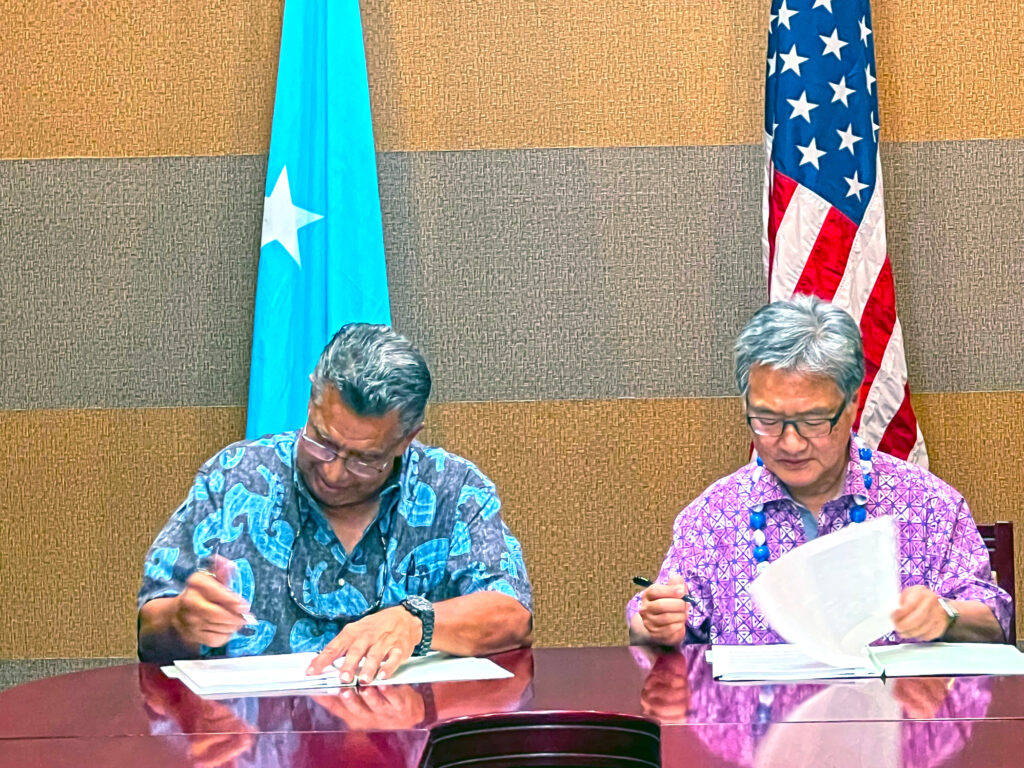
FSM Chief Negotiator Leo A. Falcam Jr. and Yun initialed the new Compact funding agreement at the Office of the President in Palikir, Pohnpei on Monday. On Wednesday, in Palau at the nation’s Capitol, Yun joined Palau chief Compact negotiator Kaleb Udui Jr. to initial a similar extension of the Compact treaty for Palau. Both documents are expected to be formally signed later this month, ending two years of negotiations.
The FSM will reportedly receive $3.3 billion and Palau $760 million over the 20-year life of the new funding agreements, according to U.S. officials. The Marshall. Islands has agreed to $1.5 billion and an additional $700 million related to the nuclear weapons test legacy.
Yun was scheduled to visit Majuro beginning Thursday this week fresh off the approvals of the Compacts in Micronesia and Palau. But the situation in the Marshall Islands appeared murkier than ever.
“The RMI looks forward to reaching an agreement soon with the U.S.,” Marshall. Islands Chief Negotiator and Foreign Minister Kitlang Kabua said Wednesday. It is unclear at this stage when the two governments will reach agreement on a new 20-year deal, despite Kabua and Yun having initialed a memorandum of understanding in January that spelled out the amounts of funding to be provided to RMI over 20 years.
Yun acknowledged the situation with the Marshall Islands telling the Reuters news agency that it was “doubtful” that the U.S. and Marshall Islands would sign off on the Compact before he departs Majuro this weekend.
At least one member of the Marshall Islands Compact Negotiation Committee said Tuesday he was in the dark as to next steps. “I really have no idea what is the game plan here,” he said.
In a widely circulated email on the eve of Yun’s visit, Arno Nitijela Member Mike Halferty said there had been no involvement of Arno and the majority of islands in the nation in developing the Compact. “There is no report on the Compact negotiations for us to understand the situation,” he said. He objected to the exclusion of Arno and other islands from participation, saying the people of Arno are Marshallese like the people involved in the talks with the U.S.
Halferty also revived the conversation about a recent legal memo issued by U.S. constitutional law expert Lawrence Tribe that stated a plebiscite is needed to legally approve a new Compact. “If we are truly a democracy, we should have had (a vote on Compact Two) and should now let the people vote to decide their own fate,” he said.
Reuters cited an unnamed “senior U.S. official” who said the discussion between the U.S. and RMI “is no longer about the amount of money but…about how the money will be structured and how it will be spent and what issues it will cover.”
Minister Kabua’s comments to the Journal tended to confirm this analysis: “The RMI has matters tabled in the negotiations that are unique to our bilateral relationship with the U.S. These matters include the nuclear legacy, the communities affected by the U.S. military operations and presence in-country, and the existential threat of climate change.”
Kabua added: “We are also keen on strengthening processes to facilitate the RMI working jointly with the U.S., without jeopardizing accountability and transparency, to utilize resources for areas of priorities as deemed by the RMI government’s strategic plan and other planning documents for the future.”
Yun was expected to arrive in Majuro Thursday afternoon. No formal negotiating discussions were scheduled, though he was scheduled to meet with the Foreign Minister Thursday evening, and then Friday morning with President David Kabua and the Cabinet. He was scheduled to also meet with the Council of Irooj, Nitijela members, nuclear representatives, local students, the Compact Negotiation Committee, NGOs, and the Chamber of Commerce during his two-and-a-half-day visit.
The range of meetings suggest Yun and his delegation hope to get a sense of the “pulse” of the nation in relation to the Compact.
Due largely to internal disagreements over the memorandum of understanding initialed by Yun and Kabua in January, the situation remains unclear as to next steps. Many members of the Compact Negotiations Committee criticized the terms of the MOU after it was signed in January and little has transpired to resolve these concerns. Some related to details around the proposed $700 million for nuclear legacy needs, while others are hoping to address a range of technical issues related to how the agreed-to U.S. funding is provided.
“We are fervently working internally and with Special Presidential Envoy Yun and the U.S. government to conclude the talks in a way that is mutually beneficial and dignified, as Presidents Kabua and Biden have agreed to in the early stages of the negotiations,” said Foreign Minister Kabua on the eve of Yin’s visit.
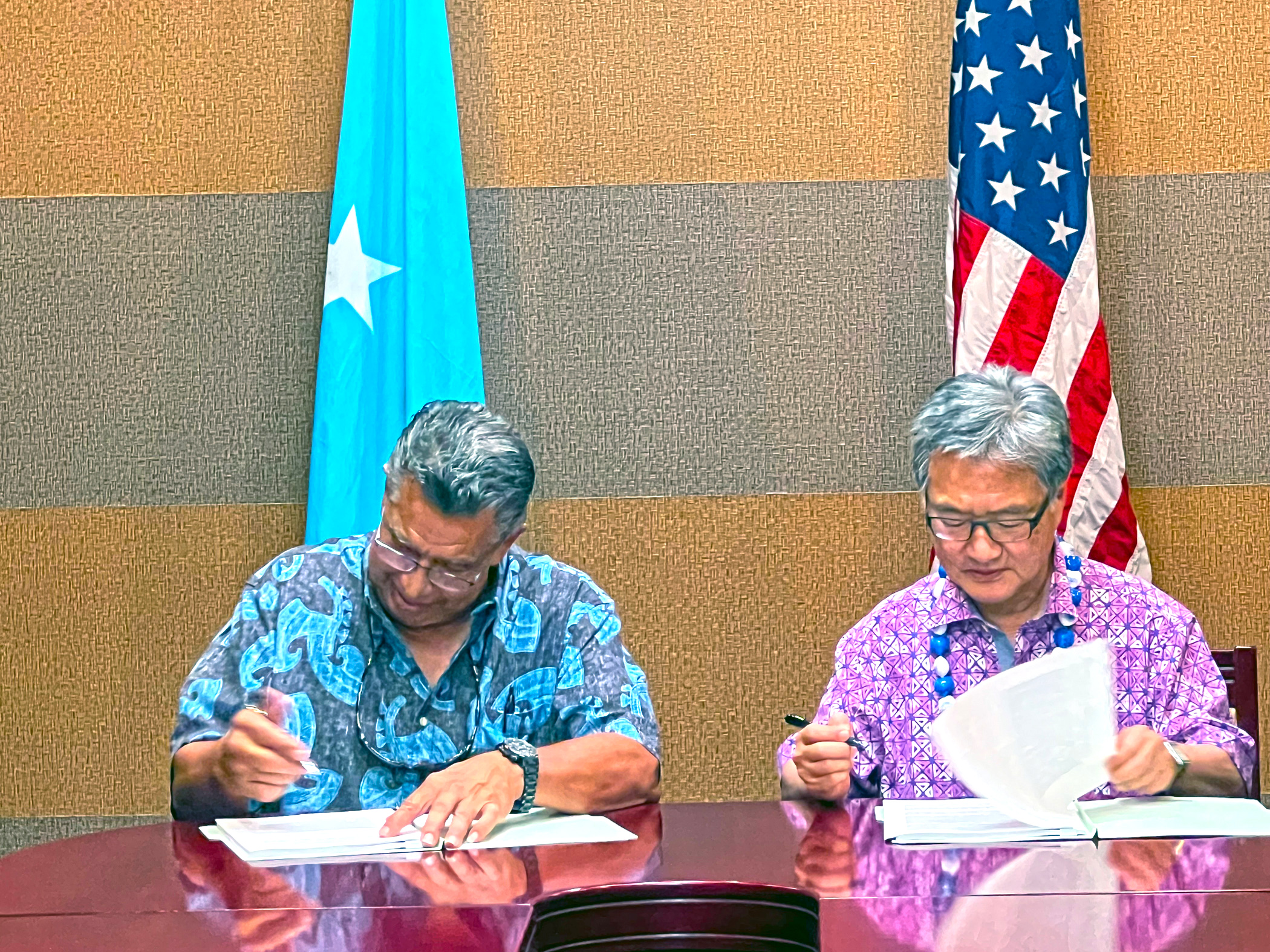
FSM Chief Negotiator Leo A. Falcom Jr., left, joins Special Presidential Envoy Joseph Yun on Monday this week in Pohnpei to initial a nearly final version of the new 20-year funding agreement for extending the Compact of Free Association.
