






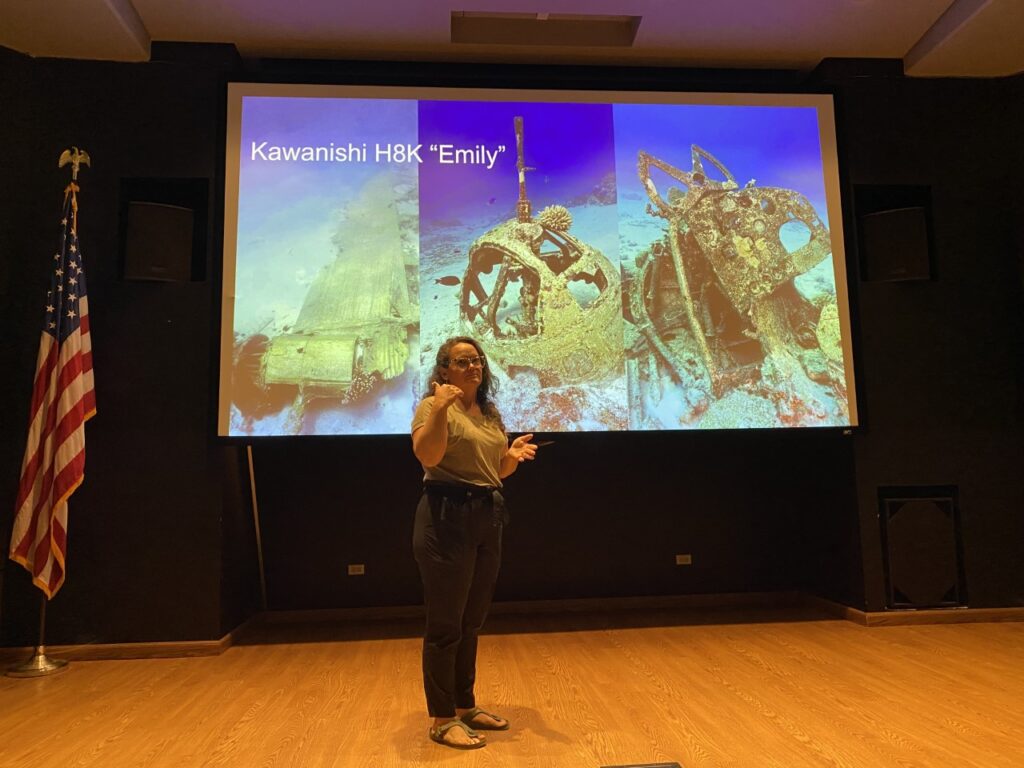
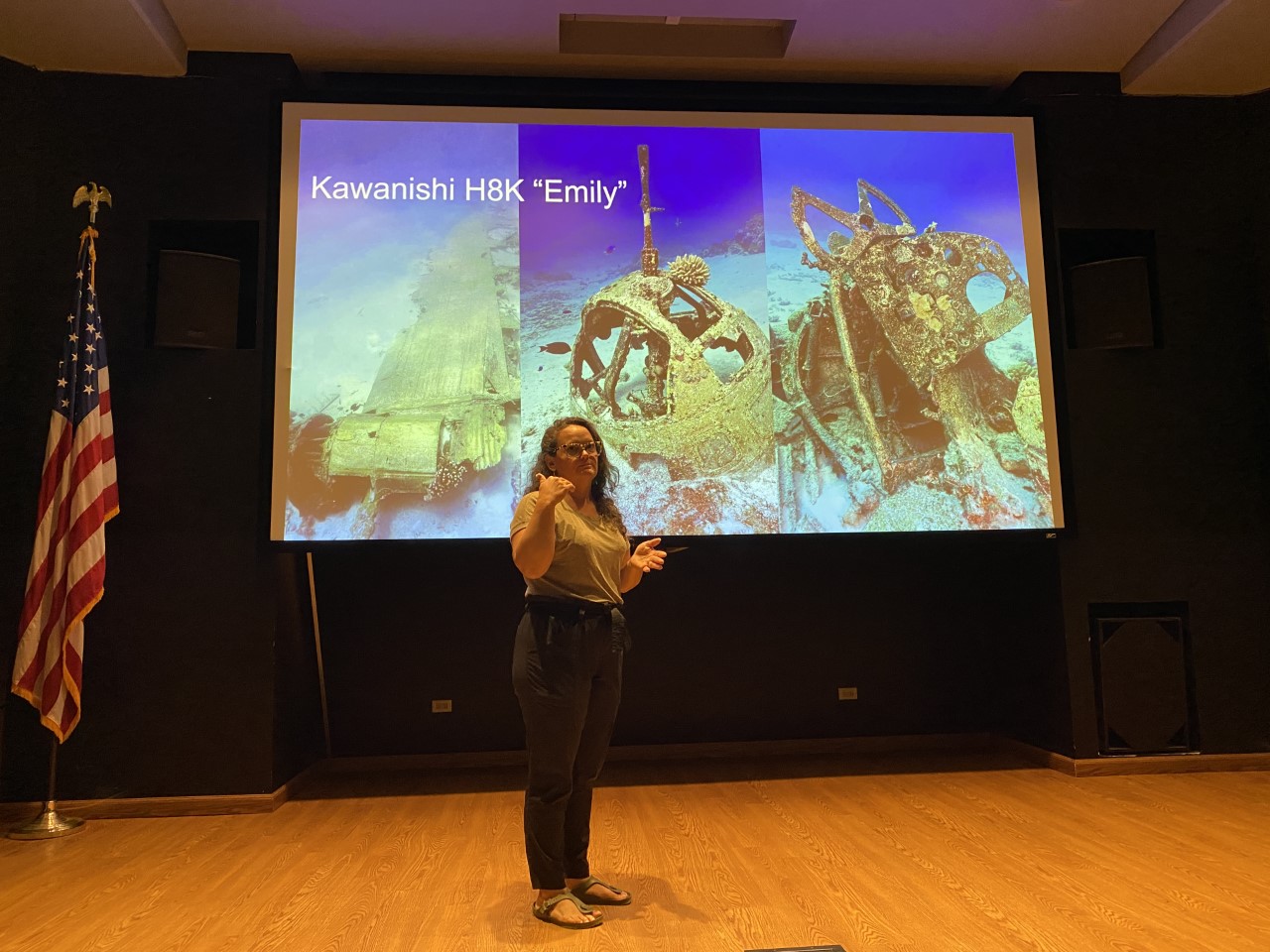
Project lead Jennifer McKinnon stands in front of a picture of “Emily,” a sunken World War II plane that has been the target of artifact theft and graffiti.
AT an underwater archaeology workshop for veterans at American Memorial Park on Wednesday, scientists shared the importance of conserving cultural heritage sites and urged participants to become “citizen scientists.”
The workshop was a training opportunity conducted by the non-profit organization Ships of Discovery in conjunction with the Mariana Islands Nature Alliance.
Participants spent Wednesday morning learning about conservation and marine sciences. Later in the day, they transitioned to hands-on practice with data collection of samples provided during the workshop.
From Thursday until May 12, participants will be underwater in the Saipan Lagoon and beyond, studying World War II wreckage. They will collect environmental DNA samples and other site data from the Pacific WWII Maritime Heritage Trail.
The trail is a “collection of underwater heritage sites featuring Japanese and U.S. shipwrecks, assault vehicles, and aircraft wrecks from the Battle of Saipan,” according to its official website.
The trail features four aircraft, three ships, one landing vehicle, and the three M4 Sherman tanks in the Susupe portion of the Saipan Lagoon.
Nicole Grinnan, who spoke on why archeologists work to conserve cultural heritage sites, said when historical sites are gone, there is no turning back.
“We’ll never be able to grow new sites from World War II or from other periods in our history,” Grinnan told the veterans. “These are non-renewable resources. We have to protect the ones that we have.”
Grinnan also touched on the importance of “in situ conservation,” which is conserving a heritage site in place, without removing its artifacts from the environment.
Grinnan said “the natural environment becomes a part of the archeological site,” and wreckage buried under sand can be among the best preserved artifacts.
She also mentioned that although the underwater environment does corrode metal, the artifact eventually reaches a “state of equilibrium” that slows its corrosion.
Jennifer McKinnon, the workshop’s project lead, told Variety that the Pacific WWII Maritime Heritage Trail is generally in good shape.
“I think it’s being managed properly by the community,” McKinnon said. “They’re doing a great job of being stakeholders of that heritage.”
During her presentation, she also noted that maritime heritage sites on Saipan are facing minor threats from diver impacts and damage caused by boat anchors.
McKinnon compared two sites in the heritage trail: the “Emily,” which is a wrecked Kawanishi H8K Japanese World War II airplane, and the Martin PBM Mariner, a sunken twin-engine U.S. aircraft.
Both are located off Tanapag, but the “Emily” is more frequently visited.
As a result, McKinnon said, the “Emily” has more “site disruption,” including graffiti and theft.
She told Variety that increased ocean temperatures will also lead to more oxygen in the ocean, which she said can “throw the sites into an active corrosion status.”
For Navy veteran and small business owner David Cabrera, it’s important to preserve the history of the NMI.
“I do believe in preservation of cultural and historic sites,” Cabrera said. “[The heritage trail] are the sites that we have the least amount of access to, which [means] we’re probably missing a lot of contextual history….”
Cabrera said he wants to take the experience he gained at the workshop and translate it to his historic preservation work on land. He is interested in starting a non-profit to develop and maintain hiking trails around historic sites on Saipan.
He said it is important to be aware that these historic sites exist in the Saipan Lagoon.
“What [lack of awareness] leads to is the finders-keepers mentality. If there’s unregulated looting from these sites we lose a lot of contextual history behind some of these sites,” he added.
Cabrera was one of many veterans taking part in the workshop. They included veterans from off-island participating in the study of the heritage trail.
One of them was Terry Schappart, a Special Forces veteran who is a member of another partner of Ships of Discovery, Task Force Dagger, which “provides assistance to wounded, ill, or injured U.S. Special Operations Command members and their families.”
Schappart and other veterans with the non-profit look forward to assisting in the repatriation of human remains they may find at wrecks around the lagoon.
He said “most people think academia and the military bump heads,” but Task Force Dagger enjoys its relationship with Ships of Discovery.
“Archaeologists are used to living in rugged conditions,” Schapart said. “They have oddball senses of humor like we do. It’s really been great.”
“We also want to get more of the local people that are interested in what we’re doing,” Schappart added. “Come out and watch what we’re doing. Participate. We want that because this is your home.”
