






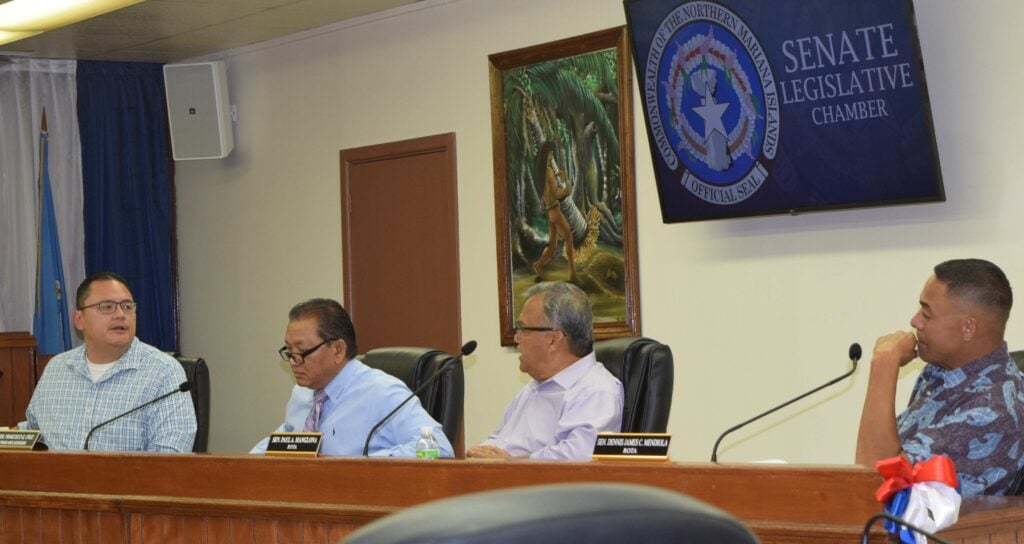
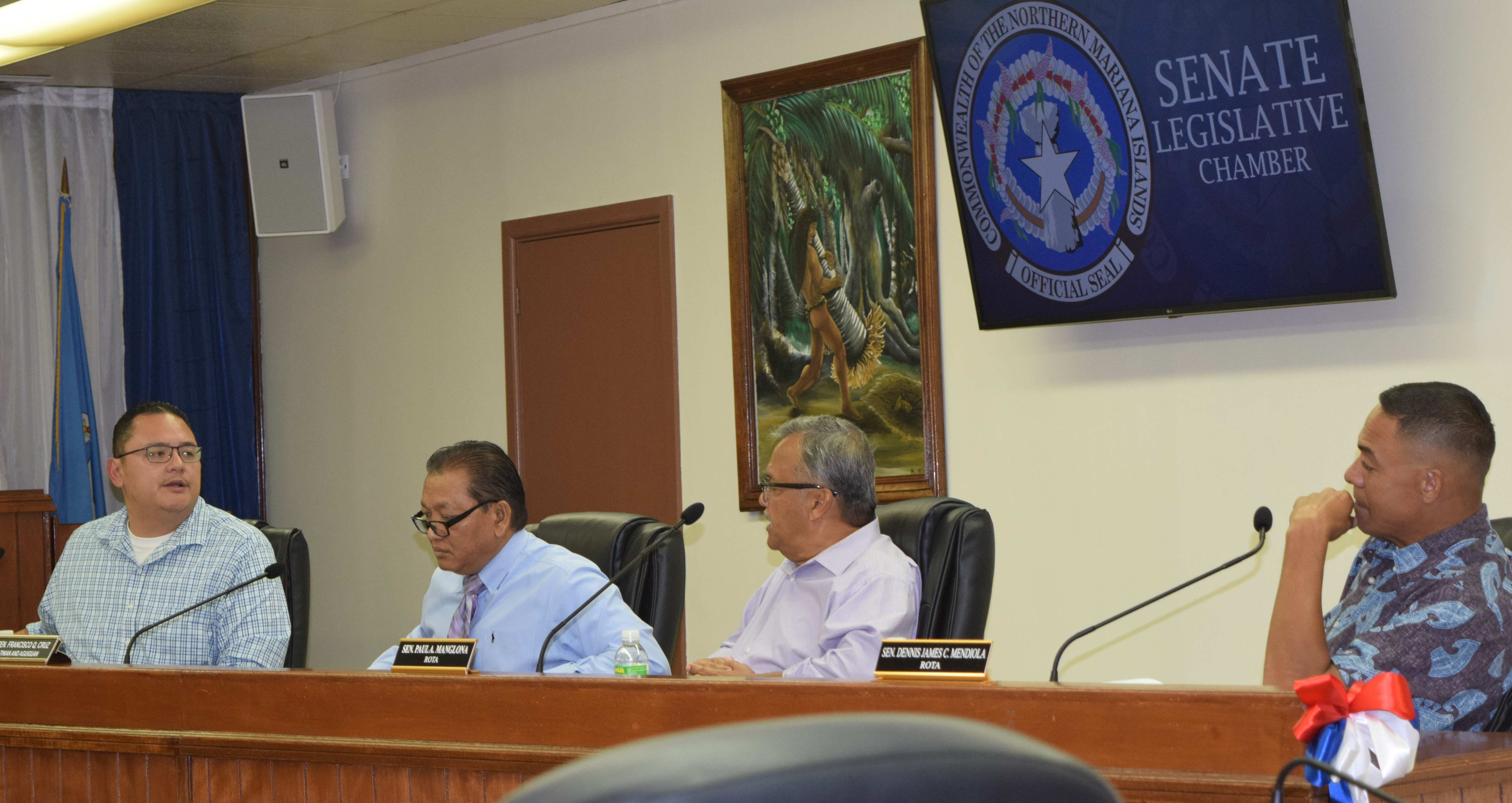
From left, Senate Vice President Donald M. Manglona, Sen. Paul A. Manglona, Sen. Frank Q. Cruz and Sen. Dennis Mendiola confer during a break from a Senate session on Monday.
THE Senate on Monday, Sept. 11, approved a $114.2 million budget bill for fiscal year 2024 that is expected to be rejected by the House of Representatives.
Lawmakers have until Sept. 30, 2023, to pass a new balanced budget. Otherwise, there will be a partial government shutdown.
The Senate and the House earlier adopted House Concurrent Resolution 23-2 to reduce the FY 2024 projected revenue to $163.4 million from $172.5 million, and the budgetary resources available for appropriation to $114.2 million from $115.4 million.
The Senate Fiscal Affairs Committee’s substitute bill also reduced the work hours per pay period of the Legislature and judiciary.
On Monday, the Senate, with eight members present voting yes, passed its version of the budget. Sen. Jude U. Hofschneider was excused from the session.
The Senate budget proposal includes other major amendments that the House is expected to reject.
One of them is the reduction of Medicaid funds by $2.2 million to give the Tinian Mayor’s Office $1.7 million so it can save the jobs of its employees.
Sen. Karl King-Nabors offered a floor amendment to allow the Tinian Municipal Treasury to return $531,277 in American Rescue Plan Act money to the general fund on a monthly basis to pay for the salaries of 24 Tinian mayor’s office employees. He also proposed to require the Legislature and the judiciary to pay their own utility bills.
Senate Vice President Donald M. Manglona, for his part, offered a subsidiary amendment to require the central government to pay for the shortfall if the Legislature and judiciary cannot sufficiently pay their utility bills.
He said courts on Rota and Tinian will “suffer the most” if the judiciary is not provided funds for utility costs.
All the eight members present voted to approve King-Nabors’ floor amendment and Manglona’s subsidiary floor amendment.
The Senate also approved King-Nabors’ floor amendment to restore funds for the Tinian Department of Public Works position for landfill supervisor that was defunded in the administration’s budget proposal.
Other changes
In discussing the Senate version of H.B. 23-66, Manglona mentioned the other major changes that the Fiscal Affairs Committee, which he chairs, has made.
These included a provision that regulates donation of sick leave; a provision requiring the central government to pay for the utilities of the municipalities of Rota, Tinian, Saipan and the Northern Islands; the removal of the House proposal to double the marriage license fee because the committee believes it should be done in a separate bill; the removal of fiscal year limitations and the inclusion of a provision allowing the Legislature and the judiciary to establish their respective hours of operation, meaning the presiding officers and the justices of the judicial branch can decide how to apply austerity measures “the way they see fit.”
The committee also included a provision that mirrored the FY 2023 budget for local Medicaid to allow the agency “to move money around in case of budget shortfall in a particular business unit.”
The Senate committee likewise removed the provision on Compact-Impact funds based on the information that the CNMI will not be receiving Compact-Impact funds in FY 2024.
Once the House rejects the Senate version of the budget bill, they will form a bicameral conference committee to draft a version acceptable to both chambers.
