



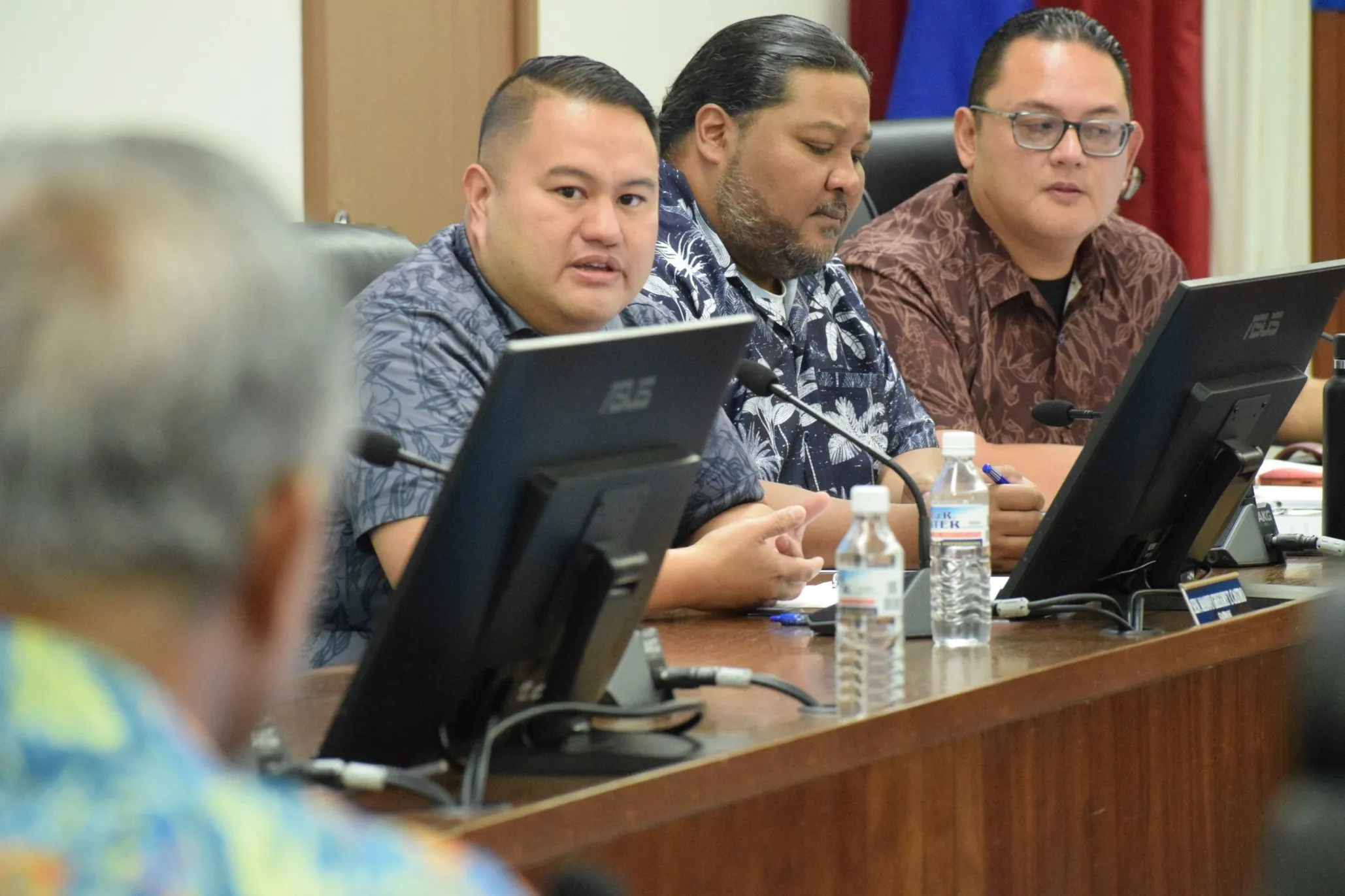


Rep. Tina Sablan, Ind.-Saipan, on Friday said the report was “depressing,” as it indicated that nothing has changed at CUC.
According to CUC’s latest financial statement, its liabilities total $216 million or 60 percent more than its assets of about $129 million.
In a 27-page report, the House Committee on Public Utilities, Transportation and Communications then chaired by Rep. Heinz S. Hofschneider, R-Saipan, stated that CUC, then under Executive Director Ramon S. Guerrero, was having trouble paying its fuel supplier Shell Marianas.
Yet CUC was getting subsidies from the general fund and advances from the CNMI government from fiscal years 1987 to 1991 totaling more than $39.7 million.
CUC was created on Oct. 1, 1985 as an autonomous government agency by Public Law 4-47.
In 1988, CUC was given $2 million in supplemental appropriation to help defray its fuel cost at a time when the oil price was much lower compared to soaring rates today.
In 1992, the Legislature passed Public Law 7-28 which provided CUC with $7.5 million to pay Shell.
Despite this bailout, CUC continued to incur arrears with Shell — about $2 million of which was outside the contractual terms.
The House committee questioned CUC’s practice of check disbursements and awarding contracts for different services or supplies.
“For example, Phelps Dodge Philippines Inc., a U.S. vendor based in the Philippines supplying CUC with secondary triplex wires was paid without evidence of CUC inquiring for best price from other U.S. vendors. CUC disregarded competitive sealed bidding as required by regulations,” the report stated.
A review of CUC’s collections and expenditures from 1990 to 1992 showed that the agency spent over $99 million in questionable expenditures.
In July-August 1992, the committee subpoenaed CUC’s Guerrero and his acting comptroller Renato Alcazar. Guerrero snubbed the committee’s invitation claiming that the subpoena was defective.
Then-Speaker Thomas P. Villagomez, R-Saipan, cited Guerrero in contempt of the legislative subpoena.
“There was an untiring effort by the executive branch, particularly [then-Lt. Gov.] Benjamin T. Manglona to have the House committee…drop the contempt charge, citing the political ramifications it would have upon the Republican Party which controls both branches of the government,” the report added.
The issue was settled after the Attorney General’s Office decided to drop the criminal nature of the contempt citation and pursue it as a civil case.
The GOP later expelled Hofschneider for “disloyalty” to the then-Republican administration.
Washington, D.C. was not pleased with what was happening at CUC which had been receiving millions of federal dollars.
In a letter to then-Gov. Lorenzo I. Deleon Guerrero, Stella Guerra, the director of the U.S. Department of the Interior’s Office of International and Territorial Affairs, said: “I must reiterate my expressed concern regarding the management and financial problems at [CUC]. … It is time for CUC to put this gamesmanship behind it and start addressing its real problems.”
Guerrero’s deputy, Timothy P. Villagomez, was named CUC executive director in 1994. He remained the agency’s top executive until Juan N. Babauta was elected governor in 2001.
As lt. governor, Villagomez was asked by Gov. Benigno R. Fitial to oversee CUC.
Last Aug. 11, Villagomez was indicted by a federal grand jury on charges of conspiracy, fraud and theft in a case that involves CUC and federal funds.
