






A HOUSE joint panel finds it unbelievable that Department of Commerce-Economic Development Director Jesus Taisague did not influence the decision of the Building Optimism, Opportunities, and Stability Together or BOOST program review panel in approving the $225,000 grant request of Love Birds bar of which he said he is a part owner.
Taisague, who owns 45% of the business entity, said he recused himself from the review and discussion of its grant application.
Taisague represents Commerce Secretary Edward “Tofila” Deleon Guerrero on the review panel whose two other members are Office of the Governor Chief of Staff Wil Castro and former Finance Secretary David DLG Atalig.
The BOOST program administrator is Bank of Saipan whose president, John Z. Arroyo, told the joint panel last week that the bank should not have submitted a BOOST grant application. The bank was awarded a total of $500,000 in BOOST grants.
As for Taisague, his business partner, former Tinian Dynasty Hotel Casino Assistant Manager Alexandra Jing, owns 55% of Love Birds which opened in February 2021 on Tinian. The bar, which opened a restaurant after receiving the BOOST award, got the largest amount of BOOST grants provided to Tinian.
Taisague also admitted that he is the resident agent for Jing’s other businesses, the Flower Tea House in Garapan, which received $125,000 in BOOST grant, and the Saipan Horse Course in Kagman which was awarded $200,000 in BOOST grant.
During Tuesday’s hearing, the House joint panel noted that Taisague’s business partner also owns Saipan Goddess, which received $125,000, and Sakura Group, which was awarded $50,000.
On Wednesday, Taisague clarified that he has no stake on Saipan Horse Course, Flower Tea House, Saipan Goddess or Sakura. He said the only company he has a financial interest in is Love Birds, and that was the reason he recused himself from the review panel when its BOOST application was submitted.
“Do you expect people to believe that?” Rep. Tina Sablan asked.
She presented a text conversation between Castro and Bank of Saipan personnel indicating that Castro was following up on the BOOST grant application of Love Birds and Tinian Shipping Services which received $200,000.
Taisague said he wasn’t aware about any discussion about Love Birds because he had recused himself, but he could not recall if he left the room when its application was discussed. “I have no recollection on that,” he added.
Sablan asked why the applications of Love Birds and Jing’s other businesses were on top of the stack of BOOST applications, and why Castro was following up on them.
Taisague replied, “I wish I can answer you on that one. I have no knowledge on that,” he said adding that he did not intervene on behalf of Love Birds.
Sablan reminded him that he was under oath, and added that due to the BOOST review panel’s lack of records and minutes of meetings, Taisague has no proof that he recused himself from the review and discussions of his business partner’s BOOST applications.
Open Government Act
Rep. Celina Babauta, the co-chair of the joint House committee, asked Taisague, “You expect people and this joint committee to believe you that it was purely coincidental that your business partner’s businesses were awarded over $1 million because it just happened that her application papers were on top of the applications stack when the review panel randomly picked them?”
Taisague replied, “I have no comment on that.”
Babauta said the review panel, as a government entity, should have followed the Open Government Act provisions when conducting its business. These include keeping records, she added.
“I cannot comment on that without legal counsel’s guidance,” Taisague said. “I came here in good faith to engage myself in providing information, but when you start pulling laws on me, this is the time I would need legal representation.”
Babauta said the joint committee appreciates his appearance in good faith, but added that she had to raise the issue regarding the Open Government Act.
Taisague replied, “I have already mentioned that I did not know, but you started showing me laws, rules…I guess you should afford me legal representation.”
House legal counsel Joe Taijeron told Taisague: “We are not denying you your right to counsel, but that does not give you the right to refrain from answering the questions.”
Personal relationship
Asked by Sablan how well he knows Alexandra Jing, Taisague said, “Very well. She reached me out when she was interested in a family property. She was referred by an individual that knows me and my siblings who own the property. That was how we met. It was quite some time back, probably almost 10 years ago.”
“You have a personal relationship with Alexandra Jing? Is she your girlfriend?” Sablan asked.
“No, she’s not my girlfriend, but she is a good friend,” Taisague said.
On Thursday last week, Variety sought comment from Alexandra Jing who said, “Why come only to me, when there are over 200 other applicants who received BOOST awards?” She declined to comment further.
Badgering the witness
Taisague complained that Sablan was badgering the witness when she asked him about fairness, and if the review panel favored certain BOOST applicants.
Taisague said the program is designed to encourage everyone to apply, which means everyone is privileged to apply.
Taisague said he would also prefer to speak Chamorro because he “stumbles” in English.
Babauta volunteered to interpret his answers in English, but Taisague said last time she did that, he was misquoted in the newspaper.
He asked Babauta to please translate his Chamorro accurately in English.
Sablan then asked him about the process involved in the second round of BOOST applications. Can just one review panelist tell the bank to issue a second check? she asked.
Taisague said he could not comment on that, but added that once the panel already reviewed a business plan and submitted an application to the governor for his final approval, then if there was a second check, that means it was also considered in the first round of review.
He said the process involves the collective decision by the panel.
In the case of Love Birds’ application, Sablan asked, “If you recused yourself, who else aside from Castro told the bank to award Love Birds?”
Taisague said, “I don’t know. I have no knowledge on that one.”
“Did you tell the other review panelists why you recused yourself?” she asked.
Taisague said, “I would have probably indicated that. And I did, I believe so.”
Sablan said there should have been records of evaluations and statements of recusal in the minutes of the review panel’s meetings as required by Commonwealth law.
Sablan then asked Taisague, “You said everyone is privileged to apply; isn’t it true that not everyone is privileged to get awarded?”
Taisague said, “Like I said in the beginning, this program is to revitalize, enhance the economy in order to expand the tax base. Based on my understanding of the program, when we opened it to everybody, and also based on my understanding, it is not a stimulus program that everyone would receive.”
Sablan said, “Yes, we heard you say that. But the problem is, not everyone is even privileged to have their applications…reviewed, and you said yesterday that not all applications were reviewed.”
She added, “One panel member’s…associates [were] among the first awardees to take over $1 million from this program. More than 10% of the initial $10 million. That is privilege, right?”
Taisague said, “I wouldn’t say that was privilege. Everyone can apply and be reviewed.”
“But was everybody reviewed?”
“Not yet, because we’re not done yet,” Taisague said.
“When [will you be done]?” Sablan asked.
“Good question,” Taisague said.
“I know it’s a very good question. You don’t even know when the next review session will be, and you don’t even know when there’s even funding in the program.”
“Isn’t it time,” she said, “that we stop misleading people and say their applications haven’t been reviewed yet, and that the program is not done yet? “
Taisague said, “I would not say that we were misleading the people.”
Word twister
Sablan said there’s evidence on the record that the former Finance secretary also followed up the checks for the applications of close family members even before the applications were completed and approved. “That is not privilege to you?”
Taisague answered, “I don’t have any knowledge of that.”
“What about the privilege of the single biggest BOOST award to Bank of Saipan?”
“I don’t have any knowledge on that. I also said I did not participate in the review of [the bank’s] application,” he said. He earlier said that he only reviewed applications from small businesses.
Sablan continued, “And the privilege of the very first non-profits…awarded more than hundreds of thousands of dollars [as well as] start-ups…associated with another review panelist who also happens to be the governor’s chief of staff and the re-election campaign manager. That is also privileged.”
“I don’t have knowledge [about that].”
But you are a review panelist, right?”
Taisague told Sablan in Chamorro, “You are twisting your words to trick me.”
But Sablan said she was just stating the facts from the records, to which Taisague replied, “the records I have no knowledge of.”
Sablan said “but they are the records that you should have knowledge of if you are a panelist reviewing these applications.”
“You are badgering the witness,” Taisague told Sablan.
Babauta reminded Taisague that he freely appeared before the joint committee without counsel.
“Yes, but I came here in good faith and not to be badgered,” Taisague said.
Sablan told Taisague that it was not her intention to badger him. “But you are a review panelist making decisions for millions of dollars of public funds.”
“Yes, I know,” Taisague said.
Sablan said, “And so maybe there are hard questions that we need to ask because people are demanding answers. And going back to the question of who is privileged in this program, without records or documentation, or even a real process to ensure the integrity of this program, and accountability for these funds, isn’t it possible for ‘insiders’…and their family members and their associates to take millions of dollars from this program while the vast majority of applicants get nothing at all? Isn’t that actually what happened?”
Taisague said, “I will not comment on that because that is not what transpired. There is a process, there is an understanding that if there is conflict of interest, one has to recuse himself.”
He said he has already explained that BOOST is not a stimulus program. “There is a process and when I’m on the review panel, I read the business plan of the applicant. But you keep asking me, insisting that just because a lot of people are complaining, you keep going round and round and asking me the same questions. Each one of you. You keep badgering me,” Taisague told the joint panel members.
Sablan asked, “Do you really expect people to believe you, knowing what they know about who got the awards and how they are connected to the review panelists [or] to the Republican Party? Do you even expect people to believe that this is a fair process?”
Taisague said, “It may not be a perfect program because there is no program that is perfect.”
Sablan said “it is far from perfect.”
“That is your opinion,” he replied.
“So, we agree that it is far from perfect,” Sablan said.
“That is what I am saying, I kept repeating myself. There is always room for improvement. And you think I would stumble as you are trying to entrap me, I think this is the moment for me to bring an attorney,” Taisague said.
He was still talking when Babauta called for a recess.
‘How is that fair?’
Rep. Edwin Propst asked Taisague how many employees Love Birds has.
Taisague said it has three employees but has expanded after receiving $225,000 in BOOST grant.
Propst said there are other restaurants that applied for BOOST awards. These include restaurants that have been in existence for many years and have more employees. He said one of them requested $55,000 but was awarded $10,000 only.
“Why is Love Birds more deserving? How is this possible that your restaurant was more important than several restaurants that received not one penny while in operation long before your own establishment was open in 2021? How is that fair?”
Taisague declined to comment.
“And you expect the [joint committee] co-chairs, [our] legal counsels, myself, and my colleagues and everyone watching to believe that your business associate somehow, someway, by coincidence received 10% of the total amount of the BOOST program that was awarded originally? That somehow, one person who happens to be your business associate and business partner miraculously received 10% of the entire BOOST? Sir, you mean to tell all of us that this is just sheer coincidence?”
Taisague said, “I have already established [the fact] that I recused myself and I have answered your questions to the best of my knowledge, and to the best of my recollection.”
Propst said, “You recused yourself, you said that. But there is no proof of that sir. And that is the most troubling thing when I said it because you have zero records, which, by the way, are required by law. You [should] have written that statement in the minutes. That is Commonwealth law. Yet you guys were not taking minutes whatsoever. There is no record of anything…because they do not simply exist.”
Propst added, “You…can say that we are badgering you…but so far in your testimony, in everything that you have given, you have shown that there is no true rubric, there are no defined plans. Your decisions for giving the amounts and who received them were strictly and purely subjective based on how you guys felt at that time. You have clearly established the fact that you only gave 10 to 15 minutes per proposal…. There is no fairness, but what we have seen is a mockery of it, sir…. I don’t have a question for you. I am just frustrated at this point that we had to deliberate and ask questions and we’ve gotten nowhere with the answers.”
The joint committee’s co-chair, Rep. Donald Manglona, then dismissed Taisague and called for a recess.
Serious problem
Propst said the lack of records to support the claim that a review panelist recused himself is a serious problem.
“We have $17 million used for BOOST and the very first problem you had was that you never consulted with legal counsels. If you had, they would have told you, perhaps ‘we shouldn’t do this,’ or they should have given you some fair warning, some good advice,” he told Taisague.
“And if the panel consulted with an attorney to do the things the way they did, that attorney needs to be fired for giving you bad advice.”
Propst said an attorney should have advised the panel to include the Office for Grants Management in the decision-making process.
He said the review panel “violated Commonwealth law, it violated federal laws, and…when the internal audit…happen[s]…the federal government will come down hard. The federal authorities will ask if the review panel and the administrator followed local law or local regulations. And the answer will be no. What do you think the federal government will do at that point? Let me tell you what they will do. They will do what they have done in the past. They will do an investigation, they will find things wrong with it, and then, they will say the CNMI must pay the $17 million back.”
“And who is going to be on the hook sir?” Propst asked. “It is not going to be you and not your fellow panelists. It would be our taxpayers who will have to pay that money back. This is a very serious matter. This is not something to be taken lightly. There are tons of proof that this is not done in a right manner and that there is possibly fraud committed. I’ve seen enough today.”
The public hearing will resume at 10:30 a.m. today, Thursday, for another witness, a Bank of Saipan employee.
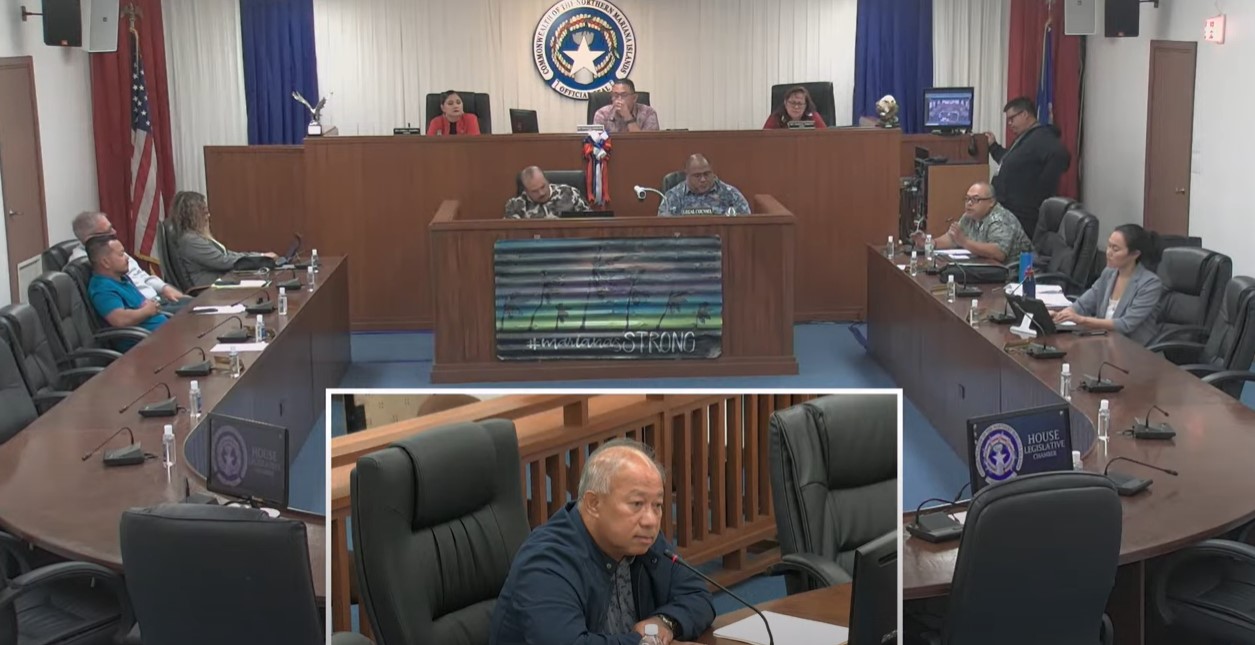
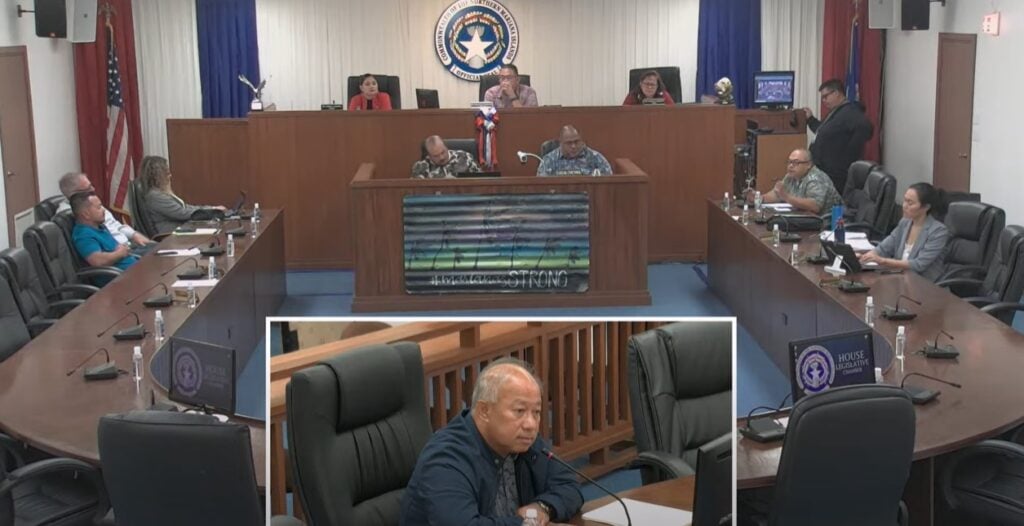
Department of Commerce-Economic Development Director Jesus Taisague appears before a joint House panel on Wednesday during the resumption of its public hearing on the BOOST program.
