



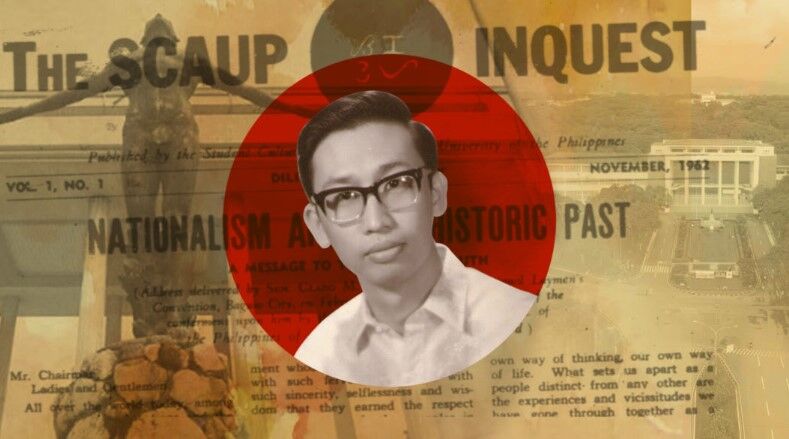
JOSE Maria Canlas “Joma” Sison, who passed away last week at the age of 83, never held elective office in the Philippines which he left in 1986, never to return again. Yet for over half a century, he was one of his country’s most influential political figures. When he was in his 20s, he set out to change the course of Philippine history. He certainly did, but not in the way he had envisioned.
Born to a prominent landowning family, Joma as a teenager wanted to be a lawyer, go to Harvard and run for office. Instead, he ended up getting a degree in English literature, writing poems and joining the pro-USSR Communist Party of the Philippines. Saying that the party, which was founded in 1930, was hopelessly outmoded, he “re-established” the CPP under “the glorious banner of Marxism-Leninism-Mao Zedong Thought” on Dec. 26, 1968, the 75th birthday of Chairman Mao. Joma was 29. His new party had 12 other members, all in their 20s. They vowed to wage a “people’s democratic revolution” whose aim was “the seizure of state power and the consolidation of people’s democratic power as the transitional stage toward socialism.”
On March 23, 1969, Joma’s party and a 23-year-old Huk, Bernabe Buscayno, aka Commander Dante, founded the New People’s Army. The “old” people’s army was the Huk (short for “Hukbong Bayan Laban Sa Hapon” or the People’s Army Against Japan) which valiantly fought the Japanese during World War II. After the war, the Huks waged armed struggle against the brand new Republic of the Philippines, but were crushed by the U.S.-backed Philippine military. By the 1960s, the few remaining Huks were basically bandits or guns for hire whose clients were elected officials.
Joma, whose nom de guerre was Amado Guerrero or Beloved Warrior, launched his revolution with an “army” consisting of about 50 peasants with 35 weapons. Their enemy was the well-armed and U.S.-backed Armed Forces of the Philippines which had thousands of servicemembers in addition to the police force and the government’s para-military groups.
Brimming with Maoist optimism, Joma believed that the New People’s Army or NPA would grow rapidly. He was right. The NPA’s “best recruiter” turned out to be President Ferdinand Marcos Sr. who declared martial law in 1972 and ruled by decree. Eventually, hundreds if not thousands of college students and young professionals would join the CPP and/or the NPA and willingly fight and die for Joma’s revolution.
The guerilla is like a poet, so goes one of Joma’s most famous poems:
Keen to the rustle of leaves
The break of twigs
The ripples of the river
The smell of fire
And the ashes of departure.
In his 1989 book, “Red Revolution,” Gregg R. Jones wrote that by 1984, U.S. officials “who had dismissed [the] NPA as little more than a nuisance” had been “jolted from their lethargy by the spectacular expansion of guerilla operations in the countryside and communist political activities in the cities. Dire assessments from Washington raised the specter of the CPP seizing power or forging a coalition government with moderate opposition forces…. Marcos and his political allies were discredited; the nonviolent political opposition was fragmented and lacked an alternative vision for governing.”
In contrast, Jones added, “the revolutionary forces were well organized and well disciplined. The rebel movement offered a clear vision of the future, and its leaders were some of the brightest and most dedicated Filipinos who had come of age since the 1960s.”
The Philippines’ most wanted man, Joma was arrested in 1977. He was severely tortured by the military. “For the first 18 months of his imprisonment in a Manila army stockade, he was manacled and fettered to his cot,” Jones said. Joma “was held in solitary confinement for five years.”
He was released in 1986 following the ouster of President Marcos in a military-backed popular uprising during which the CPP-NPA didn’t play a major part.
Since then, many of Joma’s old comrades and followers have ceased to be true believers. Some of them became his enemies. But Joma never wavered in his convictions — despite the CPP-NPA’s dwindling membership, China’s forsaking Maoism and the disintegration of the USSR and other socialist regimes around the world. (Incidentally, he chose exile in the Netherlands, a capitalist, constitutional monarchy, and not in, say, Cuba or North Korea.)
In one of his last public statements, Joma’s “diagnosis” of Philippine society and politics showed little or no divergence from his pronouncements in the 1960s:
“The chronic crisis of the ruling system continues to worsen rapidly. The broad masses of the people desire revolutionary change. They are sick and tired of false promises of political agents of the exploiting classes. The conditions for the further advance of the people’s democratic revolution are therefore more favorable than ever before….”
Says a former Marxist, the American writer David Horowitz:
“Why do [leftists] not see that the future they are promoting has already failed elsewhere? First, because they see history as something to transcend, not as providing a reservoir of experience from which they must learn. Second, because in their eyes the future is an idea that has not yet been tried.”
As the Communist Party of the Philippines would put, it is “certain that with the treasure of Marxist-Leninist-Maoist work that [Comrade] Joma has produced over the past five decades of revolutionary practice, the Party is well-equipped in leading the national democratic revolution to greater heights and complete victory in the coming years.”
Amen.
Send feedback to [email protected]

In the 1960s, Jose Maria Sison taught English literature and political science in several Philippine universities. One of his former students is former President Rodrigo Duterte who calls himself a socialist.
