






MAJURO — Outgoing Federated States of Micronesia President David Panuelo issued a bombshell letter Thursday detailing what he described as China’s efforts to undermine the FSM’s sovereignty and to bribe government leaders to gain endorsement of agreements beneficial to China but not to the western Pacific island nation.
In a 13-page letter addressed to FSM Congress Speaker Wesley Simina and the speakers and governors of the four Micronesian states, Panuelo said “the FSM is an unwilling target of PRC-sponsored Political Warfare and Grey Zone activity.”
Panuelo lost his bid for reelection in the FSM’s every-four-year national election Tuesday March 7. He issued the letter two days later.
Panuelo lists numerous examples of what he described as attempts at diplomatic interference, influence or manipulation.
The FSM holds a unique position among the three freely associated states in the North Pacific that have security and economic agreements with the U.S. The FSM also has diplomatic ties with China. Both Palau and the Marshall Islands recognize Taiwan. Panuelo has been outspoken in efforts to navigate his country’s strategic position between the increasing competition of Being and Washington for influence in the region.
The direction that Chinese diplomacy took toward the FSM over the past three years prompted Panuelo to meet Taiwan Foreign Minister Joseph Wu last month “to solicit from Taiwan what their potential assistance would to the FSM would look like if we switched diplomatic relations to supporting them instead of China, and what benefits we can get if we don’t switch relations formally but do explore initializing a Taipei Economic and Cultural Representative Office.”
The meeting, said Panuelo, resulted in Wu outlining specific areas of support for the FSM, including a $50 million injection of funding to the FSM trust fund, an annual aid package, and numerous other areas of Taiwan-provided cooperation. In follow up to the meeting with Wu, Panuelo invited representatives of Taiwan’s International Development and Cooperation Fund to visit the FSM later this month.
Last year, when China attempted to gain approval of Pacific Island Forum members for a regional security agreement with China, Panuelo publicly opposed it in a lengthy letter written to all heads of state in the region.
In his latest letter, Panuelo cites numerous examples of China’s “political warfare and gray zone” activity against the FSM.
Panuelo said the FSM government chose to make available U.S.-provided Covid vaccines made by Pfizer, Moderna and Johnson & Johnson due to their being “the most effective available. It was a medical decision, based on science and with the intent of protecting our nation.” But, said Panuelo, China was relentless in attempting to get the FSM to accept Chinese-produced Covid vaccines that Panuelo said “were not particularly effective.”
So intense was the campaign by the PRC’s ambassador to the FSM Huang Zheng that Panuelo and his secretaries of health and foreign affairs all changed their mobile phone numbers “due to incessant calls from Ambassador Huang.” Ultimately, Panuelo said, PRC got its way with FSM accepting Chinese-made vaccines.
Agreements important to the PRC in the geopolitical rivalry with the United States became issues of serious concern as a result of heavy-handedness by Beijing officials, Panuelo said.
He said the FSM’s foreign policy is founded on two concepts: The FSM is a friend to all and enemy to none, and the FSM extends to all nations “that which we seek: peace, friendship, cooperation and love in our common humanity.” But, he said, this policy creates a vulnerability for the FSM.
While he said it is the right policy for the FSM to implement, “it also presents an opening that, if not watched for, and if not managed, could allow the sovereignty that we jealously guard to chip away before our own eyes.”
Panuelo said a PRC white paper shows that President Xi Jinping has instructed the People’s Liberation Army to be prepared for an invasion of Taiwan by 2027. While the FSM doesn’t know when or even if an invasion will happen, it knows that “the FSM has a key role to play in either the prevention or such a conflict, or participation in allow it to occur,” he said. “It is on this basis that political warfare and gray zone activity occur within our borders; China is seeking to ensure that, int he event of a war in our Blue Pacific Continent between themselves and Taiwan, that the FSM is, at best, aligned with the PRC instead of the United States, and, at worst, that the FSM chooses to ‘abstain’ altogether.”
He lists page after page of incidents related to the FSM that he says are examples of how China intends to form a “new type of international relations.”
He said he rejected an agreement from China that purported to support development of a Blue Prosperity Micronesia initiative because it “included a number of serious red flags.” Among these was the FSM opening the door for the PRC to “begin acquiring control of our nation’s fiber optic cables as well as our ports.”
In June last year, Panuelo said he told the cabinet that the FSM would reject the “Deepening the Blue Economy” memorandum of understanding. But the PRC continued to promote the MOU. “In December 2022, I learned that we were mere hours from its signing,” he said. “I put a halt to that MOU, and formalized, in writing, our permanent rejection of it.” But, he added, the same evening that he issued formal rejection of the MOU at a farewell dinner for departing Ambassador Huang, the ambassador suggested to a Cabinet member “that he ought to sign the MOU anyway, and that my knowing about it — in my capacity as Health of State and Head of Government — was not necessary.”
In case anyone could misunderstand what he was saying, Panuelo added: “The same ambassador who relentlessly shouts that the PRC does not interfere in the governance of other countries was himself actively attempting to interfere in our country’s governance, so as to accomplish his mandate benefit to the PRC but not to the FSM.” The MOU was further lobbied for by the PRC Special Envoy Qian Bo during a visit to FSM earlier this year, he said.
Panuelo said at the first China-Pacific Island Countries Foreign Ministers Meeting, held in late 2021, the “proposed Joint Communiqué was laced with several problematic layers of statements that we as a nation had not agreed to. There were references towards establishing a multitude of offices that our government wasn’t aware of, some of which could be seen as benign or harmless. Regardless, the FSM requested that countries receive more time to review the Joint Communiqué before it went out.” But island leaders’ requests “were unheeded, and China immediately published the Joint Communique inclusive of remarks which were false, that the FSM and the other Pacific Island Countries had agreed to it, which, in our case, we hadn’t.”
The theme of disrespect of the FSM’s sovereignty by China continues “with PRC saying we have achieved a consensus when we have not.”
He said bribes are a weapon in China’s political warfare arsenal. “What else do you call it when an elected official is given an envelope filled with money after a meal at the PRC Embassy or after an inauguration?” he asked. “What else do you call it when a senior official is discretely given a smartphone after visiting Beijing? What else do you call it when an elected official receives a check for a public project that our National Treasury has no record of and no means of accounting for?”
He said shortly after Vice President Aren Palik was sworn in as the new vice president of the FSM in September last year, he was invited to the Chinese Embassy for a dinner and was offered an envelope filled with money, Panuelo said. “Vice President Palik refused, telling the ambassador to never offer him a bribe again and upon doing so was advised by Ambassador Huang something close to the effect of ‘you could be president someday’ as the rationale for the special treatment.”
Panuelo, who will step down when a new administration comes into office in May, said ties with Taiwan could be beneficial with the FSM in more than simply economic terms. Aid would be coupled with “the greatly added layers of security and protection that come with our country distancing itself from the PRC, which has demonstrated a keen capability to undermine our sovereignty, rejects our values, and uses our elected and senior officials for their own purposes.”
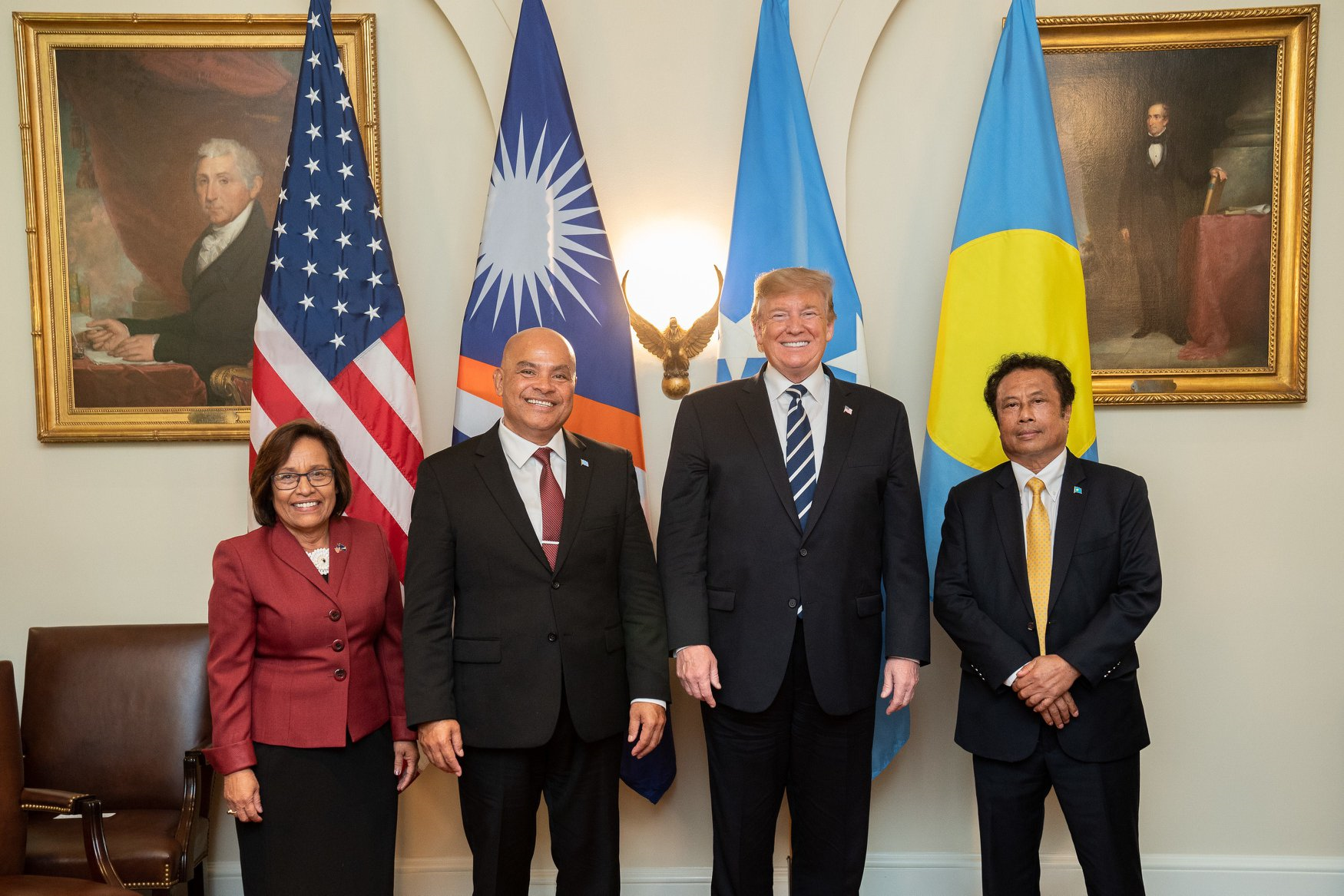
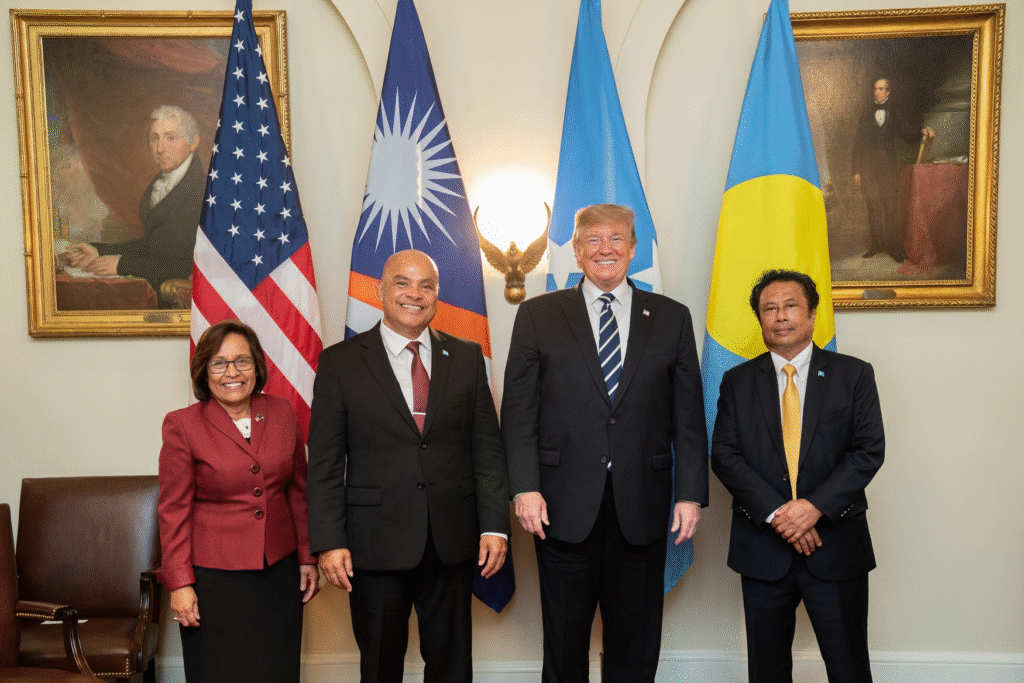
In this 2019 file photo, Federated States of Micronesia President David Panuelo, second from left, joined U.S. President Donald Trump, Marshall Islands President Hilda Heine and Palau President Tommy Remengesau Jr. at the White House.
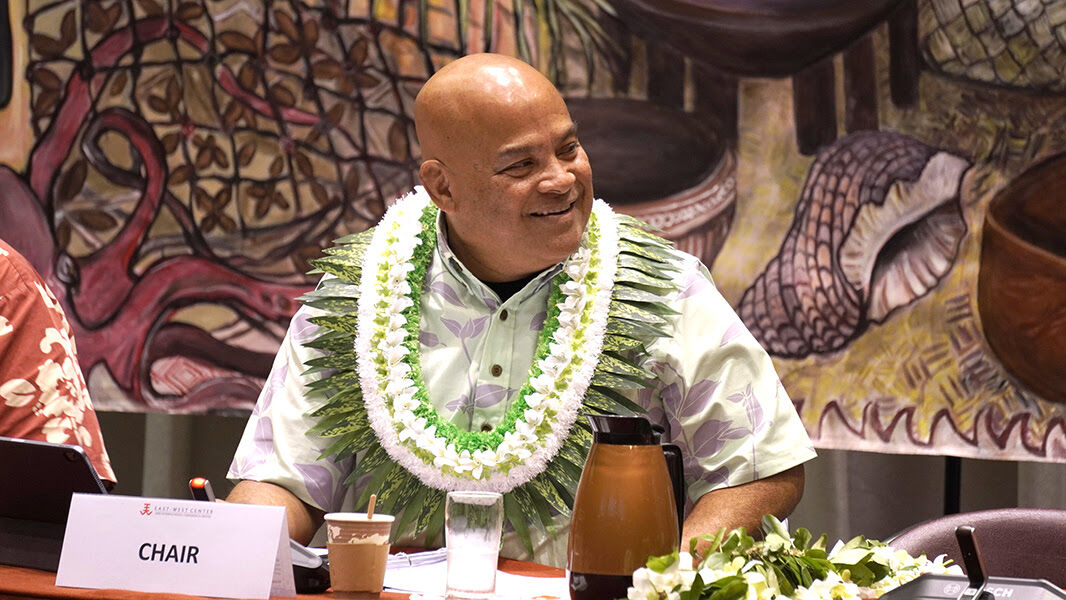
Federated States of Micronesia President David Panuelo chaired the Pacific Islands Conference of Leaders held at the East-West Center in Honolulu last year.
