



GOVERNOR Arnold I. Palacios transmitted to the Legislature on Wednesday a revised fiscal year 2023 budget that proposes a “temporary” reduction of government work hours from 80 to 72.
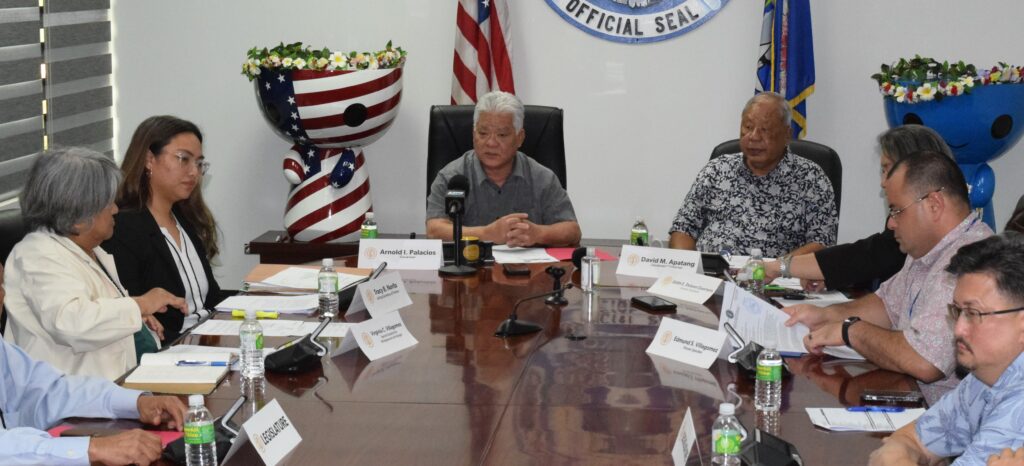
The governor, Lt. Gov. David M. Apatang, acting Finance Secretary Tracy B. Norita and Special Assistant for Management and Budget Vicky Villagomez conducted a press conference with lawmakers at 3:30 p.m. to announce proposed changes to the budget.
Apatang noted that the revenue collections for the first and second quarters of the fiscal year were up by 11% or $11.2 million, which he said indicates that “there are some positive developments in economic activities.”
But Governor Palacios said the over $481 million in American Rescue Plan Act funds, which would have been sufficient to cover CNMI government expenditures for three years, had been “depleted within just 18 months.”
The depletion of the ARPA funds, which were supposed to cover 20% of the government’s personnel cost, could have resulted in the reduction of work hours to 64 from 80 per pay period. However, the governor said, “as we monitor cash collections and the effectiveness of cost-containment measures, the revised budget we propose instead provides for a temporary reduction from 80 to 72 hours.”
Public Law 22-22 or the FY 2023 budget measure identified $109.7 million in projected revenue that should be available for appropriation.
In his March 8, 2023 letter to Speaker Edmund S. Villagomez and Senate President Edith Deleon Guerrero, the governor said the revised estimated net revenue for FY 2023 is $116.1 million.
However, acting Finance Secretary Norita said the local economy “hasn’t returned to a pre-Covid-19 level yet,” which means that the CNMI government still relies heavily on federal funds.
The governor said the proposed budget revision will “reflect the fiscal crisis we are facing and…ensure the continuity of essential government functions, programs, and services. This fiscal crisis has forced our hand, to make difficult and painful decisions in the coming months.”
For the remainder of the fiscal year, the governor said “local revenues must be utilized to sustain government operations and services.”
He said the CNMI “faces no other choice but to revise the Appropriations and Budget Authority Act for FY2023 to reflect the depletion of ARPA funds by removing ARPA as an identified resource to pay government operational cost.”
He added, “A revised budget is urgent and necessary because the current budget law assumes the availability of federal funds to cover major government obligations, based on the assurances of the previous administration.”
Palacios said his administration is aggressively pursuing other federal reimbursements owed to the CNMI government. He said they will continue to press upon the Public Assistance Office and the Federal Emergency Management Agency to urgently process reimbursements for all major disasters declared in the CNMI since 2015.
He said his administration intends to apply the funds received in FEMA reimbursements to cover at least a portion of the Commonwealth’s obligations to meet the local match requirement for Medicaid and the 25% portion of retiree pensions.
But Palacios said a significant amount of anticipated reimbursements from the federal government must be used to replenish ARPA funds that were, in effect, borrowed during the previous administration.
He said the fiscal response team he formed to review the CNMI government’s finances has determined that a total of approximately $116.3 million in ARPA funds were used to pay general fund obligations for Super Typhoon Yutu and Covid-19 recovery and government operations.
Of this amount, Palacios said the fiscal response team identified payments totaling $78.6 million that were not part of the ARPA spending plan approved by the U.S. Treasury. These “may be required to be reimbursed with local revenue if amendments to the spending plan are not made,” he added.
“My administration is preparing to submit to the U.S. Treasury a request for amendments to the Commonwealth’s ARPA spending plan,” Palacios said.
“We now know that both ARPA and CDL (Community Disaster Loans) funds were in reality overspent and overcommitted by the previous administration and are no longer available in this fiscal year. Taken together, the ARPA and CDL funds — totaling nearly $600 million — ideally would have been sufficient to help the CNMI cover expenditures through 2026. And because ARPA and CDL are no longer available to sustain government operations and services, we now have to remove them from the budget and rely almost entirely on local revenues to keep the government functioning for the rest of the fiscal year,” Palacios said.
He said his administration has proactively implemented other cost-containment measures including:
1) Termination of about 500 ARPA funded positions.
2) Suspension of within-grade increases.
3) Termination of vehicle and office leases in the executive branch.
4) Restrictions on locally funded travel.
5) Review of vacant positions and whether they can be eliminated to fund operations for the remainder of the fiscal year.
6) Ongoing streamlining of government functions to increase efficiency and reduce costs, including the merger of particular functions between the Department of Lands and Natural Resources and the Department of Public Lands, and the transfer of key functions of the Infrastructure Recovery Program to the Office of Planning and Development.
The governor said they will continue to actively monitor cash collections, the effectiveness of containment measures, and economic conditions to determine if any further adjustments need to be made.
“Achieving fiscal stability and recovery will require the collective efforts of all branches of the government, and especially the partnership of our legislative branch, and the support of our community. As part of our commitment to a transparent government, we will continue to update our legislative partners, and our community, about the Commonwealth’s fiscal and economic conditions, and the path forward to sustainability,” Palacios said.
For his part, Apatang said the $11.2 million projected increase in local revenue will be reallocated to government operations and priority obligations for the remainder of the fiscal year.
He said he and the governor will ensure continued payment of debt service; continued payment of the government’s obligations to the Settlement Fund and the Public School System; the allocation of $1 million to cover group health insurance for the remainder of the fiscal year; support for the Commonwealth Healthcare Corporation’s health network program, formerly known as the medical referral program, amounting to $1 million, which is on top of the $1.16 million already provided to CHCC; and support for public educational institutions and other critical functions of government through outside sources, including Compact Impact funds and CW fees.
While the administration makes these necessary adjustments to the FY2023 budget, Apatang said he and the governor will continue to aggressively pursue federal reimbursements owed to the Commonwealth so that these funds can be applied to the local match requirement for Medicaid and the 25% portion of retiree pensions.
He said they will also expand enforcement initiatives at the Division of Revenue and Taxation to enhance tax audit, collection, and enforcement activities; strengthen efforts to audit and recover misspent funds; work with federal partners to obtain direct federal financial assistance through grants and other programs that support government initiatives; and partner with the private sector to enhance entrepreneurial and business development.
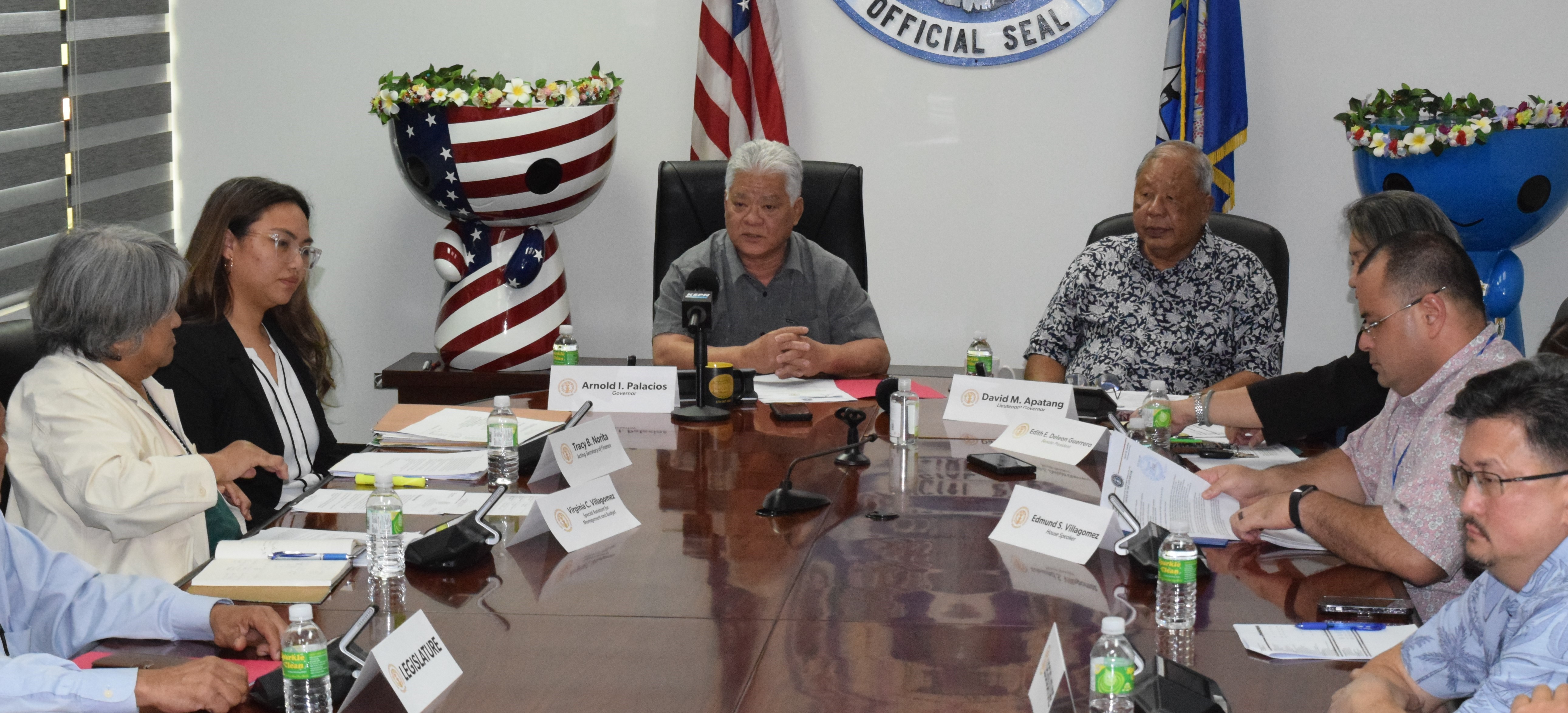
Gov. Arnold I. Palacios, center, speaks as Lt. Gov. David M. Apatang, fourth right, listens during a press conference on Wednesday. Also in photo are Special Assistance for Management and Budget Vicky Villagomez, acting Finance Secretary Tracy B. Norita, Senate President Edith Deleon Guerrero, partly hidden, Speaker Edmund S. Villagomez, and House Floor Leader Edwin Propst.
