



THE NMI Humanities Council hosted a forum last week to discuss the results of its “i Minagåhet-Ellet: Reporting the Truth in the Northern Mariana Islands” report.
“We’ve asked you to join us today to learn more about the results of the survey, to explore the role of the humanities in fostering an informed citizenry, to improve our understanding and appreciation of the role of our local journalists and those of us who are tasked with the role of a public information officer,” said Humanities Council Executive Director Leo Pangelinan in his remarks.
Human rights lawyer and author Julian Aguon of Guam gave the keynote address during the forum, touching on his personal experiences with the media.
“As a lawyer, I have found that the media has been largely unhelpful to me. I’m just being very frank,” said Aguon, a Pulitzer Prize finalist.
As a young attorney litigating high-profile cases, he had defended the Guam Legislature in its attempt to legalize medicinal marijuana on Guam for the first time.
“It was a mess. Honestly, the media was so unhealthy to me in the beginning because I was so young, and it doesn’t help that I also look a little younger than I actually am. I think people just thought that I was some 21-year-old running around,” Aguon said.
“The radio media was particularly bad. You have so many radio hosts just saying that this was such an important issue, legalizing [cannabis], and they sent a boy to do a man’s job… I had to face all kinds of things. I want to be clear though that we won that case.
“The media has a weird way sometimes. We get trapped up in old tropes, this idea that young people do things they don’t think are competent. We have community values, some of which are written in this report for example, about respect for elders. But on the flip side, there are so many examples where I think the media sort of underestimates the power and the capability to be able to do great things,” he said.
In a past case that involved ancestral classification, Aguon said that the media largely conflated two issues: race and ancestry.
“They are not always the same thing, so that is a delicate sort of thing that had to be teased out, and we teased it out quite successfully in some ways throughout the process, but every time the media would report on it, they would actually be so unhelpful because they would [describe it] in a way that was legally inaccurate. So, technically, there was not enough depth from reporters to really report on it correctly, and that requires time, work, and effort. I believe that the media that did report on my case, did it incorrectly,” he said.
Aguon said the community is longing for more investigative journalism and regional reporting.
“That is the whole point of democracy. It rests on the asking of hard questions. It does. The entire enterprise will fall apart if we do not have an informed citizenry. This survey made clear that [the people] are not altogether apathetic. The readers are not throwing up their hand and not throwing in the towel. They’re not giving up. They want democracy and they want to be more engaged,” he said.
“One very concrete thing that I would suggest to the community, especially to those who pay the salaries of the reporters, is to take the time to do deeper and more investigative pieces. I think that is really important. It takes time, money, and resources. It’s an attack on the quality of our work collectively as a community if we don’t expect better, if we don’t demand better, if we don’t demand excellence of ourselves and of others.”
Media ethics
KUAM regional correspondent Thomas Manglona II gave a presentation on media ethics and practice, presenting examples of skewed media reports that were either left- or right-leaning on the political spectrum.
He showed an “All Sides Media Bias Chart” that indicated ratings based on online U.S. political content, categorizing news sources as either far-left, left-leaning, center, right-leaning, or far-right.
He asked forum attendees to determine where local media partners would fall on this spectrum.
Manglona also spoke about Pacific Islander representation in national and global media.
He said major global news sources tend to be vague and inaccurate in their reporting of the Pacific Islands, citing as an example a Fox News report that only military people on Guam are the Americans that would be affected by a North Korean missile attack, disregarding the rest of the population.
Manglona said the Associated Press Stylebook serves as one of many guides for news reporting, adding that the Pacific Islander Journalism Task Force, of which he is a founding member, and the Asian-American Journalists Association can also provide guidance.
He said the press acts as a fourth check and balance between the three branches of government.
In today’s digital age, he said the journalists’ roles have expanded, forcing them to be multimedia-faceted in small newsrooms, with a number of ethical and editorial dilemmas.
Manglona served on a media panel later that afternoon, alongside this reporter and Saipan Tribune associate editor Mark Rabago.
Table discussions were led by local radio personality Catherine Perry, followed by an evaluation led by Humanities Council program coordinator Naomi Tudela. Humanities Council Executive Director Pangelinan delivered the closing remarks.
To view the full media survey results, visit nmhcouncil.org/.
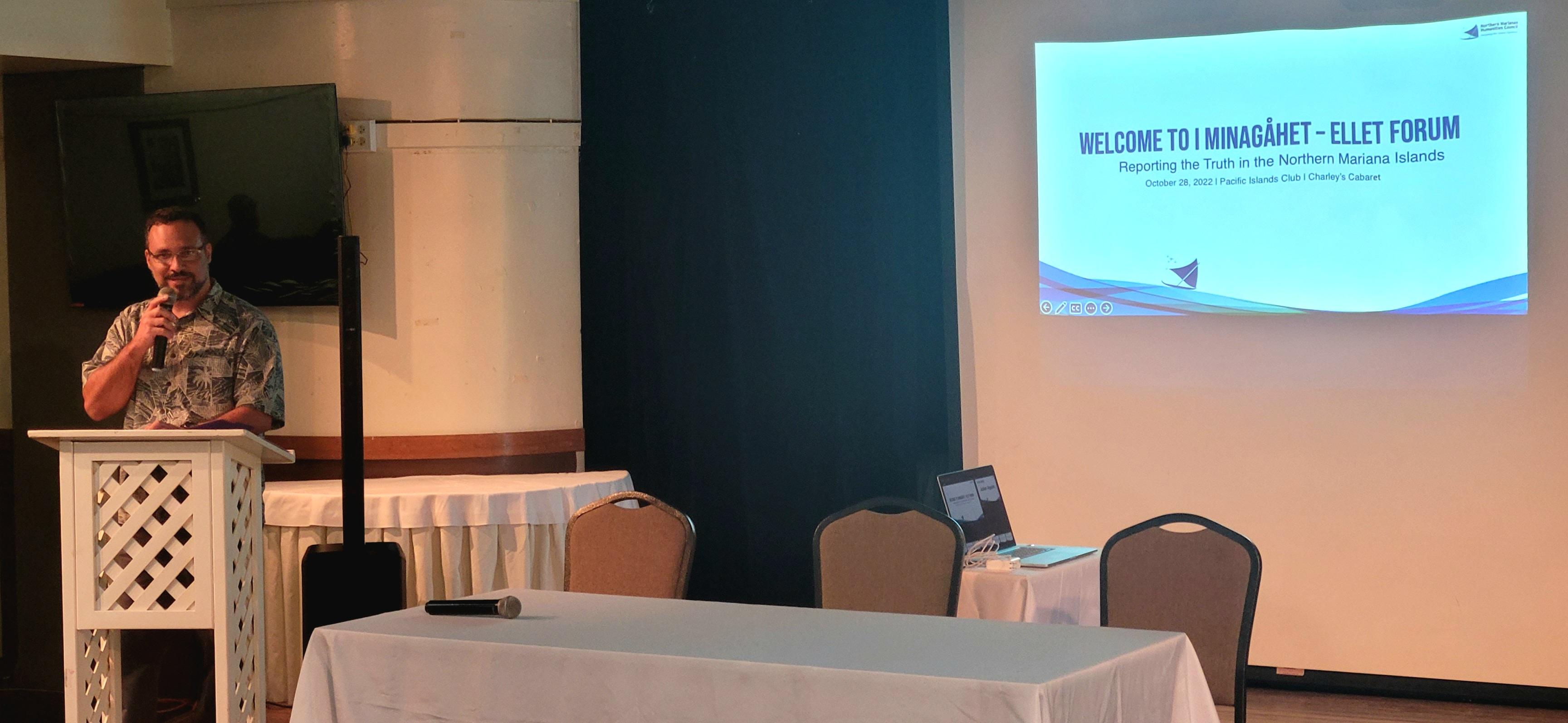
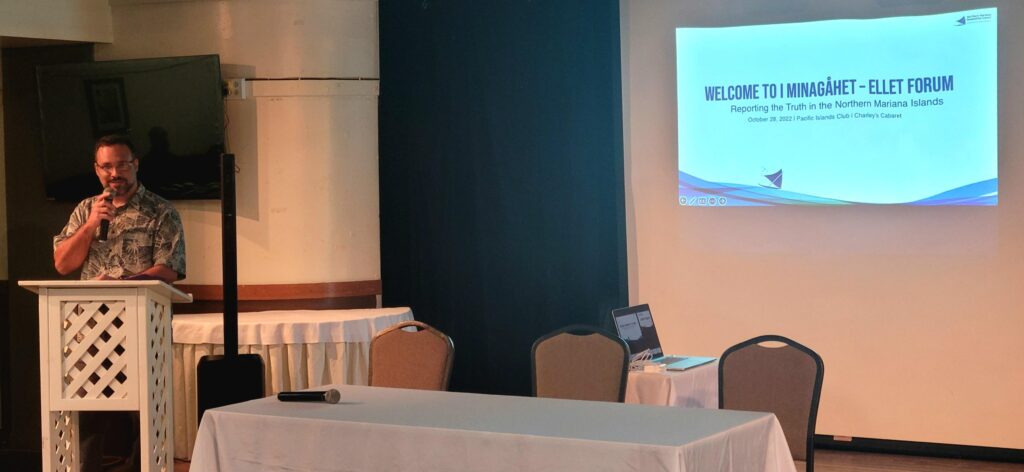
NMI Humanities Council Executive Director Leo Pangelinan gives his welcoming remarks at the i Minagåhet-Ellet forum on Friday, Oct. 28, at the Pacific Islands Club.
