





IN December 1994, Variety interviewed the then-president of the Saipan Chamber of Commerce who made what turned out to be farsighted remarks about the local economy and government. One of the main issues in the CNMI 28 years ago was the government’s humongous deficit — up to $42 million, according to then-Gov. Froilan Cruz “Lang” Tenorio. That amount is worth about $83.9 million today. And today, based on the budget bill pending in the Senate, the “total local revenue and resources available for appropriation for Commonwealth Government activities in Fiscal Year 2023” amount to $104.3 million only. (The figure doesn’t include the $5.4 million for the Department of Public Lands.)
Back in the day, moreover, it seemed that everyone was familiar with the following constitutional provision:
“If an operating deficit is incurred in future fiscal years, the government shall retire the deficit during the second consecutive fiscal year following the year.”
The deficit, in short, was an “urgent concern” that elected officials and other politicians wanted to “address.”
How? The then-new governor, Lang Tenorio, said the tax rates were low and could be raised. At the time, the local economy was still unfettered by unreasonable federal immigration rules. And many believed — economists among them — that the tourism and garment industries would take off soon. And they were right. Tourist arrivals peaked at 726,690 in fiscal year 1997 while the value of garment exports rose to $748.6 million (worth about $1.38 billion today).
In the same year, Governor Lang submitted a $247.4 million budget proposal which he later increased to $257.1 million — worth about $474.4 million today.
But in December 1994, the president of the Saipan Chamber of Commerce, local businessman Efrain Camacho, noted that “modern technology has made an island environment less competitive in business ventures…and if the CNMI would not try to catch up with the changing times, it would be left behind.”
Internet-use then wasn’t as widespread and as “high-tech” as it is today, but the chamber president foresaw that the CNMI “will [not] remain a good place for business…. Sooner of later foreign investors would have a lot of alternatives in terms of investment opportunities because of advancement in technology and the changing world economy.”
Camacho added, “We cannot continue to assume that this is…paradise and that everybody wants to come in. This is not true.” He said the CNMI must remain competitive. It must relentlessly promote itself as a tourist destination and as a conducive place for business.
“We need to begin to look at ourselves as very, very vulnerable [to the changes around us]…. We will be directly impacted by the world economy.” He noted that the CNMI had no significant natural resources, and a limited number of workers. He also didn’t believe that Japanese visitors would “forever” remain the CNMI’s main tourism market. In the future, he said, they would prefer Hawaii.
In addition, Camacho said the CNMI government should look into the enforcement of its laws. He said “many laws have been passed but they have never been enforced to the fullest” — if at all.
The government itself should “streamline its operation,” Camacho said, referring to the “numerous offices that are either non-essential or are not functioning well.” For their part, government officials and other politicians should “stop politicking and instead deliver the services to the people without in-fighting and personal motive[s].”
He said “the Trust Territory mentality should no longer reign in everyone’s mind. This mindset limits productivity and accountability…because the person has the belief that the government will always be there to help.”
“We need to start realizing,” he added, “that we have to pay for services. We cannot continue free handouts. Hospital bills, for example, are not being paid by some, giving the government additional burden in addressing its budgetary problems.”
Problems that today with a shrinking economy have gone from bad to worse.
Send feedback to [email protected]

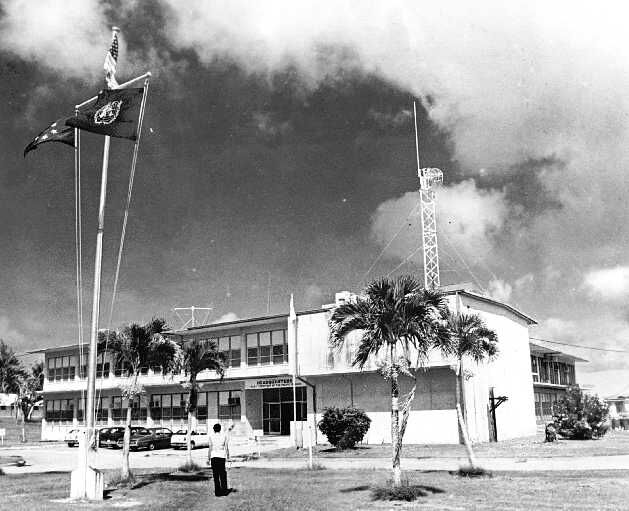
The Trust Territory headquarters on Capital Hill in the 1970s.
