




HAGÅTÑA (The Guam Daily Post) — Residents who were born on Guam, but have parental ties to the Federated States of Micronesia, may have a pathway to obtain dual citizenship — if the Pacific nation passes a proposed constitutional amendment allowing the process to begin.
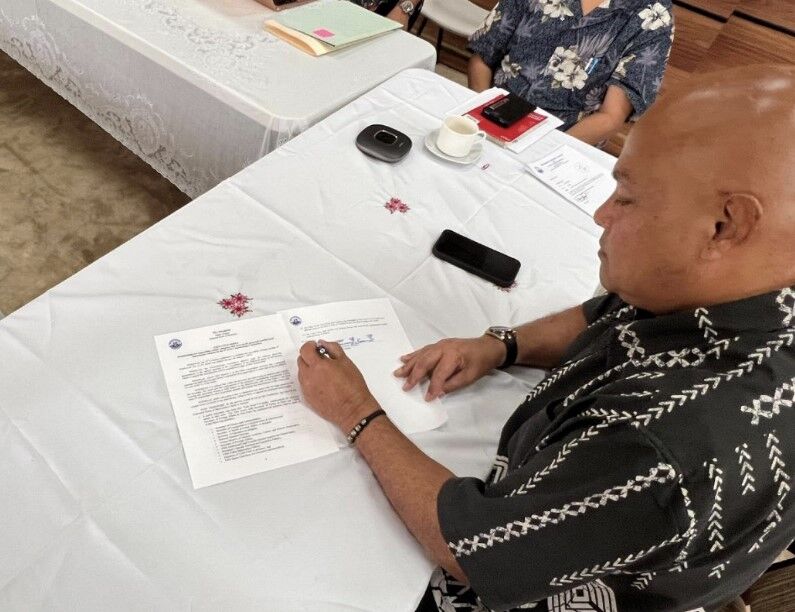
The potential major change is just one of eight adopted amendments approved during the FSM’s fourth constitutional convention, which adjourned in July. President David Panuelo, through an executive order issued Sept. 6, established a public education task force, an initiative he wrote “is key to familiarize voters with the legal, practical and related issues involved with the amendment, either in favor or against the proposed amendments.”
Panuelo’s office said a vote on the amendments, set to be taken during a special election, may occur as soon as July 2023.
A release from the constitutional convention explained the dual citizenship amendment, labeled Proposal 4-05, would authorize FSM citizenship to people with one or both parents who are citizens of the nation. Those “who lost their citizenship because they failed or were unable to renounce their citizenship of a foreign country,” may also have their citizenship restored through the amendment.
Residents living on Guam may choose to weigh in on the proposals.
The FSM president’s office told The Guam Daily Post that “all eligible voters are able to participate” in the upcoming special election, “whether they live in the FSM, Guam, Hawaii or the U.S. mainland.”
According to the constitutional convention’s website, the eight proposed amendments are:
Constitutional amendment approval threshold: Proposal 4-04 would lower the percentage of votes cast required in each FSM state to adopt amendments to the constitution from the current three-fourths of the votes required in three-fourths of the states, to two-thirds of the votes in three–fourths of the states.
Dual citizenship: Proposal 4-05 would allow person born of parents, one or both of whom are citizens of the FSM, dual citizenship; restore FSM citizenship to those who lost their citizenship because they failed or were unable to renounce their citizenship of a foreign country; and provide a pathway for FSM citizens who knowingly renounced their FSM citizenship to restore their FSM citizenship.
Revenue sharing on fishing fees: Proposal 4-13, CCD1, would provide that revenue derived from fishing fees is shared with FSM’s states. Currently 100% of this revenue is granted to the national government.
Overrides to a presidential veto: Proposal 4-03 would increase the number of votes needed for Congress to override a presidential veto. Under the proposal, the affirmative votes by two-thirds of election-district representatives and three-fourths of at-large members would be needed to override a presidential veto. Currently, Congress can override a presidential veto by the affirmative vote of 3 of 4 state delegations.
Revenue sharing on seabed resources: Committee Proposal 4-06, CCD2, would establish how the states’ share of the net revenue from the exploitation of minerals and nonliving resources within the jurisdiction of the Federated States of Micronesia beyond the 12 miles from island baselines would be shared between the respective states where the mining or exploitation took place. Currently, the constitution does not provide a mechanism for sharing the net revenues when more than one state has a claim.
Eligibility to run for Congress: Committee Proposal 4-11, CCD2, would create consistency between the eligibility requirements to run for Congress and to be elected president, and require residency within the FSM to be eligible to run for Congress. To run for Congress, a person would need to be at least 30 years of age on Election Day, a citizen of FSM by birth, a domiciliary of the state the person is representing, and must be residing in the FSM for at least five years immediately prior to running for office.
Jurisdiction over land cases: Committee Proposal 4-07, CCD2, provides that the state courts have exclusive jurisdiction of cases where an interest of land is at issue. The intent of the amendment is to create an exception to the jurisdiction of the FSM Supreme Court for cases where an interest in land is at issue.
Establishment of an independent prosecutor: Committee Proposal 04-09 creates an Office of Independent Prosecutor, an independent agency of the national government tasked with investigating and prosecuting individuals, governments and entities that receive and misuse public funds from the national government, and to investigate and prosecute certain national government officials for national offenses involving public corruption.

Federated States of Micronesia President David Panuelo signs an executive order on Sept. 6, establishing an educational task force to focus on informing the community about eight proposed amendments to the country’s constitution. A special election for citizens to vote on the proposals can occur as soon as March 2023.
