







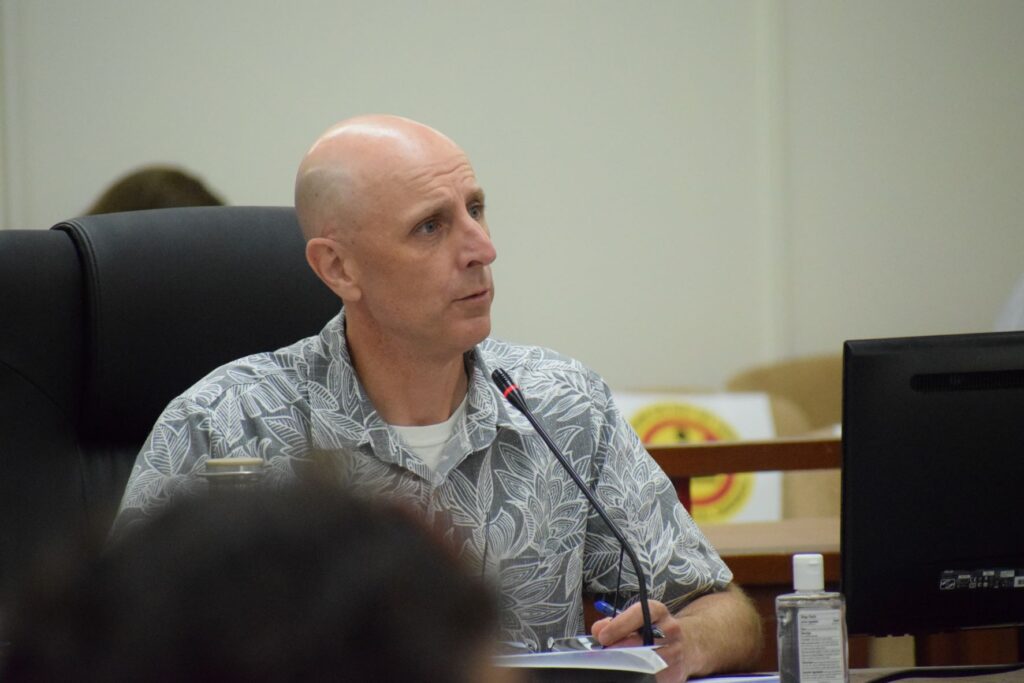
CITING “concerns” from their constituents, members of the House Committee on Public Utilities, Transportation and Communications on Wednesday afternoon met with Commonwealth Utilities Corp. officials led by its new deputy executive director, Chretien Voerg (pronounced “verge”), PE, who is originally from New York.
The committee chairman, Rep. Richard Lizama, said they wanted to “find a solution to help our consumers out there,” referring to the Fuel Adjustment Charge or FAC, a key component of CUC’s electric bill.
The CUC officials who joined Voerg to answer questions from lawmakers were Richard Cano who is in charge of the CUC power plants; Betty Terlaje, chief of administration; Greg Cruz, chief financial officer; and Carl Castro, grants coordinator.
CUC Executive Director Gary Camacho was off island.
Like Camacho had done in a previous meeting with the same committee, Voerg also explained that when fuel prices go up, the FAC also rises.
CUC said adjustments are made when the Mean of Platts Singapore monthly pricing equals or exceeds a 4.5% differential of the average per gallon cost of fuel in the calculation of the fuel adjustment charge.
According to Energy Insights, “Mean of Platts Singapore is a pricing basis for many refined products in southeast Asia. It refers to the average price reported by the price assessment agency Platts for a product in the Singapore trading hub. For most refined products, MOPS is the benchmark price for the Asia market.”
“I think it’s also important for our customers and for everyone to understand that this is not even a full cost recovery,” Voerg told the lawmakers. “CUC is actually losing on that. The amount of money we are charged for fuel exceeds the amount of money we collect from FAC. There are additional charges on top of the FAC that CUC has to come up with.”
Lizama said the old engines at CUC’s power plants should be “changed.”
Voerg agreed, but he pointed out that CUC’s “issue right now is funding and we have outstanding accounts that had not been paid and…they add up to…tens of millions of dollars. Those funds would go to replacing equipment at our power plants that will make us more efficient…. And that will reduce the amount of energy we need to consume….”
The CNMI government is CUC’s largest delinquent customer.
Time and again, Voerg had to reiterate that CUC has not increased its base rate since 2014 and that the FAC is the rate CUC has to pay to its fuel supplier so it can run the power plants that generate electricity for its customers.
Also present in the meeting were Speaker Edmund S. Villagomez, Reps. Tina Sablan, Leila F. Staffler, Ralph Yumul, Corina Magofna, Joel Camacho and Vicente Camacho.
Don’t enforce FAC
Sen. Teresita Santos in an interview, on Wednesday said CUC should defer or hold the implementation of the 19.49% FAC due to the recent fuel price rollback. “They should not enforce FAC as a result of [a] decrease in fuel price today,” said Santos, the author of a Rota legislative resolution urging CUC “to be creative in finding alternatives to avoid any utility rate increase every time fuel costs go up.”
On June 30, 2022, CUC said that “through the efforts of Gov. Ralph DLG Torres, and in coordination with the Department of Finance, we have been permitted to reallocate funds granted to CUC by the Governor’s Office to provide short-term relief to the current FAC crisis.”
“All active residential electric accounts will be credited $150 for the month of July,” CUC said. “In the meantime, the Governor and the Secretary of Finance continue to look into additional utility stimulus funding to give some relief to the residential community for the upcoming months.”
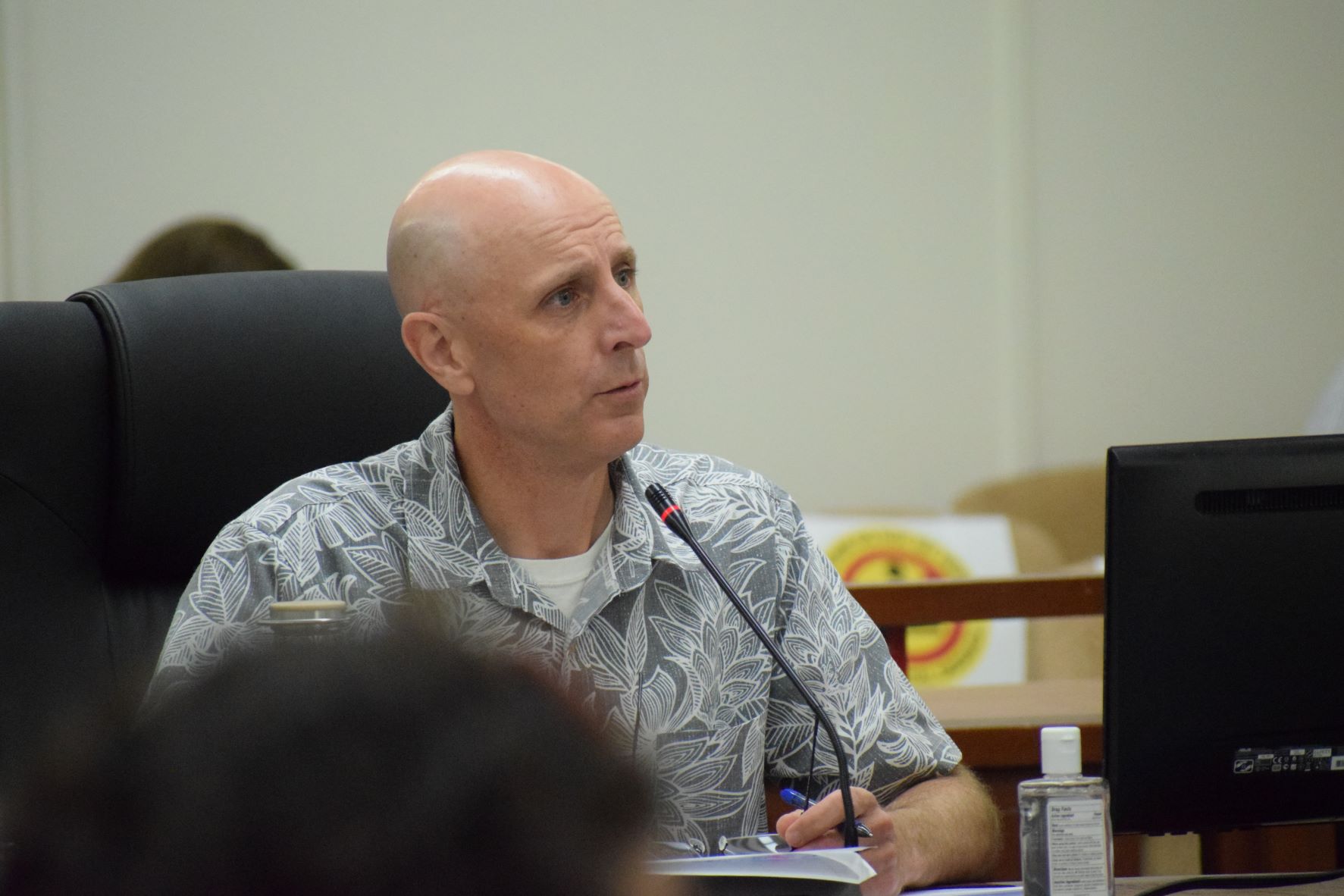
Commonwealth Utilities Corp. new deputy executive director, Chretien Voerg, answers a question during an “emergency” meeting of the House Committee on Public Utilities, Transportations and Communication in the House chamber on Tuesday.
