





THE Northern Marianas Descent Corporation and the United Carolinian Association have filed an amicus brief in the U.S. Supreme Court, opposing the petition of three American Samoans who have asked the court to overturn the Insular Cases.
These are “a set of century-old rulings used to deny equal rights and federal benefits to the residents of American Samoa, Puerto Rico, Guam, and other U.S. territories.”
The two non-governmental organizations jointly filed the friend of the court brief through attorney Joseph Horey on July 13, 2022.
“NMDC and UCA have no quarrel with the individuals who are seeking U.S. citizenship by way of the petition,” Horey said.
“However, they believe it is misguided, inconsiderate and dangerous for them to do so by attacking the Insular Cases. Those cases are the legal foundation of Article XII and the Commonwealth Senate, thus of the entire U.S.-CNMI Covenant. Overturning them would invite a constitutional crisis in the CNMI,” Horey added.
He said NMDC and UCA hope that the Commonwealth government, and any other concerned parties, will join them in opposing the petition.
According to the brief, NMDC and UCA are organizations dedicated “to the protection and advancement of the interests of the indigenous peoples of the Northern Mariana Islands…with a particular focus on advancing the economic, educational, cultural and overall well-being of the Carolinian people.”
Both organizations are dedicated to protecting the existing restriction on acquisition of land in the Northern Mariana Islands to persons of Northern Marianas descent, a restriction that has been upheld on the authority of the Insular Cases.
Horey was referring to Article 12 of the CNMI Constitution which restricts ownership of land to indigenous people.
In the brief, Horey stated that the CNMI was established pursuant to a mutually binding constitutional agreement between the Northern Marianas people and the United States, known as the Covenant.
He said the Covenant creates a bilateral political union between the United States and the CNMI, and it sets out certain conditions which shall prevail in the CNMI notwithstanding any conflict with the U.S. Constitution.
“One of these is that neither grand nor petit jury shall be required for trial by local law. Another is that each of the three principal islands of the CNMI (Saipan, Tinian and Rota) shall have equal representation in one house of the CNMI legislature, regardless of differences in population. A third — the condition of chief concern to Amici — is that the acquisition of long-term interests in real property in the CNMI shall be restricted to persons of Northern Marianas descent.”
Each of these conditions likely conflicts with one or more provisions of the United States Constitution, Horey said.
Yet they are explicitly recognized in the Covenant as “fundamental” provisions, to which no change is permissible without the agreement of both the United States and the CNMI, he added.
They were “integral matters of sufficient importance that the Covenant could not have been adopted without them,” Horey said.
“All have been challenged on constitutional grounds, but all have been upheld. And they have been upheld on the specific authority of the Insular Cases.”
The overruling of those cases would therefore endanger key Covenant provisions on which the CNMI’s existence rests, Horey said.
In particular, he said, it would endanger the land alienation restriction, which enables the people of the Northern Marianas “to retain the ownership of their most precious asset: their land.”
“Because of the reliance that has been placed on their validity by the people of the Northern Marianas, and because they were correctly decided in the first instance, the Insular Cases should not be revisited or overruled, and the petition for writ of certiorari, which seeks to overturn them, should be denied.”
Alternatively, Horey added, if the petition is granted, the writ should be limited to any asserted grounds for citizenship which do not implicate the Insular Cases.
Three American Samoans who are residents of Utah — John Fitisemanu, Pale Tuli, and Rosavita Tuli — have petitioned the U.S. Supreme Court for a writ of certiorari, to take up their case which challenges the validity of previous Insular Cases rulings that, they say, deny them equal rights.
American Samoans born in American Samoa are considered U.S. nationals while those born on Guam, the Northern Marianas Islands, Puerto Rico and the U.S. Virgin Islands are U.S. citizens.
The petition highlighted the rights denied to American Samoa-born nationals living in the U.S.
The plaintiffs argue that the 14th Amendment’s Citizenship Clause, which grants birthright citizenship to persons “born or naturalized in the United States, and subject to the jurisdiction thereof,” extended that right to anyone born in U.S.-controlled territories.
“John Fitisemanu was denied the right to vote. Pale Tuli cannot seek the job he wants, as a police officer. And Rosavita Tuli is unable to sponsor immigrant family members who wish to move to the U.S.,” the petition stated.
In 2019, U.S. District Court Judge of Utah, Clark Waddoups ruled that the three American Samoans were entitled to birthright citizenship under the 14th Amendment to the Constitution.
But that decision was overturned in 2021 by a panel of judges from the U.S. Court of Appeals for the 10th Circuit who relied solely on the Insular Cases.
The petitioners sought to revisit and overturn the Insular Cases, through a writ of certiorari from the U.S. Supreme Court.
According to the petitioners, the appeals court’s decision extends the Insular Cases beyond their original context and subject matter and brings them into direct conflict with previous rulings granting birthright citizenship.

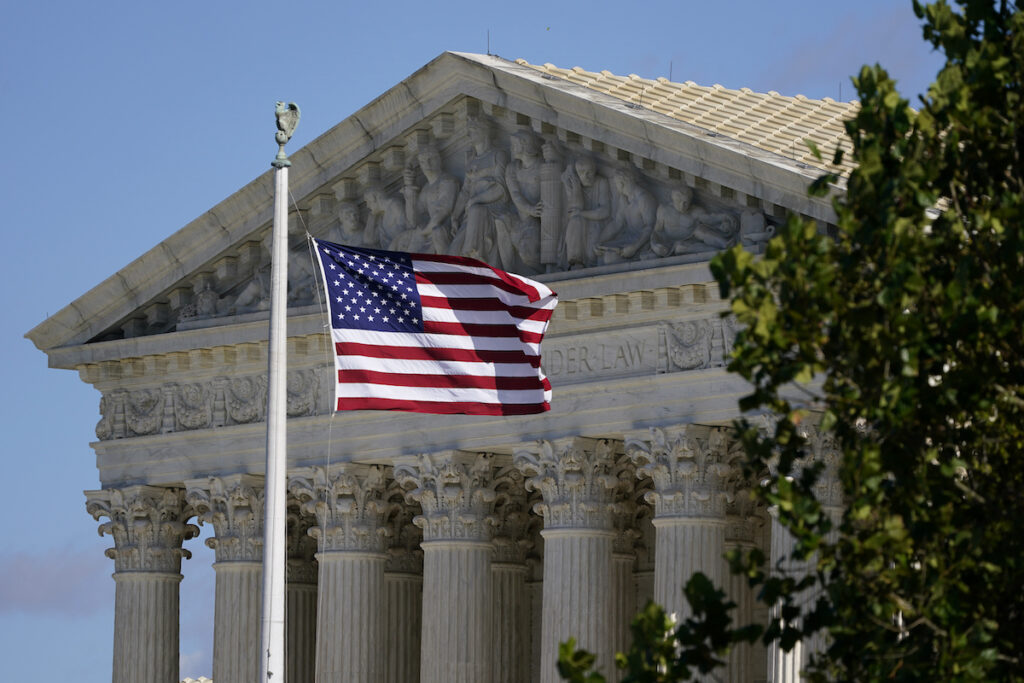
An American flag blows in the wind in front of the Supreme Court building on Capitol Hill in Washington, D.C. on Nov. 2, 2020.
