





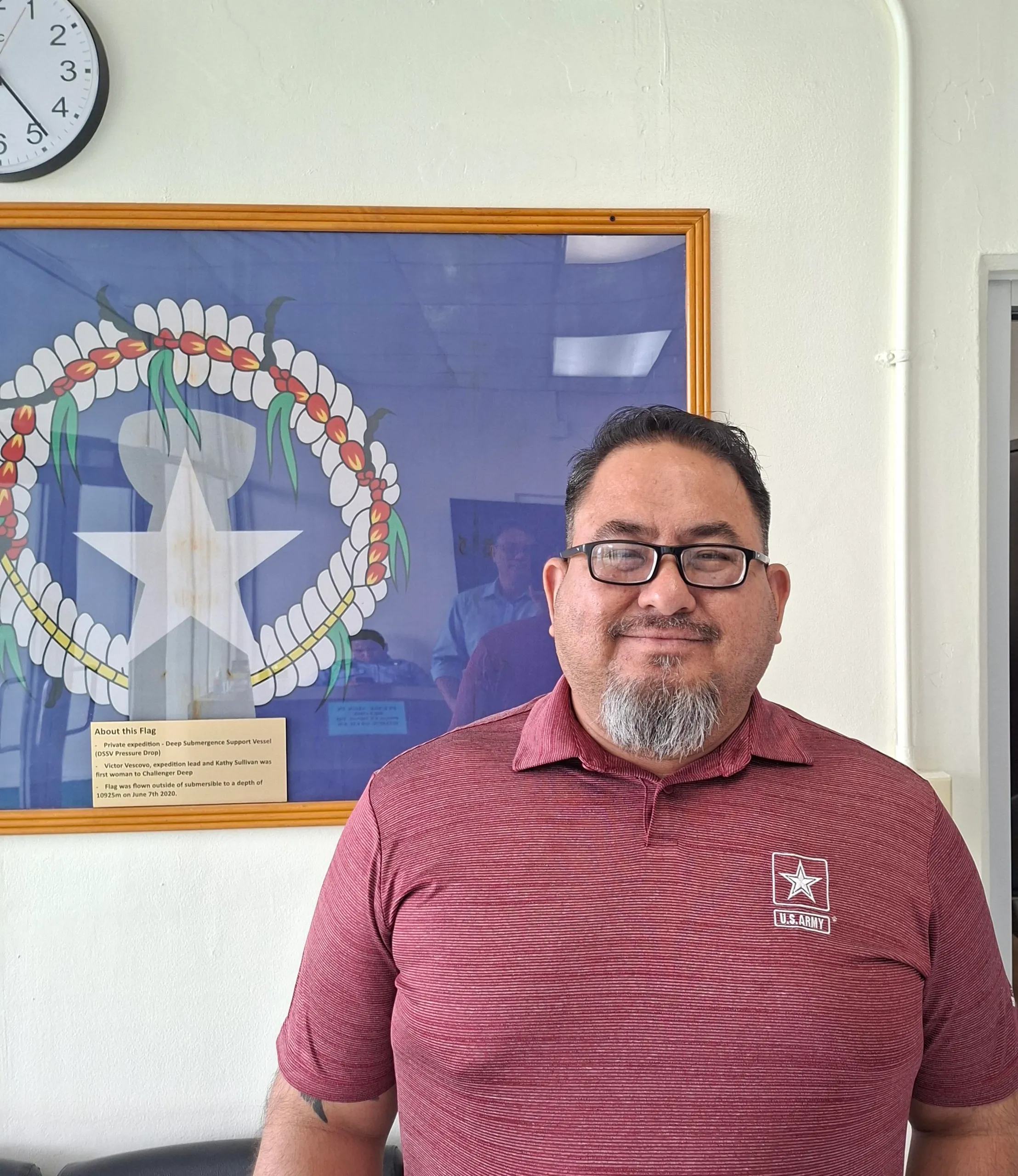



THIS week, Jerry Diaz, a certified National Academy of Sports Medicine personal trainer, wants to talk about the importance of training with a purpose.

Rhonda DiCostanzo walked the Camino de Santiago or Way of Saint James in Portugal and Spain after a year of preparing for it by training at BBJ Athletics on Saipan.
“When I prepare for a 10k, a half-marathon run, obstacle course, or a basketball tournament, I had to go through a series of training sessions that allow my body to adapt to the upcoming rigorous event,” he said.
The same goes for his clients.
“When assisting an individual preparing for a fitness event or competition, we also discuss essential training principles that can optimize their performance,” Diaz said.
• First on the list is individuality. Each individual is different and responds differently to fitness training. Some people are able to handle higher levels of training intensity while others may respond better to moderate intensities. This is based on a combination of factors such as body type, muscle fiber types, current fitness level, and mental-emotional state.
• Next is specificity. If the goal is to be a great pitcher, running laps will help the person’s overall conditioning but will not develop the skills at throwing or the power and muscular endurance required to throw a fastball 50 times in a game. Swimming will help improve your aerobic endurance, but it will not develop tissue resiliency and muscular endurance for plyometric movements related to basketball games.
• Then comes progression. In order to reach an individual’s optimal fitness ability, s/he must be exposed to levels of progressive training that will allow him or her to experience challenges related to the event s/he will participate in. In order to swim a 500 freestyle, for example, the individual will need to be able to maintain his or her body position and breathing pattern well enough to complete the distance. The individual will need to build muscular endurance to repeat the necessary motions.
• Then there’s overload. To increase strength and endurance, the individual will need to add new resistance or time/intensity. This principle works in synchronization with progression. To run a 10-kilometer race, athletes need to build up distance over repeated sessions in a reasonable manner in order to improve muscle adaptation as well as soft tissue strength/resiliency. But remember: any demanding exercise attempted too soon risks injury.
• Next is adaptation. Over time, the body will become familiar to exercising at a given level. This adaptation results in improved efficiency, less effort and less muscle breakdown at that level. That is why the first time you ran two miles, you were sore after. But now it is just a warm up prior to your main workout. And this is also why you need to aim for higher intensity or longer duration in order to continue improving.
• Recovery is one of the principles that is usually overlooked. The body cannot repair itself without rest and time to recover. Both short periods, like hours between multiple sessions in a day, and longer periods, like days or weeks to recover from a long season, are necessary to ensure that the body’s system does not suffer from exhaustion or overuse injuries. But motivated individuals or athletes often neglect this. At the basic level, the more the individual trains, the more rest the body needs.
• And lastly, reversibility. If an individual stops performing a particular exercise, like running five miles or bench-pressing 150 pounds 10 times, he or she will soon lose the ability to successfully complete that exercise. Your muscles will atrophy (degenerate) and the cellular adaptations like increased capillaries (blood flow to the muscles) and mitochondria volume density will reverse. But you can slow down the rate of loss by conducting a maintenance/reduced program of training during periods when life gets in the way. This is why all coaches tell their athletes to stay active during offseason.
Diaz said these principles show why practicing frequently and consistently is important for individuals who want to improve performance.
Applying these principles to your training program will bring you closer to your fitness goals, he added.
For professional fitness inquiries, contact Jerry Diaz through Instagram at @BBJ_Athletics or Facebook.
