



JUNE brings back many awesome memories of WWII.
June 10, 1944. I distinctly remember what happened. The United States Task Force 58 began the invasion of Saipan and Tinian. U.S. aircraft began bombing Tinian and Saipan night and day. Five days later, June 15, 1944, the western seaside of Saipan was covered with all kinds of U.S. warships in preparation for the invasion of the islands of Saipan and Tinian.
On June 11th, Monday, Elias Sablan, our Dad, decided for us to move up to the hill into a cave somewhere just south of Mt. Tapochao. When we reached the location, I noticed there were already local family members that had moved into the cave. Already in the cave were the families of Guerrero, Crisostomo and others. We were the Sablans and the Semans.
On the morning of June 15th, we saw dozens of war ships that covered the western horizon of the Saipan sea. We then saw hundreds of small vessels approaching the beach on the western side of Saipan. We discovered later that the “small vessels” were in fact amphibious tanks and landing craft that the U.S. used to bring forces for the eventual take over of the island of Saipan.
We were in the cave for close to three weeks and we had nothing but the juice of sugar cane to consume as our daily meal. Every morning before sunrise, able bodied young men would sneak down the hill into the sugar cane field below to cut sugar cane and bring them to the cave for our daily meals. This went on for about three weeks.
One day, three young men went out early to cut sugar cane for our meals that day. They ran into a patrol of Japanese soldiers, so they hid in the field until it was safe for them to go back up the hill. When it was safe, they rushed back to the cave. Since the sun was now up, the U.S. ships offshore saw people crawling around the hilltop, so three Marines were ordered to the location, but they were unable to locate the whereabouts of the men. We then heard people talking outside our cave, so we immediately took to the corners of the cave. In the process, a little baby in the cave cried and gave away our exact location.
The three Marines carefully approached the entrance of the cave and saw a crucifix displayed on top of the entrance of the cave. One of them yelled into the cave in Japanese saying, “SINPAI NAI DE DETE KOI” (without fear, come out). My father, Elias, and my eldest brother, Ignacio, immediately went out with their hands up. Dad said “I surrender” in English. One of the Marines, John Sullivan, said, “Ah, you speak English.” Dad responded, “just a little.” The Marine asked, “Are you by any chance ELIAS SABLAN?” Dad responded “Yes.” The Marine told Dad that there were thousands of Japanese, Koreans and natives already recovered and that they were looking for Sablan to help the Americans interpret for the captives.
With that, we were all happy, but cautious, and very glad to get out of the cave!

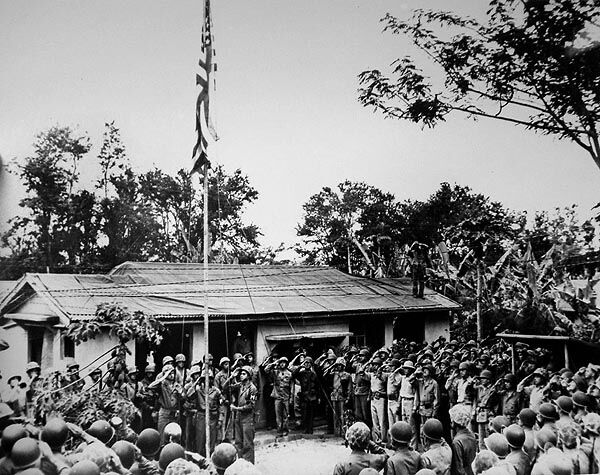
U.S. servicemembers hold a flag- raising ceremony in Chalan Kanoa village on July 10, 1944. With this event, the Northern Marianas came under the control and administration of the U.S. Navy.
