





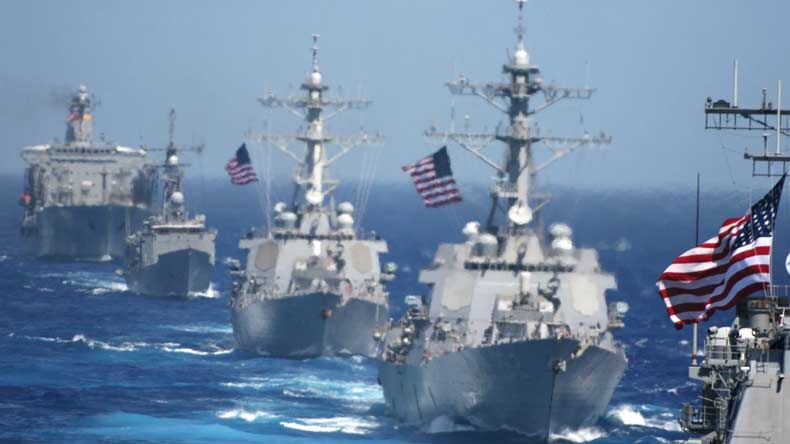
THE CNMI government and the U.S. Department of Defense are still sorting through the details of plans for the U.S. armed forces to conduct joint military training for the nation and its allies.
With China as a notable threat, U.S. Marine Corps Maj. Gen. Mark A. Hashimoto, the U.S. Indo-Pacific Command Mobilization Assistant to 26th Commander Adm. John Aquilino, said there is training across the various regions, from the east Asia to the western coasts of the continental U.S.
Admiral Aquilino leads the U.S. military’s effort to keep peace in the region that stretches from the West Coast of the United States to the India-Pakistan border and north to the Arctic and South to Antarctica, commanding over 380,000 marines, soldiers, sailors, airmen, coast guardsmen, and guardians.
“Those of us who live in the region, it’s very clear that China represents the greatest strategic threat to security, not only in the Indo-Pacific, but to the entire globe. If you look at the regions closer to the east Asian mainland, you can see the relevance of the training that can be undertaken there in the Mariana region and really what brings the value way up is the way that we can combine, as I said, the top three DoD priorities of the preparedness through the trainings, the partnerships that we strengthen with our allies and partners, and then the way the region is networked, not only for where we have our installations, our supplies, but also our training facilities,” said Hashimoto.
He noted that the DoD has three big priorities: preparedness, partnership, and promoting a networked region.
“You should all know that the Biden administration has made clear the criticality of supporting a free and open Indo-Pacific region… So, on behalf of Admiral Aquilino, I have the privilege of working with the agencies, leaders, and stakeholders of the CNMI to enhance our training and facilities. As we do so, our goal is to strike the right balance among our four obligations: protecting natural and cultural resources, lessening and mitigating training impacts, improving economic opportunity, and advancing national security interests. I’ve been honored to learn from some of you that we have a responsibility… is to make good, and therefore, we move forward in our discussions. Our team will do so in a manner that shows a deep respect for the land, people, and culture of the CNMI,” said Hashimoto.
Regarding the timeline of these proposed trainings in the Marianas region, the revised draft of the environmental impact statement will include these details.
However, this is not available to the public at this time, given that there are still various details for the local and federal partners to work through before disseminating the EIS to the general public.
Federal partners said that the revised draft EIS will contain a very high degree of detail about the proposed action because that is what is necessary for them to do: an appropriate environmental analysis.
It is not clear at this point what the engagement would look like, but the federal partners will be working together with the CNMI government to try and navigate through some of these challenging issues.
They are not, however, currently in the position to roll out a concrete schedule, but may be able to share additional information as time progresses and vital details are worked through and thoroughly comprehended.
“The way I think about it is a concern over loopholes, I guess that’s the term that I would use, that might exist because of… the overlap of the Mariana Islands training and testing study area, as well as the Mariana Islands range complex, so that is absolutely something that we will focus on going forward, and I look forward to having those conversations,” said Hashimoto.
“Again, we’re still talking at the conceptual level with our partners in the CNMI because it is a collaborative process, but certainly to be able to, as part of the development of the EIS documents, we have to have those details about usage rates because we have to understand it in detail to understand the impacts. Something that really impresses me is the thoroughness of that environmental impact study that looks at everything from airspace and air quality to water and utilities and noise and geology, soil, socioeconomics, transportation, cultural resources, the coastal environment, as well as even things like visual aesthetics, so that will all be part of the process. That will be subject to, as you know from previous activity, scoping meetings, public comment. We’ll be able to provide those details at the right point, as we reach those milestones in the EIS process.”
He added, “The information that we’ve shared with our CNMI partners is very, very preliminary. It just kind of gives broad contours. I think there are more formal documents… The reason that I’m hesitant to say right now is because what is going to come out, while it has been favorably responded to initially by the CNMI… the details are really going to have to be understood before we can say something. That’s something that the DoD is committed to collaboration is willing to say, okay this is what we formally want to put forth,” said Hashimoto.
The major general was, however, able to share some details as to what happens next following recent talks between the state and federal governments.
“The EIS process is very thorough. We would like to get through that process by 2025. Construction on the CNMI Joint Military Training project, as we’re talking about, would occur following that. As you know, and I mentioned earlier, training on Tinian occurs today. We will continue, not just the Marine Corps, but the Air Force, Navy, and the Army have plans to continue training throughout that period prior to the signing of the record of decision. What we anticipate seeing after the record of decision, which would lay out the mitigation and all the things like that, is that we would have standing environmental coverage for more comprehensive, more complex, and more future-focused types of training,” he said.
“Our training does not require the completion of the divert project, obviously because we do it today. I think as most of you know, the phase one had its groundbreaking and that’s going to be the parking apron and the airfield development, to be followed by phase two, which is going to be the fuel tanks, the taxi way, and the pipeline. So, to wrap that all up, we look forward, over the next few years, even before the record of decision, to continue training, to continue to work with the CBMA to enhance the way that we coordinate our current activities, and we look forward to a future where we are able to have in place a more advanced training capability that works for everybody.
Hashimoto shared that national forces and their allies are part of this training.
“We see people coming from everywhere. The location of the Mariana Islands is very conducive to not only our forces, but some of our partner nations’ forces, so, by no means is this limited to the forces on Guam, but we have forces that are transiting the Pacific on ship, others who might come west from their bases in northeast Asia, or east from the continental United States and Hawaii, so I see forces coming from all U.S. and allied and partner forces coming from everywhere,” he said.
The training in the Marianas region will be under the cognizance of the Joint Region Marianas, he noted.
“While Tinian provides a tremendous training environment, it’s not ideally suited for a number of reasons, to try to do everything… I would say that it’s not necessarily a downscaling, but a shift in the kind of training that we’re going to accomplish because… from a future force perspective, the value of what we will derive from the concept that we’ve been discussing with the CNMI are going to be of immense value to the Department of Defense, so if we want to conduct the kind of training again involving high explosives or amphibious landings or other things like that, we will have to conduct that at other places,” said Hashimoto.
He noted that the DoD conducts this kind of training in many places across the various regions.
“The way that we look at our training need is by region, by subregion, and generally, by association, where we have troop concentration, as I mentioned, [in] northeast Asia, the Mariana Islands, Hawaii, and the continental United States. That’s where we have large permanent installations. We sort of look at things again and what the local needs are there… I don’t foresee that we would try to establish something new. With that said, there are existing training opportunities throughout the entire Pacific region. It’s just a matter of us being able to coordinate with those countries or other kinds of entities to be able to conduct that kind of training, because everywhere we go, the Department of Defense applies U.S. law, and we also have to take into consideration, like we did in the CNMI, the concerns of the local municipalities. So, we don’t see that as a deficit, although we have conducted extensive studies to understand what our gaps are, and as the operating environment, as we call it, changes – meaning our adversary capabilities, our operating concepts change, we’re always looking for new opportunities that work for us and for the local communities,” he said.
“We have to be ready for a broad range of contingencies. That’s not to say that the traditional kinds of land conflicts or what we call forcible entry operations, which are familiar to the region from World War II and the Korean War where we have to come across a defended beach. We have to be ready for things like we saw in the Vietnam conflict, focused on a certain kind of terrain. To a large sense, we have to be ready for everything. It’s not that things are less important than others… the pacing threat that our forces here in the Pacific are training to optimize our readiness against the way we think things will happen in this theater. That being said, all of our forces, especially the Marine Corps, are globally deployable. We focus on broad areas of readiness, offensive operations, defensive operations, amphibious operations, and things of that nature. It’s just the details. I wouldn’t characterize it as the kind of training that we focused on maybe during the Cold War… is not important, but we understand where our focus needs to be and we’re going to conduct that kind of training in other places, like I mentioned, in the continental United States, areas where that are larger land masses that are more conducive to our training.”
Where is this focus? Hashimoto said that it’s on a smaller yet lethal forces.
“I separate missile defense from the kind of training that we’re talking about. That’s actually in the defense of our homeland. The focus needs to be – and I can talk about my own service, but I don’t want to limit it to the Marine Corps, but in 2019, the commandant of the Marine Corps shifted our focus to being a lighter, more mobile force… Our units would be more spread out. They have to be smaller and they still have to maintain the lethality that really makes them credible. They have to be able to operate under conditions where their electronic systems might be degraded because of advanced enemy space and cyber capabilities. We have to be able to, over broad areas, provide them with logistical support. So, instead of thinking about the clash of mass armies on land, what we think more about now is the combination of these smaller, distributed, harder to target units acting in concert with air and navy forces to accomplish the kinds of missions that we think that we’re going to accomplish both here potentially in the Pacific and in other regions,” he said.
How will this change in the proposal for the Marianas affect military readiness? Hashimoto said that this is just a piece of the puzzle.
“We can’t solve the readiness challenge in one place at one time because the needs are so varied, so we think about all, as we call them, domains: land, air, sea, space, and cyber domains. There’s never going to be one place. Every location that we train is going to add something to that equation. Our training requirements and our measurements of readiness are constantly changing, especially as the United States Army and the United States Marine Corps have developed, as I mentioned, new operating concepts that move away from the style of activity that was present there in the Mariana Islands in the summer of 1944 and beyond. We have moved well beyond that because our adversaries require us to. If we can achieve, with our partners in the CNMI, the vision that we’ve described, our ability to conduct operations in the type of geography that is present and the hydrography that is present there in the Mariana Islands is going to be of significant benefit to the US services,” he said.
Hashimoto lauded the CNMI government and community for their roles in these discussions with the DoD.
“It’s been a pleasure to have the opportunity today to talk about some of the ideas about the future and really encourage meaningful public input and involvement when we start the process of evaluating the environmental impact of proposed federal actions in the CNMI,” he said.
“It’s been a humbling experience for me to meet many of you and hear the pride in your voices… I’ll tell you that the people of the CNMI’s sense of duty stands out among any group of United States citizens. What also stood out for me is your passion for caring for and nurturing the ocean that has always given life to your islands. Your courage, your steadfastness while engaging in discussions with the Department of Defense has led all of us to a better place. From your elders to your youth, all should stand tall because of this, and I am very, very grateful for what you’ve done.”
“You spoke, we listened, and have come up with a better, more effective proposal. This is a model for how DoD can work with local governments for a mutual benefit. When we were there last month, we provided that broad outline of what our proposal was to see if it was something that you would support and as we discussed, Rota will likely resemble a lot of the kinds of training that occurs now on Tinian,” he said.
“The devil is in the details, and all the concerns and the impacts are subject to ongoing discussions, but really, what it is, and some of the concept has been mentioned, but it’s a modern technology-based training concept that provides realistic training for our forces. As mentioned, it’s probably defined as much by what it isn’t as for what it is: no activity on Pagan, no explosive munitions – so, no bombs, no artillery, no tank, no mortar firing. It shouldn’t significantly impact the interisland air traffic, doesn’t envision any amphibious landing ramp which protects the coral and other sea life, and it’s not going to put the entire military leased area off limits to the residents of Tinian, so we look forward to working with the CNMI agencies to continue to share alternatives. We have a whole process that we look forward to that is part of the law, the National Environmental Policy Act, and so as we move through the process of creating a document called the Environmental Impact Statement, we encourage – we want your input, because collectively, we can achieve better outcomes, and we want to work towards agreements with long-term efficacy for future generations,” said Hashimoto.

