





Victoria-Lola Leon Guerrero
HAGÅTÑA (The Guam Daily Post) — As Guam moves closer to a potential political status vote in 2026 or 2028, independence advocates are intensifying their community outreach efforts, arguing that education is the key to changing minds about what they see as the island’s best path forward.
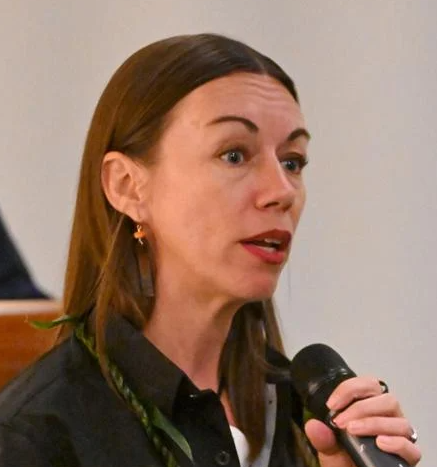
Victoria-Lola Leon Guerrero, co-chairperson of the Independent Task Force of the Commission on Decolonization, says her organization has seen firsthand how information can shift public opinion on political status options.
“When everybody had entered the event, they took a poll, and the majority of them had chosen statehood,” Leon Guerrero said, referring to a debate hosted by the Commission on Decolonization at Tiyan High School several years ago. “After the debate and hearing all three sides, that changed, and the majority had chosen independence.”
The anecdote illustrates what Leon Guerrero believes is the central challenge facing independence advocates: overcoming a lack of widespread community engagement on decolonization issues.
“There hasn’t been the level of engagement that we’ve seen in the past around this issue,” she said during a recent interview with The Guam Daily Post. “A lot of students in Guam go through their entire education on the island and don’t really learn about the differences between the status options or critique what it means to be in unincorporated territory.”
The three U.N.-recognized decolonization options are independence, free association (a form of self-governance with negotiated agreements with the U.S.), and statehood (full integration into the U.S.).
Independent Guåhan, the advocacy arm of the Independent Task Force, has maintained what Leon Guerrero calls the most active community engagement among the three political status task forces over the past decade. The organization hosts regular educational discussions, operates a popular weekly podcast called “Fanachu!,” and organizes cultural events, including hikes to historical sites and annual concerts.
Active outreach efforts
Independent Guåhan, the advocacy arm of the Independent Task Force, has maintained what Leon Guerrero calls the most active community engagement among the three political status task forces over the past decade. The organization hosts regular educational discussions, operates a popular weekly podcast called “Fanachu!,” and organizes cultural events, including hikes to historical sites and annual concerts.
“We host events almost every month, and we have a podcast once or twice a week,” Leon Guerrero said. The group’s annual ” Na’lå’la’ Songs of Freedom” concert, held July 4, combined local music with informational booths about political status options.
“We’ve done mural projects and cleanups to kind of show our commitment to keeping, you know, to the community itself,” said Leon Guerrero.
These efforts are funded through the Commission on Decolonization’s annual budget allocation to each task force, though Leon Guerrero noted that the independence task force “typically are the only of the three task forces that use our budget.”
Co-chairperson Michael Bevacqua, who also serves as curator at the Guam Museum, emphasizes that their educational approach goes beyond traditional presentations to include artistic and cultural activities designed to engage younger community members.
The case for independence
Leon Guerrero argues that independence offers something the other status options cannot: complete sovereignty over decision-making that affects Guam.
“Independence is the only choice that gives us complete sovereignty over our island, which basically means that independence is the only option that means that all decisions made about Guam are made by us,” she said.
She contrasts this with Guam’s current status as an unincorporated territory, where “oftentimes decisions are made for us that don’t prioritize us for our actual safety.”
Bevacqua told The Guam Daily Post how independence could position Guam differently in regional and global affairs, particularly on environmental issues.
“Freely associated and independent Pacific Island nations have been some of the loudest, most passionate, and most consistent voices in terms of climate change and its impact on the world,” he said. “Guam, as a territory, is limited in what it can do. It is not able to participate fully in many of these forums because it has no sovereignty and can’t be seated.”
Addressing fears and concerns
Both advocates acknowledge that independence faces significant skepticism from residents who worry about the island’s ability to govern itself or maintain economic stability.
“A lot of fear, again, is rooted in this idea that we are not having the kinds of conversations we need to have about our current governance,” Leon Guerrero said. “The government of Guam is still a very young government. We’ve only actually been electing our governors since 1970.”
She points out that Guam continues to operate under an organic act “we did not author, we did not sign, that was imposed upon our community.”
Bevacqua addresses concerns about military security, arguing that independence wouldn’t necessarily mean the end of defense partnerships.
“If the bases were to close and the U.S. were to reduce its presence, one thing that we have seen in places like Okinawa and the Philippines after U.S. bases close is that once the area is returned to private commercial development, it provides far more value to the local economy than whatever money the base did,” he said.
Contemporary political context
Leon Guerrero sees recent statements by President Trump regarding potential territorial acquisitions like Greenland as examples of continuing colonial behavior that underscore the need for Guam to assert its right to self-determination.
“These actions continue to represent colonial behavior. It’s still in the spirit of colonialism, where you’re seeing someone say, ‘This is what we want from another place and not what that place may want,'” she said.
She emphasized that any political status change must be based on consent from Guam’s people, not imposed from outside.
Path to a vote
Leon Guerrero supports maintaining the native inhabitant voter registry for any political status referendum, viewing it as essential to restorative justice.
“We’re voting to restore justice to a very distinct group of people who had a right taken away from them…the right to sovereignty,” she said. “The Native Inhabitant vote is truly rooted in restorative justice, the idea that we want to restore a right that was taken away.”
She believes that regardless of whether a vote occurs in 2026 or 2028, the community has the capacity to prepare itself if the issue becomes a priority.
“As a community, we can prepare ourselves, but we would have to come together. It would have to be prioritized,” she said.
Historical precedent
Bevacqua notes that independence has significant precedent globally and regionally, with “close to 200 independent countries in the world” and “dozens of countries that are smaller than Guam.”
He cites the Philippines as an example of a former U.S. territory that achieved independence through a transitional period and notes that under the U.N. Charter, “the U.S. has an obligation to ensure a transition period into the chosen political status option.”
“There are over 80 places in the world that have decolonized. There are 17 that remain. Of course, Guam is one of them,” Leon Guerrero said. “We have plenty of models to learn from of what worked and what didn’t work.”
The Independent Task Force continues its educational mission as the island moves toward what many see as an inevitable political status determination, with advocates hoping that increased information will lead to increased support for what they view as Guam’s best path forward.
“We have to believe in ourselves, and we have to begin really nurturing future leaders,” Leon Guerrero said. “We can, and we will lead ourselves to something better.”
