

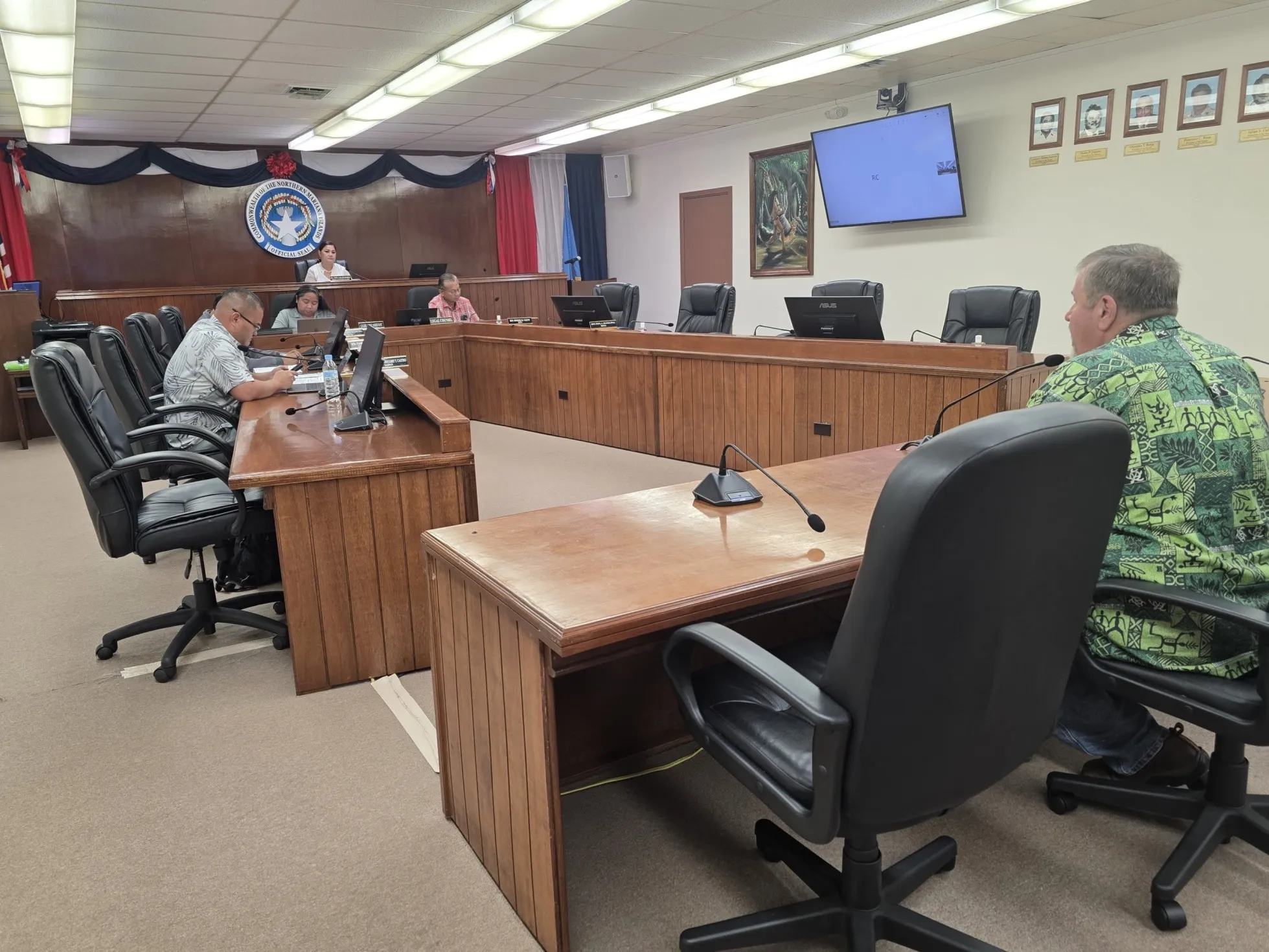



“LEGISLATIVE immunity is not limited to individual legislators,” the House Committee on Judiciary and Governmental Operations legal counsels Joseph L.G. Taijeron and Brendan Layde said in response to Gov. Ralph DLG Torres’ opposition to the JGO’s motion to dismiss his lawsuit.
Torres through his legal counsel Gil Birnbrich and the Banes Horey Berman & Miller law firm has asked the Superior Court to find the subpoena issued by the legislative committee invalid and unlawful.
The House legal counsels said legislative immunity attaches to the JGO as a body, not just its constituent members.
“The case law on legislative immunity, under both the common law and the Speech and Debate Clauses of various U.S.-affiliated jurisdictions’ constitutions, does not support the Governor’s assertion that it is limited to individual legislators. Nor would the policy interest of legislative immunity be well-served if it could be so easily circumvented,” Taijeron and Layde said.
They said policy interest served by the legislative immunity clause would be defeated if plaintiffs could circumvent it simply by changing the case caption.
“As the governor would have it, the seven legislators of the JGO lose their legislative immunity when they are aggregated into the committee. But seven times one is seven, not zero. If plaintiffs ‘Ralph Deleon Guerrero Torres in his official capacity as governor of the Commonwealth’ and ‘the Office of the Governor’ had sought injunctions against members of the committee to enjoin them individually from enforcing the subpoena, the governor concedes legislative immunity would attach. Such immunity would be meaningless if it could be rendered a nullity simply by naming the JGO committee as a body instead,” the House legal counsels said.
Citing a previous local ruling, they said the issue has already been litigated in the Commonwealth. “The Fifth Commonwealth Legislature was a named defendant as a body in the Millard case. The plaintiff filed a lawsuit to quash a subpoena by a special committee of the Legislature, and the court granted the Legislature’s motion to dismiss ‘on the ground that the complaint fails to state a cause of action, but also as an affirmation that the Legislature has the power to issue subpoenas in aid of its legislative functions.’ ”
Taijeron and Layde reiterated that the subpoena served on Governor Torres had a valid legislative purpose and asked the court to dismiss the lawsuit.
Torres’s lawyers for their part asked the court to deny the JGO committee’s motion to dismiss.
“The central question is whether a legislative committee, in aid of a purported legislative purpose, has the power to command the chief executive, duly elected by the people of the Commonwealth, to sit before it at the time, date, and place of its choosing, to give testimony on subjects selected by the committee, and remain doing so for as long as the committee desires, with a potential consequence for noncompliance of arrest and detention or criminal prosecution and incarceration,” the governor’s lawyers said.
The Republican governor was found by the Democrat-led House JGO committee in contempt of a legislative subpoena for refusing to appear before the panel which was investigating his public expenditures.
On Dec. 16, 2021, CNMI Supreme Court Chief Justice Alexandro C. Castro appointed former Judge Timothy H. Bellas to be the judge pro tempore in the governor’s lawsuit after Superior Court Presiding Judge Roberto C. Naraja, Associate Judges Wesley Bogdan, Kenneth Govendo, Teresa Kim-Tenorio and Joseph N. Camacho recused themselves from the case.
Pro Tempore Judge Timothy Bellas has scheduled a hearing for March 31 at 9 a.m.