






THE CNMI Cannabis Commission on Tuesday again requested the House of Representatives to pass House Bill 22-78, which would clarify the power of the commissioners and create a commission regulatory revolving fund.
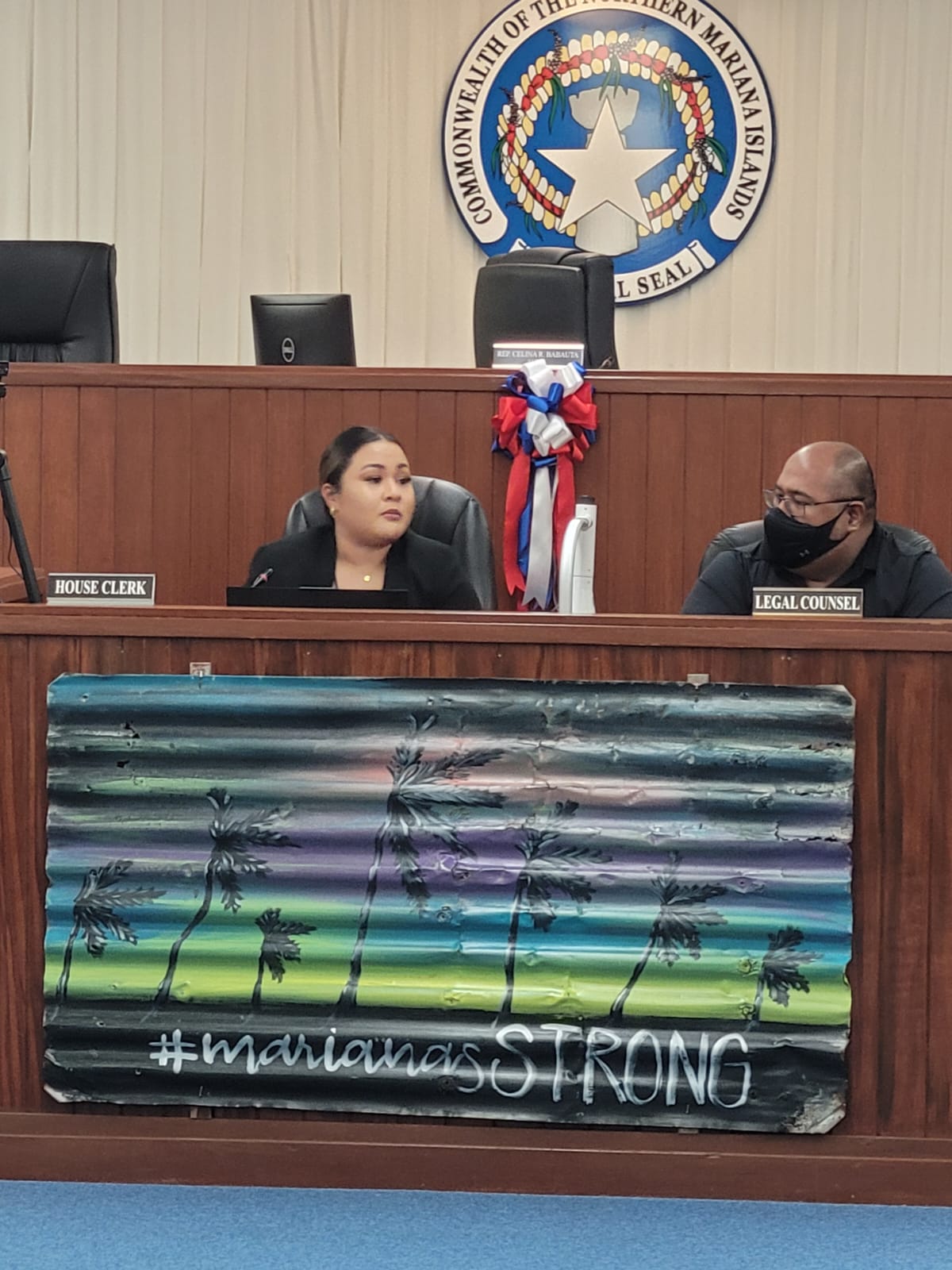
CNMI Cannabis Commission Managing Director Monique Sablan, left, speaks, as House legal counsel Joe Taijeron looks on during a meeting with the House Cannabis Committee on Tuesday.
Cannabis Commission Managing Director Monique Sablan made her request toward the end of her presentation in the House chamber. She thanked the committee for giving the commission an opportunity to present updates on the cannabis industry and told the committee members the commission is more than happy to come back and provide more information.
But she also told the lawmakers that the proposed Cannabis Act amendments “are crucial at this moment.”
“I really hope the committee can pursue and push the amendment so we can continue to do the work that we are doing,” she said.
In her presentation, she said the need to amend P.L. 20-66 and the cannabis rules and regulations are among the challenges the commission is facing.
Authored by Rep. Joseph Leepan T. Guerrero, a minority bloc member, H.B. 22-78 is still with the House Cannabis Committee. He introduced the measure in September.
Revolving fund
In her report, Sablan reiterated the need to establish a Cannabis Commission Revolving Account for operations.
She asked lawmakers “to allow us to collect the application, licensing and violation/penalty fees as regulatory fees in a revolving account to assist with operational needs.”
She said the commission needs to acquire funding for the following:
1) Purchase of a Cannabis Tracking System [or CTS]. “This is the most vital component missing from the [commission’s] efforts to regulate fairly and accurately. A CTS will enable real time tracking of cannabis within the CNMI and is a vital component in all the legalized states in the U.S. It provides a unified way to report how a licensee produces, packages, labels, delivers, transports, sells, or disposes of cannabis. CTS would majorly play a key role in preventing legal cannabis from being diverted into the illicit market and would ensure that illegally-grown product [are cut] out of the legal supply.”
2) Provision of adequate training, which includes training off-island or participating in mentorships with other well-established jurisdictions.
3) The hiring of an in-house legal counsel. “Although we are graciously assisted by the CNMI Office of the Attorney General, the commission would like to acquire its own legal counsel [who] will be devoted solely to the commission’s regulatory efforts,” Sablan said.
4) Support of enforcement and investigation and permitting and licensing efforts. Sablan said additional funding will “continue to support supplies/capital assets (i.e. uniforms, equipment, vehicles), funding for coordinated sting operations, overtime compensation, vehicles and other necessary equipment needed for effective regulatory work. In addition, more funding will allow for the ability to hire additional inspectors for current/upcoming application processing as well as agents/officers to oversee current/new licensee activities.”
