


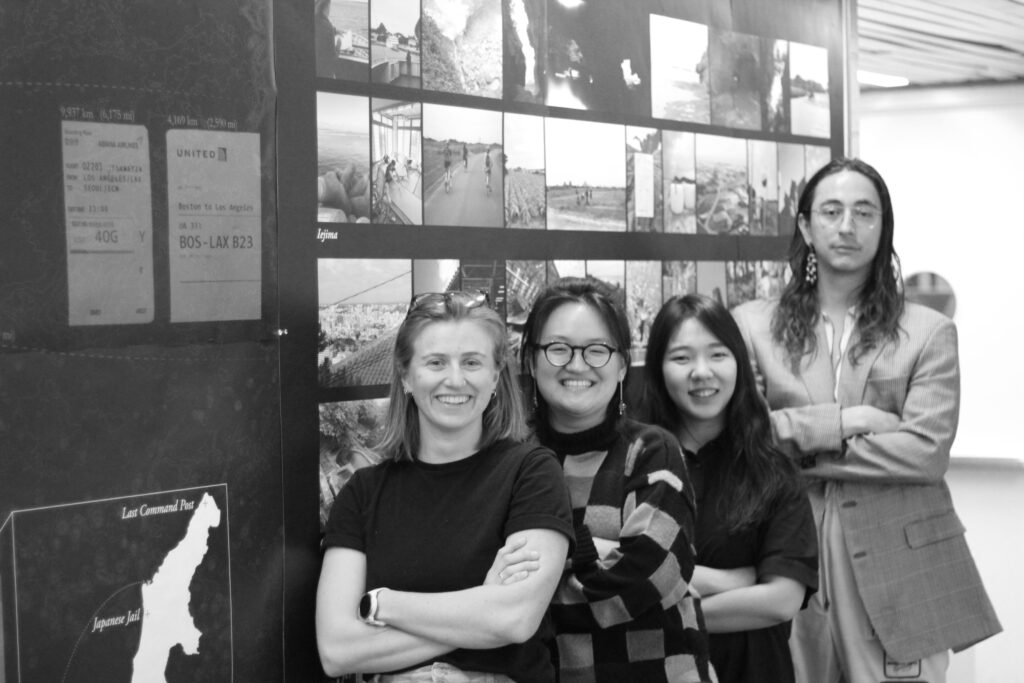
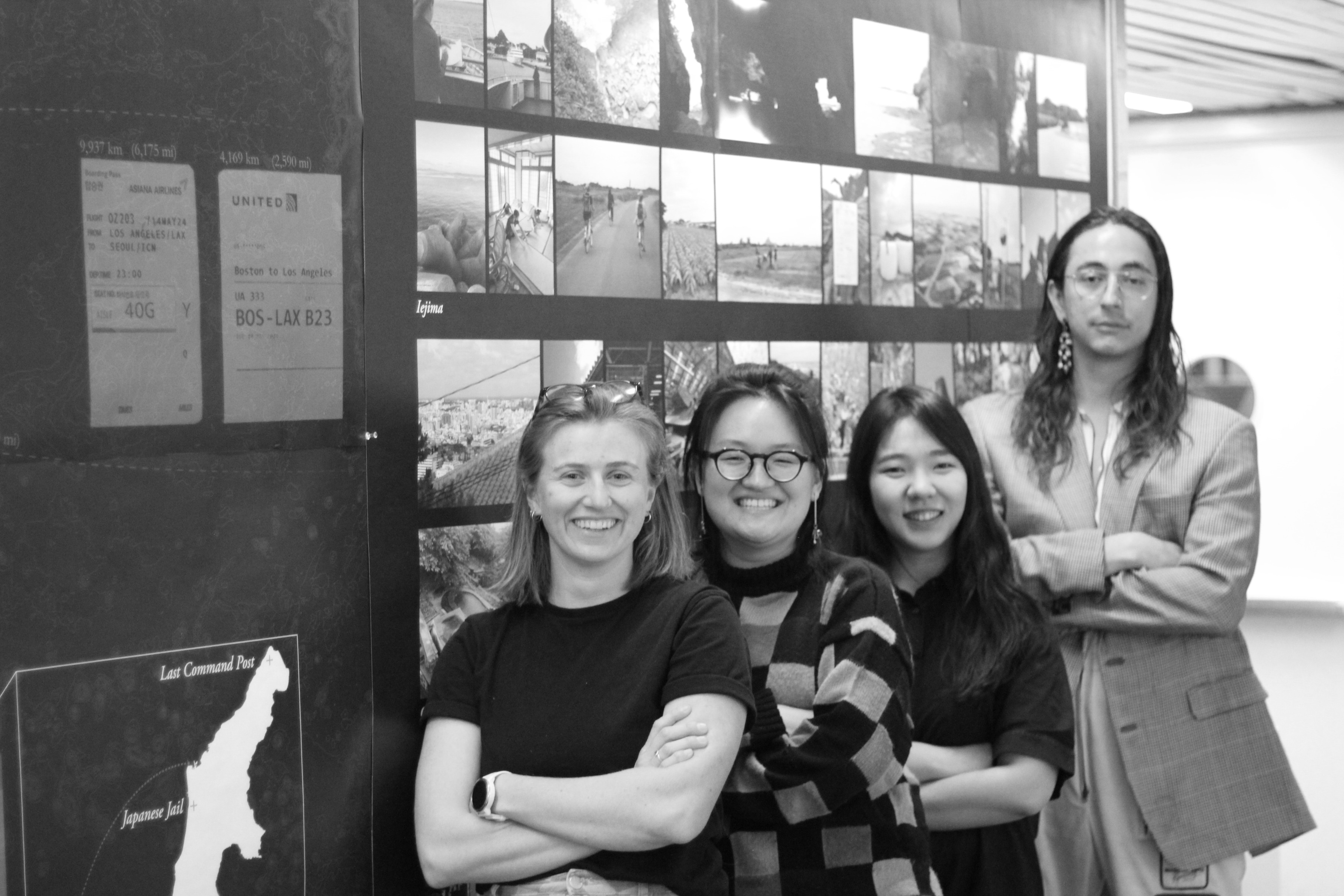
Authors of “Islands After the War” — Hannah Hardenbergh, Emily Kim, Gio Hur, and Carlo Raimondo — pose at the Quotes Gallery of Harvard Graduate School of Design, where their research was first exhibited in March 2025.
Photo by James Leppert
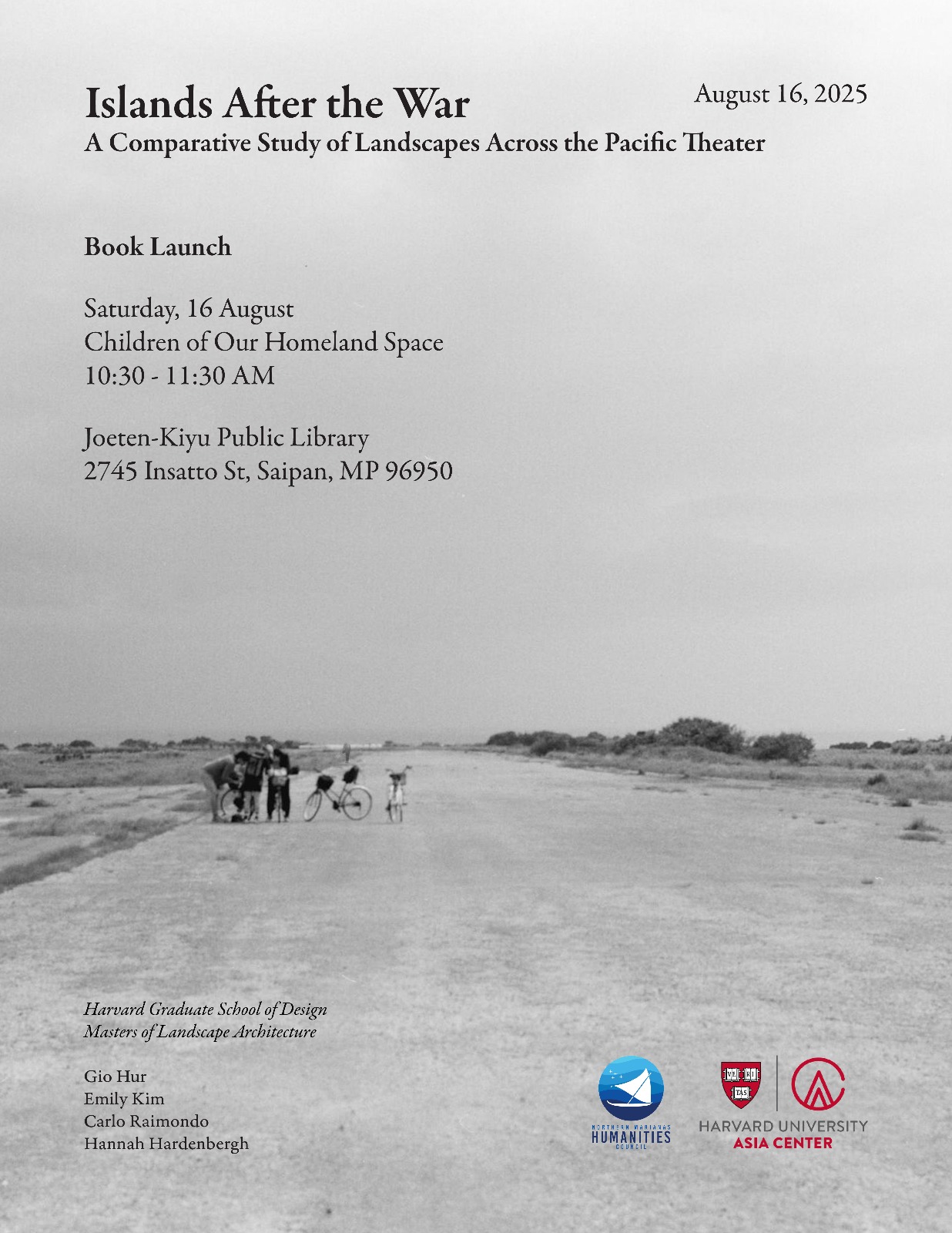
ON Saturday, Aug. 16, at 10:30 a.m., Joeten-Kiyu Public Library will serve as the book launch venue for “Islands After the War,” written by a team of Harvard students — one of whom, Gio Hur, is a 2018 graduate of Saipan International School.
The book presents a comparative study of wartime sites in Okinawa, Iejima, Saipan, and Tinian.
It was authored by Hur, Emily Kim, Hannah Hardenbergh, and Carlo Raimondo — all recent graduates of the Harvard Graduate School of Design, each holding a Master of Landscape Architecture degree.
From May to June 2024, the team traveled to eight sites across the four islands, documenting the material, ecological, and cultural impacts of the Pacific Theater.
A description of their research, which was previously exhibited at Harvard, states that these landscapes remain dynamic:
“Wartime debris have become marine tourism sites, command posts now serve as memorials, and airfields that once launched devastation stand as silent witnesses to history. Through this comparative approach, we invite you to experience these landscapes not just as static remnants of the past, but as evolving spaces where memory, identity, and history continue to unfold.”
In an email interview with Variety, the team said the project began with a question: What if “places often left off maps” — shaped by “layered histories” — became the subject of research?
“This inquiry pushed us to think more intentionally about the places we come from and the kinds of narratives that are often overlooked in landscape discourse,” the team told Variety.
“We traveled to these four islands that played major roles in the Pacific Theater, drawn to themes such as the preservation of cultural sites and spaces left to ruin, the legacies of colonialism and militarization, and the ways memory is held in the landscape.”
Hur added that on Saipan, “time and ruin” shape daily life.
“Remnants of war are embedded in the island’s daily life. Tanks rest near beaches, cannons remain by roadsides, and bomb-made cavities mark the limestone cliffs.
Some of these sites are marked by small memorials, but many remain unmarked, blending into the everyday landscape. They’re not tucked away or fenced off — residents pass them on walks, children play nearby, and drivers pass them without pause. These traces of conflict quietly shape how people move through and remember the island, offering a persistent, if often unspoken, presence of the past.”
The book is divided into four chapter. Each chapter compares two different sites from separate archipelagos, reflecting on their “shared history,” the team said.
The research began with learning about the history of these islands through texts, archival materials, and conversations with people who were either from the islands or had spent time studying them. They also consulted archival materials from the U.S. National Archives, Okinawa Prefectural Archives, and the Harvard Map Collection.
Later, they visited each island to take 3D scans, sound recordings, plant notes, sketches, and photographs.
“After months of researching these places remotely through screens, it was especially meaningful to visit and experience the sites in real life,” the team said.
“Ultimately, by pairing sites from Okinawa and the CNMI, our research highlights both shared histories and unique regional differences, offering new perspectives on their physical forms and ongoing roles within contemporary landscapes.”
In the preface to the forthcoming book, Hur writes that she was struck by how closely the histories of Okinawa and Saipan “intertwine,” noting how the coastlines of both islands show the “visible scars of war and militarization.”
“Visiting those sites — both as an outsider looking in and as someone connected through a shared history — reminded me that these islands are linked in deep and nuanced ways.
The book is an exploration of the “deep and nuanced ways”
“This project has allowed me to revisit the landscapes I thought I knew, and to fully notice what I had once taken for granted. It has also given me the chance to bring awareness to places like Saipan, which are so often left off the map yet hold stories that reach far beyond their shorelines.”
The book was published with support from the Northern Marianas Humanities Council. While the authors will not be physically present at the book launch, they will attend via Zoom. Their on-island team of advisors and collaborators will be present, the team said.