

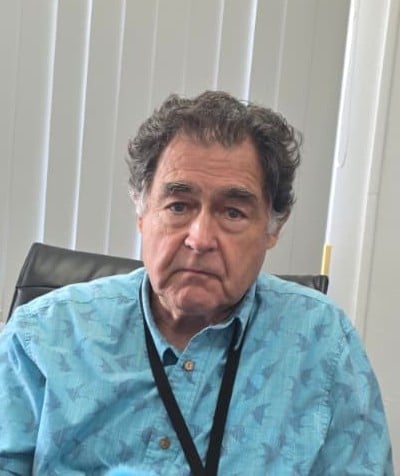



Allen P. Stayman, the former director of the U.S. Office of Insular Affairs, said there is no apparent support right now in the U.S. Congress to improve the status of long-term guest workers.
“There hasn’t been any discussion of that in the Congress other than to ask Interior to do a report with recommendations and options with regard to the future status of guest workers,” Stayman said.
He said the report is due to be submitted to the U.S. Congress in June 2010.
Congress can then decide if it wants to look into the status of the guest workers.
“Certainly there are many options,” Stayman said. “Well, everything from the range of deporting everybody or giving everybody a green card or something in between.”
He added, “There’s clearly a problem that the CNMI does not have the U.S. population that can meet its requirements. There are really only two options — have the federal government take over the guest worker program or have a more permanent solution which is to provide a permanent status under U.S. immigration law.”
Stayman directly works for Sen. Jeff Bingaman, D-N.M., who chairs the U.S. Senate Committee on Energy and Natural Resources.
At least three regulations must be drafted before the federalization law is implemented in November.
So far, only the Guam-CNMI Visa Waiver Program regulations have been drafted in their final interim form.
Regulations that will govern the presence of foreign workers and investors are still a work in progress.
But Stayman said he doesn’t see this as enough reason to further delay the implementation of the federalization law beyond Nov. 28.
“I can’t speak for the committee. I am just a staff person, but in those meetings, I’ve indicated that I don’t think a delay is possible. The deadline is so near and the amount of time it would take to pass a new law authorizing a delay is very unlikely to happen. Also, there’s the policy question on whether that’s the right thing to do,” said Stayman.
Once the federalization law is implemented, all guest workers in the CNMI will be considered as transitional workers.
Their existing contracts with CNMI employers issued by the Department of Labor will be honored until their expiration date.
“This is going to be a difficult transition. It may be that the best thing to do is just get on with it. The further delay is not going to reduce the uncertainty that we’re currently facing. Let’s get on with the process,” said Stayman.
“The [Department of Homeland Security] has a lot of flexibility to deal with things as they come up and I think that’s the best way to end the uncertainty — and end this transition. Let’s get this started,” he added.
The CNMI government said there were about 16,000 documented foreign workers as of last year.
Stayman arrived on Saipan on Wednesday with Isaac Edwards, a senior staff member of Sen. Lisa Murkowski, R-Alaska.
