








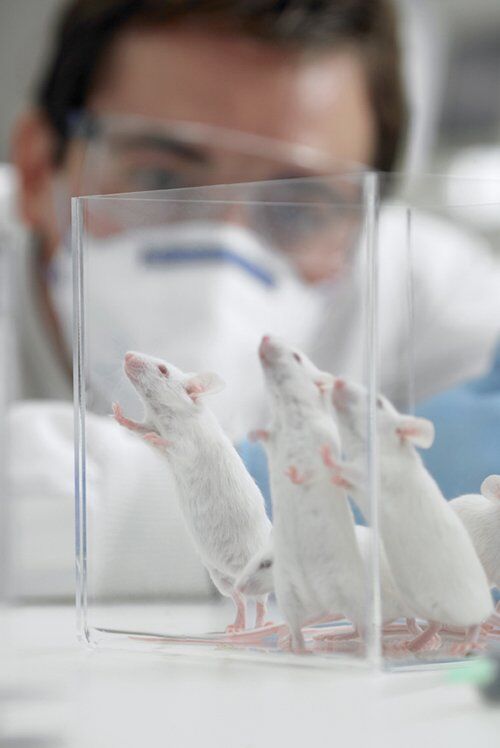
IN the 1960s, American ethologist and behavioral researcher John B. Calhoun (1917-1995) conducted mouse experiments for the National Institute for Mental Health. According to Lawrence W. Reed of the Foundation for Economic Education, “Calhoun enclosed four pairs of mice in a 9 x 4.5-foot metal pen complete with water dispensers, tunnels, food bins and nesting boxes. He provided all the food and water they needed and ensured that no predator could gain access. It was a mouse utopia.”
Calhoun wanted to observe the effects on the mice of population density, but his experiment produced results that went beyond that, Reed said.
“At first, the mice did well. Their numbers doubled every 55 days. But after 600 days, with enough space to accommodate as many as another 1,600 rodents, the population peaked at 2,200 and began to decline precipitously — straight down to the extinction of the entire colony — in spite of their material needs being met with no effort required on the part of any mouse.
“The turning point in this mouse utopia, Calhoun observed, occurred on Day 315 when the first signs appeared of a breakdown in social norms and structure. Aberrations included the following: females abandoning their young; males no longer defending their territory; and both sexes becoming more violent and aggressive. Deviant behavior, sexual and social, mounted with each passing day. The last thousand mice to be born tended to avoid stressful activity and focused their attention increasingly on themselves.”
Reed then quotes Polish biocybernetician Jan Kubań who considers Calhoun’s experiment “one of the most important in human history”:
“Utopia (when one has everything, at any moment, for no expenditure) prompts declines in responsibility, effectiveness and awareness of social dependence and finally, as Dr. Calhoun’s study showed, leads to self-extinction.”
oOo
Theodore Dalrymple is the pen name of Dr. Anthony Malcolm Daniels, a 72-year-old English prison physician and psychiatrist. He’s also, in my opinion, one of the most incisive opinion writers in today’s world where anyone who has a smartphone and internet connection is also an opinion writer.
In the introduction to his “Life at the Bottom,” his collection of essays published in 2001, Dalrymple wrote:
“A spectre is haunting the Western world: the underclass. This underclass is not poor, at least by the standards that have prevailed throughout the great majority of human history…. Like every other social class, it has benefited enormously from the vast general increase in wealth of the past hundred years. In certain respects, indeed, it enjoys amenities and comforts that would have made a Roman emperor or an absolute monarch gasp. Nor is it politically oppressed: it fears neither to speak its mind nor the midnight knock on the door. Yet its existence is wretched nonetheless, with a special wretchedness that is peculiarly its own.”
Why?
“Economic determinism, of the vicious cycle-of-poverty variety, seems hardly to answer the case. Not only is the underclass not poor, but untold millions of people who were very much poorer have emerged from poverty within living memory — in South Korea, for example. If being poor really entailed a vicious cycle, man would still be living in the caves.”
Dare we ask: is it a matter of genetics or race?
“It will come as a surprise to American readers, perhaps, to learn that the majority of the British underclass is white, and that it demonstrates all the same social pathology as the black underclass in America — for very similar reasons, of course. Genetics, moreover, can hardly explain such phenomena as the rise of mass illegitimacy, unprecedented in recorded history, since the late 1950s.”
How about the rise of the welfare state?
“Welfare states have existed for substantial periods of time without the development of a modern underclass: an added ingredient is obviously necessary.”
That “ingredient,” Dalrymple says, can be found in the realm of ideas.
“It is the ideas my patients have that fascinate — and, to be honest, appall — me: for they are the source of their misery. Their ideas make themselves manifest even in the language they use. The frequency of locutions of passivity is a striking example. An alcoholic, explaining his misconduct while drunk, will say, ‘The beer went mad.’ A heroin addict, explaining his resort to the needle, will say, ‘Heroin’s everywhere.’ It is as if the beer drank the alcoholic and the heroin injected the addict….
“The murderer claims the knife went in or the gun went off. The man who attacks his sexual consort claims that he ‘went into one’ or ‘lost it,’ as if he were the victim of a kind of epilepsy of which it is the doctor’s duty to cure him. Until the cure, of course, he can continue to abuse his consort…safe in the knowledge that he, not his consort, is its true victim.”
Dalrymple said “when a man tells me, in explanation of his anti-social behaviour, that he is easily led, I ask him whether he was ever easily led to study mathematics or the subjunctives of French verbs. Invariably the man begins to laugh: the absurdity of what he has said is immediately apparent to him. Indeed, he will acknowledge that he knew how absurd it was all along, but that certain advantages, both psychological and social, accrued by keeping up the pretence.”
The unfortunate idea prevalent among the underclass is that “one is not an agent but the helpless victim of circumstances, or of large occult sociological or economic forces….”
It’s not my fault; it is never my fault.
#Blame society/racists/sexists/the rich/dead white people/history/God/Satan/junk food/alcohol/drug pushers/advertising/technology/government/politicians/anyone else but me
Send feedback to [email protected]

