






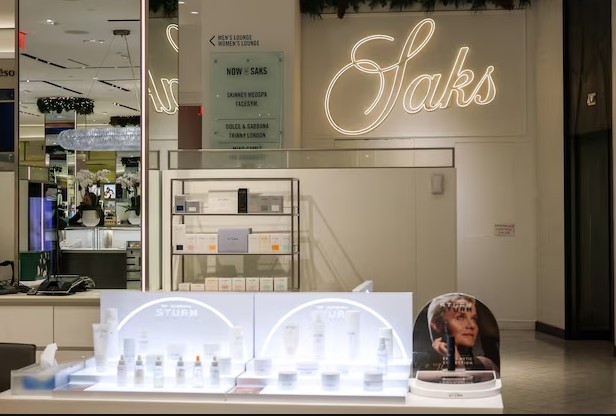
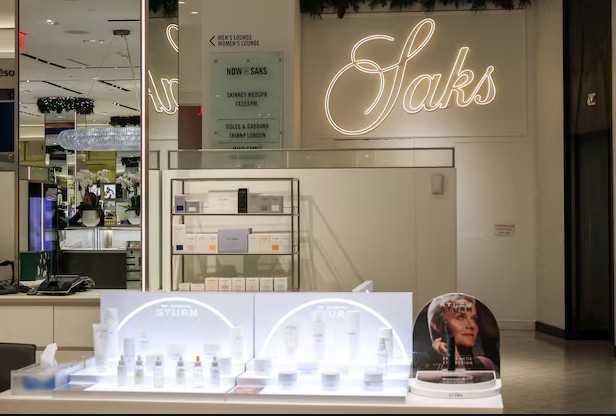
NEW YORK (Reuters) — High-end department store conglomerate Saks Global filed for bankruptcy protection late on Tuesday in one of the largest retail collapses since the pandemic, barely a year after a deal that brought Saks Fifth Avenue, Bergdorf Goodman and Neiman Marcus under the same roof.
The move cast uncertainty over the future of U.S. luxury fashion, though the retailer said early on Wednesday its stores would remain open for now after it finalized a $1.75 billion financing package and appointed a new CEO.
Former Neiman Marcus CEO Geoffroy van Raemdonck will replace Richard Baker, who was the architect of the acquisition strategy that left Saks Global saddled with debt.
The company also appointed former Neiman Marcus executives Darcy Penick and Lana Todorovich as chief commercial officer and chief of global brand partnerships at Saks Global, respectively.
Saks Global estimated in court documents filed in U.S. Bankruptcy Court in Houston, Texas, that its assets and liabilities were in a range of $1 billion to $10 billion.
The court process is meant to give the luxury retailer room to negotiate a debt restructuring with creditors or sell itself to a new owner to stave off liquidation. Failing that, the company may be forced to shutter.
A retailer long loved by the rich and famous, from Gary Cooper to Grace Kelly, Saks fell on hard times after the Covid pandemic, as competition from online outlets rose, and brands started more frequently selling items through their own stores.
The original Saks Fifth Avenue store, known for displaying exclusive brands like Chanel, Cucinelli and Burberry, was opened by retail pioneer Andrew Saks in 1867.
Financing deal
The new financing deal would provide an immediate cash infusion of $1 billion through a debtor-in-possession loan from an investor group, Saks Global said. Reuters earlier reported the loan was led by Pentwater Capital Management in Naples, Florida, and Boston-based Bracebridge Capital.
Financing worth $240 million would be available through an asset-backed loan provided by the company’s asset-based lenders, according to the company.
The luxury retailer will have access to $500 million of financing from the investor group once it successfully exits bankruptcy protection, expected later this year, the company added.
A host of luxury brands were among the unsecured creditors, led by Chanel and Gucci owner Kering at about $136 million and $60 million respectively, the court filing said. The world’s biggest luxury conglomerate, LVMH, was listed as an unsecured creditor at $26 million. In total, Saks Global estimated there were between 10,001 and 25,000 creditors.
In 2024, Baker had masterminded the takeover of Neiman Marcus by Canada’s Hudson’s Bay Co, which had owned Saks since 2013, and later spun off the U.S. luxury assets to create Saks Global, bringing together three names that have defined American high fashion for over a century.
The $2.7 billion deal was built on about $2 billion in debt financing and equity contributions from investors including Amazon, Salesforce and Authentic Brands, which were listed in the court filing as equity investors in Saks Global.
Neiman Marcus deal added debt
The Neiman Marcus deal was designed to create a luxury powerhouse, but it saddled Saks Global with debt at a time when global luxury sales were slowing, complicating an already difficult turnaround for CEO and veteran executive Marc Metrick.
Saks Global struggled last year to pay vendors, who began withholding inventory, disrupting the company’s supply chain and leaving it with insufficient stock.
The thinly stocked shelves may have driven shoppers away to rivals like Bloomingdale’s, which posted strong sales in 2025, compounding pressure on Saks Global.
“Rich people are still buying,” Morningstar analyst David Swartz said last month, “just not so much at Saks.”
Running out of cash, Saks Global last month sold the real estate of the Neiman Marcus Beverly Hills flagship store for an undisclosed amount. It had also been looking to sell a minority stake in exclusive department store Bergdorf Goodman to help cut debt.
On December 30, it failed to make an interest payment of more than $100 million to bondholders.
