






By Zaldy Dandan – Variety Editor
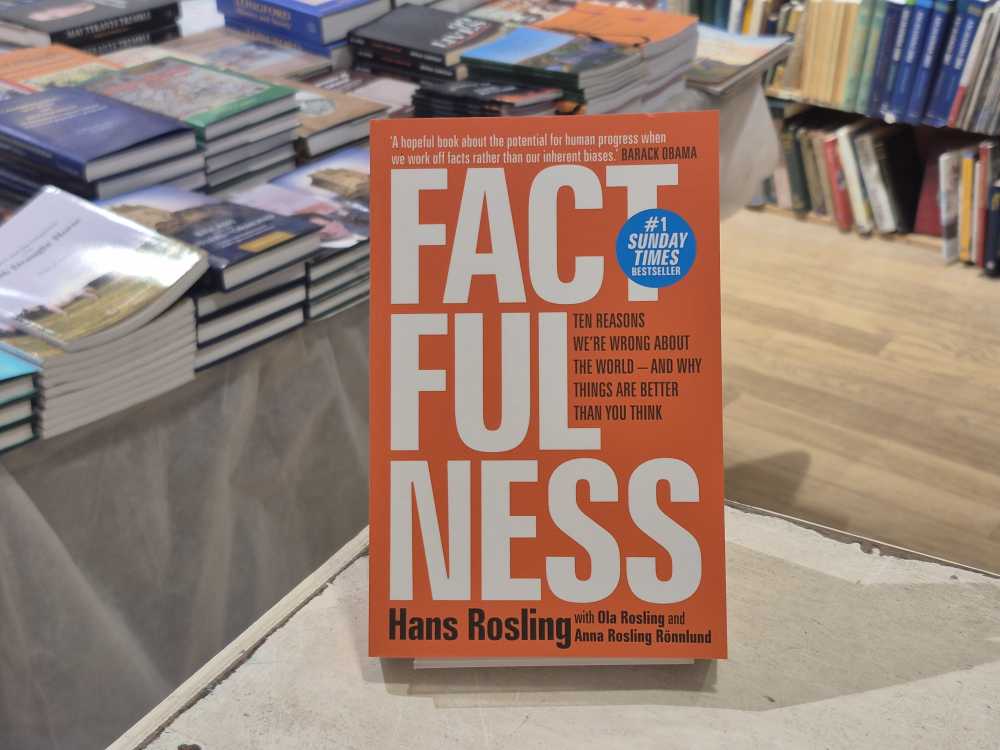
IF I had to recommend a book for the Class of 2026 to read and study, it would be Hans Rosling’s “Factfulness: Ten Reasons We’re Wrong About the World — and Why Things Are Better Than You Think.” For only $12.99 — about the price of half a case of soda — you can download the Kindle version and start reading it right away.
Rosling, who passed away in 2017 at the age of 68, was a Swedish doctor who could swallow a sword. He talked about it — and his childhood dream of joining the circus — in the book’s introduction. Rosling was one of the most celebrated TED speakers, and “Factfulness” reads like a series of TED Talks. He was non-partisan. What he advocated was “factfulness,” which he defined as “the stress-reducing habit of only carrying opinions for which you have strong supporting facts.”
His critics said he was too… optimistic. He preferred the term “possibilist.” “That’s something I made up,” he said. “It means someone who neither hopes without reason, nor fears without reason, someone who constantly resists the overdramatic worldview. As a possibilist, I see all this progress, and it fills me with conviction and hope that further progress is possible. This is not optimistic. It is having a clear and reasonable idea about how things are. It is having a worldview that is constructive and useful.”
While everyone else was running around like headless chickens and warning that a climate catastrophe was imminent, Rosling presciently expressed concern about a global pandemic years before Covid-19.
Not surprisingly, his critics included eco-radicals and Paul Ehrlich, the biologist who predicted catastrophic mass starvation and societal collapse due to overpopulation. (Speaking of which, the title of a recent policy paper prepared for the American Enterprise Institute is “Will Nothing Stop the Incredible Global Birth Crash?”)
As a wise person once said, “Don’t take criticism from someone you wouldn’t take advice from.”
Rosling, another certifiably wise person, advised us first of all to know what we are talking about. And even then, we could be wrong. Hence the need to always update our knowledge — to be open to new information and actively seek it out.
In the CNMI today, all we hear — including from commentators, activists, and politicians — is gloom and doom. To quote Rosling, they are not lying to us. But many of them — as well as the rest of us — suffer from what he called a “dramatic worldview.”
Our brains are wired to notice and remember dramatic, alarming news because it grabs attention. This leads us to assume the worst and ignore progress. And the media, Rosling said, feeds it. “Forming your worldview by relying on the media,” he added, “would be like forming your view about me by looking only at a picture of my foot.”
Consider the recent super typhoon that devastated the islands. If you compare the opinions and comments expressed by the public with those aired after Soudelor in 2015 and Yutu in 2018, you will likely be surprised at how similar they are, including the identified problems and proposed solutions, especially those pertaining to CUC.
Who wants to talk about the progress being made to restore power and water to the community? My neighborhood didn’t have power for two and a half months after Soudelor in 2015. That deprivation lasted for one and a half months post-Yutu — and only about a month after Sinlaku.
Isn’t that a significant improvement? We should also note that many of the concrete power poles and FEMA-constructed tin-roof structures withstood Sinlaku’s fury. Again, progress. And we haven’t even mentioned the outpouring of relief items and other forms of assistance provided by the federal government and charitable organizations.
There was a time when local residents had to seek shelter in caves whenever a typhoon approached. Most homes back then were made of tin and wood, easily obliterated by typhoon winds. Considering the state of the islands’ transportation system and infrastructure back then, the delivery of relief goods could take time.
No one — or not many of us — remembers any of this.
And then there are the perennial complaints about government or, more precisely, its ineffectiveness. But the CNMI is a democracy, and there will be an election this November. In fact, elections are held every two years. Even justices and judges have to face voters. Voters can also recall elected officials — and pass laws or amend the Constitution through the initiative process.
If voters are unhappy with the current leadership, then they can elect a new one this year — and every two years. If you ask voters, many will say they support only those who listen to the people, who care for the people, who will fight for the people, who will deliver for the people. I’ve been observing, covering, and writing about CNMI elections since 1993. I’m pretty sure that not a single candidate for office has ever promised incompetence, mismanagement, or corruption.
Yet voters complain of those things every election year. That should tell us something.
But surely, there are elected officials or politicians we admire, respect, and are willing to support again. Surely there are things that the government does that, more or less, work or at least don’t make things worse.
According to Rosling, when you continuously paint a picture of a world spiraling out of control, people give up. If people think nothing they do works, they fall into apathy.
Hence, we must learn to hold two seemingly contradictory ideas in our heads at once: things can be bad, and yet they can simultaneously be getting better. Rosling compared the world to a premature baby in an incubator:
The baby’s health is bad (it needs serious care).
But the baby’s health is also getting better compared to yesterday.
Only by looking at verifiable facts can we replace paralyzing fear with action that may actually solve or at least mitigate problems.
The rest is stress-inducing drama.
Send feedback to [email protected]
Zaldy Dandan is the recipient of the NMI Society of Professional Journalists’ Best in Editorial Writing Award and the NMI Humanities Award for Outstanding Contributions to Journalism. His four books are available on amazon.com/.
