






THE son of the late Philippine President Ferdinand E. Marcos, “Bongbong,” is the frontrunner in this year’s presidential election set for May. Bongbong, incidentally, is a common nickname in the P.I. where many children, to quote the writer Jessica Zafra, are named after doorbells: Dingdong, Tingting, Jengjeng.
Based on the polls, Bongbong is leading by a mile, and there are only two months left before Election Day. His handlers, it seems, believe he can afford to avoid debates with the other main candidates. His chief adviser is his wife, Liza Araneta Marcos, widely considered a top notch lawyer. She’s also a law professor and a member of the Philippine and New York bar associations.
There are, in any case, several reasons to vote for the 64-year-old Marcos Jr. or BBM. You can say, for example, that you like his “boyish charm” which you may consider “inspiring” and “full of hope.” Or you can say you like his platform, which, however, is not really distinguishable from those of his main opponents: everyone is for free this, and free that, subsidize this, and subsidize that (we’ll figure out the funding sources later). Or you can say that you admired his old man because like Marcos Sr. you’re Ilocano, someone from the northern region of Ilocos.
What you can’t say, however, is that you’ll vote for BBM because his father was a great president. That is, to be sure, an opinion, but it is contradicted by facts.
Marcos Sr. was a failed president. He did much harm to the Philippines. He was kicked out by his own military led by his own defense minister and vice chief of staff, who was his cousin.
In the last year of his presidency, the Philippines was “the sick man of Asia” — an economic basket case. The main complaint against Marcos Sr. back then was the deteriorating economy and not corruption (the eye-popping details of which would only be revealed after he was ousted). Many people were out of work. There were price and public transportation fare hikes almost every week. The peso was a rapidly depreciating currency. Investors were leaving the P.I. The Philippine government was buying dollars in the black market for crying out loud.
The U.S. inflation rate as I write this is 7.5% and a lot of Americans are outraged. The Philippine inflation rates in 1984 and 1985 were 50.34% and 23.10%.
In 2015, University of the Philippines economics professor Emmanuel S. de Dios pointed out that
“The [Philippine] economy suffered its worst post-war recession under the Marcos regime because of the huge debt hole it had dug, from which it could not get out. In fact, all of the ‘good times’ the admirers of the regime fondly remember were built on a flimsy sand-mountain of debt that began to erode from around 1982, collapsing completely in 1984-1985 when the country could no longer pay its obligations, precipitating a debt crisis, loss of livelihood, extreme poverty, and ushering in two lost decades of development.
“The economy’s record under Marcos is identical to that of a person who lives it up on credit briefly, becomes bankrupt, and then descends into extreme hardship indefinitely. It would then be foolish to say that person managed his affairs marvelously, citing as evidence the opulent lifestyle he enjoyed before the bankruptcy. But that is exactly what admirers of the Marcos regime are wont to do.”
Professor de Dios believed that “in three decades more, the whole Marcos episode will probably be regarded as no more than an avoidable nightmare; a wasted opportunity; a bump on the road on the country’s ultimate march to development.”
Writing about the Philippine economy in 1985, Australian professor Hal Hill noted that the country “continues to experience unprecedented economic decline and political uncertainty. The economy is deeply depressed…. It now appears likely that 1985 has probably been every bit as bad as 1984. In the space of just two years, the country has experience a catastrophic decline in per capita GDP of about 15 per cent…. Hundreds of businesses have gone bankrupt, and tens (possibly hundreds) of thousands of workers in the factory sector have been retrenched.”
And this was during a time when the other Asian economies were taking off.
In his 1993 book about the Philippine economy under Marcos, James K. Boyce, associate professor of economics at the University of Massachusetts, Amherst, provided more details (graphs, tables and other statistics) of the economic cataclysm that Marcosian misrule inflicted on the P.I. According to Boyce, real incomes of millions of Filipinos declined during the Marcos presidency. Broad sectors of the Filipino people experienced deepening poverty. The policies pursued by the Marcos regime “resulted in the impoverishment of the already poor, the plunder of the economy’s natural resources, massive foreign indebtedness by the [government] to finance private capital flight and an enormous enrichment of a tiny minority” — the Marcos family and their cronies.
Send feedback to [email protected]

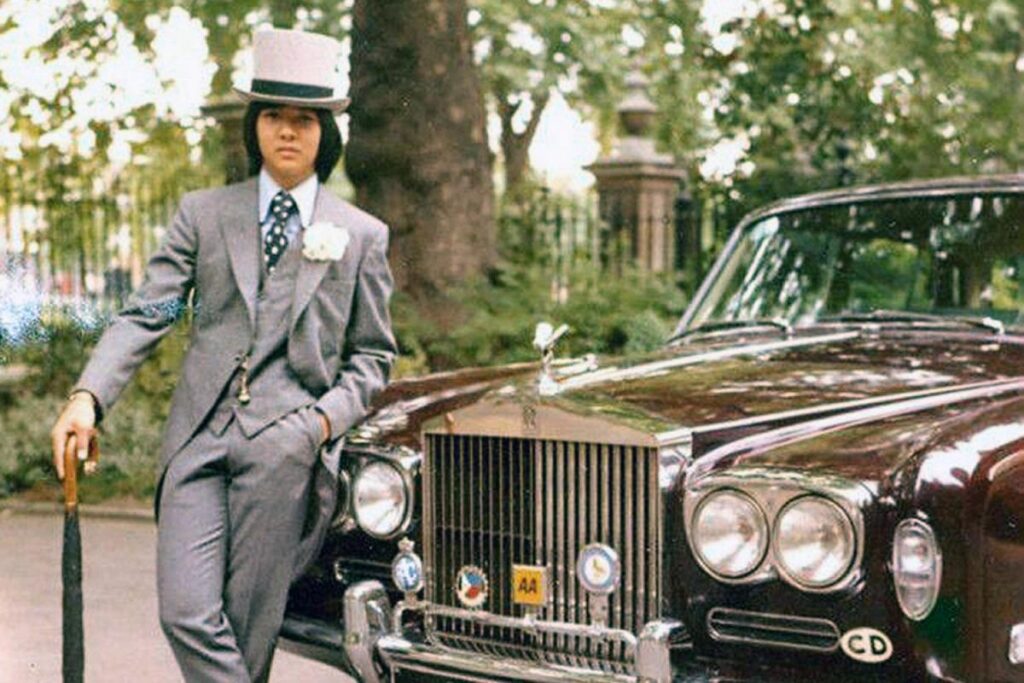
Ferdinand R. Marcos Jr. in his younger days.
