





WRITING for the Foundation of Economic Education, Joseph Kast of the Pacific Legal Foundation asked, “Can society be designed? Can an expert engineer alleviate people’s pains and struggles with a good-enough central plan and blueprint?”
The most popular answer, throughout the ages, has been, “Yes we can!”
Yes! Despite the long and seemingly never ending list of failures, miseries if not catastrophes caused by “social engineering” and/or “government planning.”
Why? Because not a lot of us remember those previous disasters. And if we do, we usually blame other “factors.” And we tell ourselves we can do better next time with the same good intentions, the same “solutions” to the same “problems,” again and again.
In 1954-1955, one of the largest public housing development in the U.S. opened in St. Louis, Missouri. Known as Pruitt–Igoe, it was touted as the “solution to poverty, crime, and housing in America’s major cities.” It was federally funded, and was planned and implemented by experts. The architect chosen by the city government was one of the nation’s “most well-respected architects in the 20th century,” Minoru Yamasaki (1912-1986). Born in Seattle, Washington state, his parents were Japanese immigrants. He was a self-made man whose talents as an architect were undeniable. (Perhaps the most widely known of his buildings was the original World Trade Center. Yes. That one.)
As Kast has pointed out, Yamasaki also subscribed to “the school of thought that people’s human nature could be improved (whether those people needed or wanted improving) by a properly planned building surrounding them.”
The Swiss-French architect and urban Le Corbusier (1887-1965), or Corbu, was a major influence for Yamasaki, Kast said. “Corbu…had unyielding faith in the power of rationalism and efficiency to improve every facet of society…. The master planner could create literal utopias by exerting his expert will from the top down.”
And so, in St. Louis, Mo., in the mid-1950s, government had the funds, the experts, the plan, the means and the authority “to do something good” — “to improve people’s lives.” (Perhaps the most terrifying phrase in the English language when uttered by a government official.)
“Yamasaki’s initial proposal,” Kast wrote, “included a mixture of two-story walk-ups, mid-rises, and widely spaced 11-story blocks. He incorporated a new type of ‘skip-stop’ elevator. These stopped only on every third floor, which both saved room for more units and encouraged a sense of community engagement by forcing residents to interact more. Or so he hoped. The hallways were wide and ‘streetlike,’ again to mimic a sort of town square inside the high-rises.”
The design was widely praised, Kast added. “An Architectural Forum article titled ‘Slum Surgery in St. Louis’ called Yamasaki’s proposal ‘the best high apartment of the year.’ City leaders boasted about the high-rises, claiming that these slum residents would now have more magnificent views of the city than its richest residents. Where there were once polluted slums, tall, modern buildings that granted light and fresh air would stand.”
Pruitt-Igoe, Kast said, “was the culmination of many turn-of-the-century progressives’ plans for the government’s top-down role in every aspect of society. But like many [such] plans and programs, the promises of Pruitt-Igoe were only truly viable on paper….”
Everything that could go wrong, did.
“Planners expected the working poor to live in the complex. Instead, many unemployed families took the apartments, which meant — because families receiving welfare paid the lowest rents — the rent revenue wasn’t enough to sustain the building.
“Also, under Missouri’s welfare laws at the time, you could receive welfare only as a single parent. This left many mothers and fathers with the grim options of staying together without the state benefits, or separating in order to receive benefits. Many fathers left their families to search for work wherever they could find it. They often didn’t return. Soon Pruitt-Igoe was mostly populated with large, single-parent families. The lack of fathers in the building (and social workers ran regular checks to ensure dad really wasn’t living there) had dangerous ripple effects for Pruitt-Igoe children. Crime quickly became common, and children joined gangs, vandalizing and damaging the buildings. Maintenance workers had trouble keeping up and occupancy dropped rapidly….
“And what of Yamasaki’s innovative skip-stop elevators? His wide hallways? Did they foster a sense of community as he intended? [In her book ‘Great Society’] Amity Shlaes paints a bleak picture:
“ ‘[The] elevators… were muggers’ traps. Poor maintenance meant the elevators often jammed, leaving gangs’ victims in with them for long extra minutes. The gangs lurked in the halls and made tenants ‘run the gantlet’ to get to their doors.
“ ‘Young men threw bricks and rocks at windows and street lamps; the activity was a regular sport. There were no good playgrounds. Because there were no toilets on the ground floor, children had accidents there, and the elevators gradually became public toilets. The community area was a sorry joke; its only function ultimately was as a place for collecting Housing Authority rents. No one seemed able to stop the decay.’ ”
From GreyScape, “a crowdsourced archive of little and well-known architecture”:
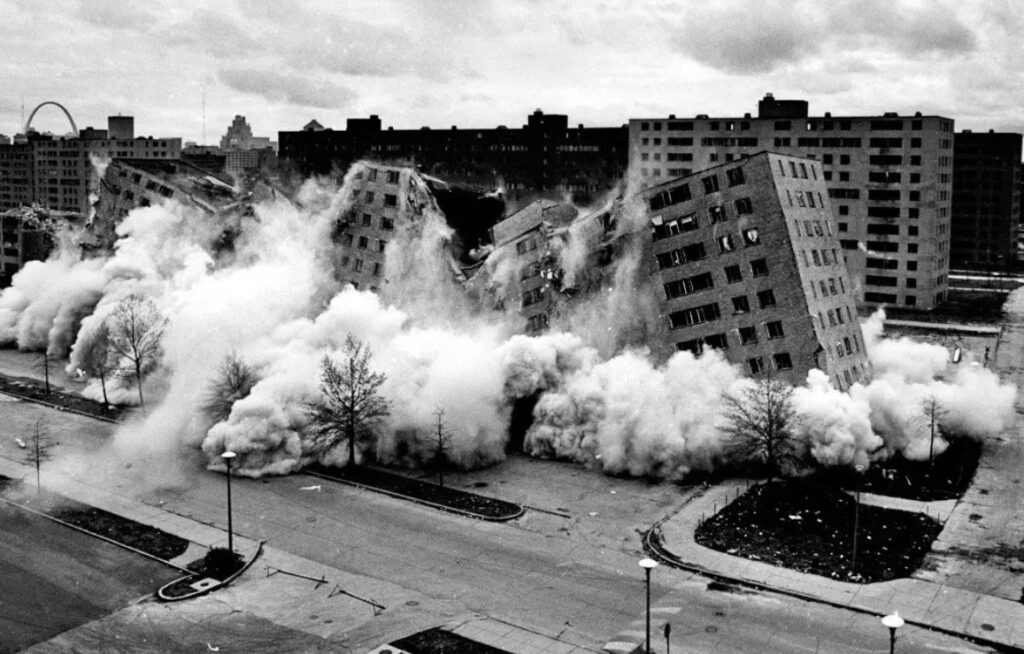
“On March 16, 1972, the first Pruitt-Igoe block was dynamited, the last demolished in 1973. By then the project was depopulated, decayed, unfit for habitation, infested with rodents and pests and crime.”
According to Kast, “St. Louis’ planners and politicians thought they could treat citizens like guinea pigs in a grand social experiment.” Sadly, he added, “the road to hell is paved with government interventions.”
Worse, many politicians — and voters — never seem to remember the horrendous consequences of many (so many) well-intentioned government policies in the past, and/or are usually unwilling to learn from them.
Send feedback to [email protected]

